Plymouth Church of the Pilgrims
57 Orange St, Brooklyn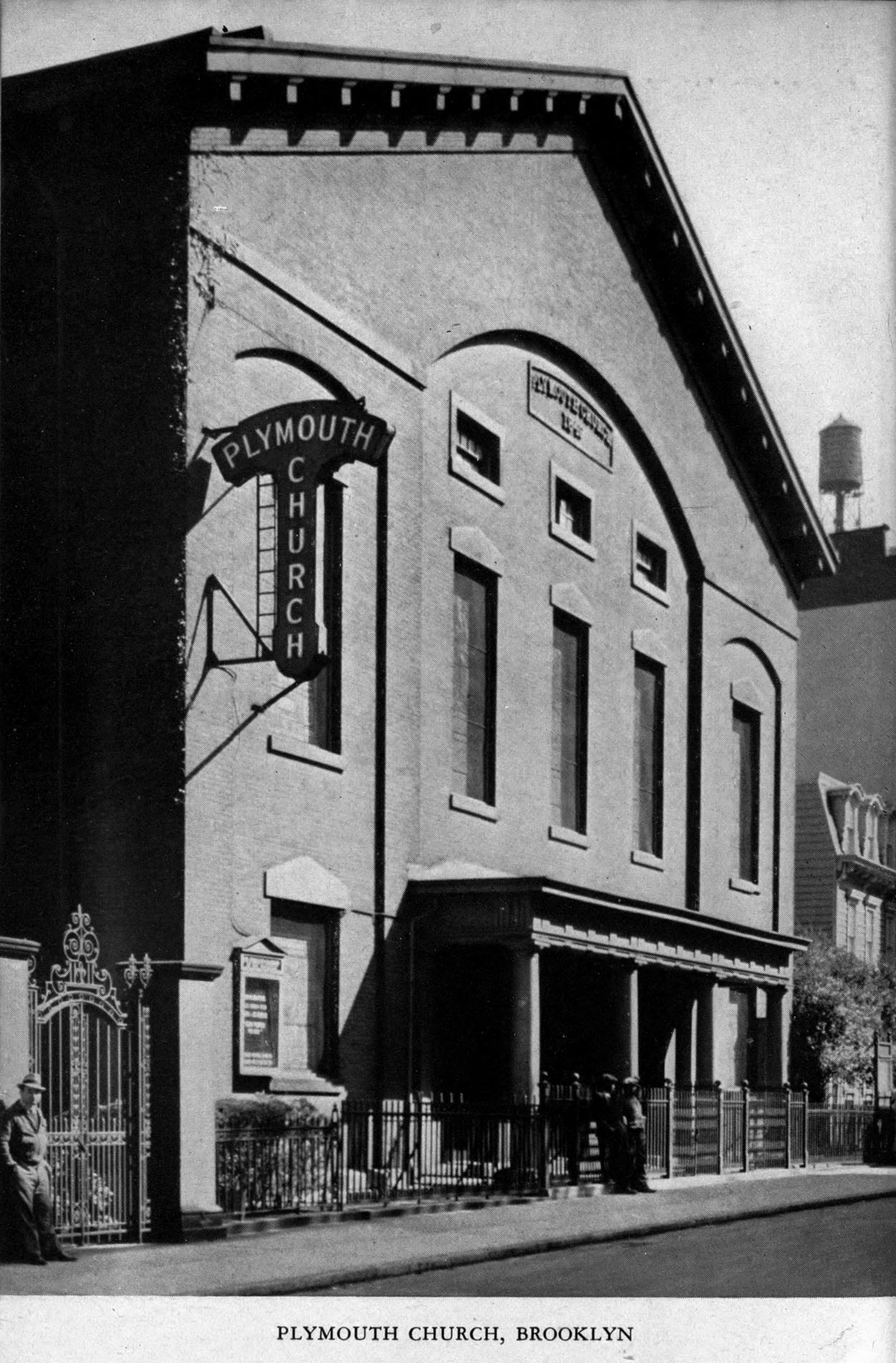
The PLYMOUTH CHURCH OF THE PILGRIMS, Orange Street between Henry and Hicks Streets, was one of the most influential churches in America during the period (1847-87) when its minister was the eloquent Henry Ward Beecher (1813-87). (Visitors admitted weekdays 9 a.m. to 5 p.m., Saturday 9 a.m. to 12 m., Sunday 9 a.m. to 1 p.m.)
As a center of Abolitionist sentiment, its pulpit was occupied by such antislavery agitators as Wendell Phillips, William Lloyd Garrison, John Greenleaf Whittier, and Charles Sumner. Charles Dickens spoke here on the occasion of his second visit to America in 1867.
Plymouth Church was established in 1846 by a group from the mother Church of the Pilgrims (see page 446), Remsen and Henry Streets, headed by Henry C. Bowen, founder of the Independent. In 1934 Plymouth merged with the parent congregation, and both now constitute the Plymouth Church of the Pilgrims.
Henry Ward Beecher rose to a position of undisputed leadership among the clergymen of his time by virtue of his passionate oratory, his uncompromising vigor, and a striking flair for the dramatic. On assuming his pastoral duties at Plymouth Church he at once stated his intention of dealing with the living issues of the day slavery, war, temperance, and general reform.
One Sunday Beecher astounded his congregation by putting up for sale a mulatto slave girl called "Pinkie." Mimicking a slave auctioneer, he roused his listeners to a fury of compassionate indignation, obtained the money to purchase the girl's freedom, and caught the attention of the entire nation. The girl, Mrs. James Hunt, returned in 1927 to speak from the same platform on which she had been sold.
During the Civil War entire Union regiments on their way to the battlefront paused for services in Plymouth Church. In 1863 Beecher visited England on a speaking tour, and was successful in helping to stem the rising tide of English sympathy for the Confederacy. At the close of the war he was chosen by President Lincoln to deliver the oration at the raising of the flag at Fort Sumter, April 14, 1865.
Beecher was also active in the woman's suffrage movement and was the founder and editor of several periodicals. From 1861 to 1863 he edited the Independent; in 1870 he started the Christian Union and later the Outlook.
The church structure, erected 1849, was designed by J. C. Wells, an English architect. It is in the New England meetinghouse style, a large, severely plain building of dark red brick, without tower, steeple, or other external ornament. The interior consists of a simple rectangular auditorium, with plain white walls and woodwork.
The balcony is carried on slender cast-iron columns, and the clear eighty-foot span of the ceiling gives an impression of spaciousness. Nineteen memorial windows, designed by Frederick S. Lamb to represent the History of Puritanism and Its Influence Upon the Institutions and People of the Republic, modify somewhat the severity of the interior.
A gallery or arcade at the rear joins the church proper with the Plymouth Institute, built in 1913 by John Arbuckle, Brooklyn coffee merchant. The institute contains a gymnasium and recreational facilities, and serves the church as a parish house. In Memorial Park, the area between the church and the institute, is a bronze statue of Beecher by Gutzon Borglum, erected in 1914.
Point of interest from New York City Guide (1939), shown as printed.