United States Navy Yard
Flushing Ave & Clinton Ave, Brooklyn· Located to the block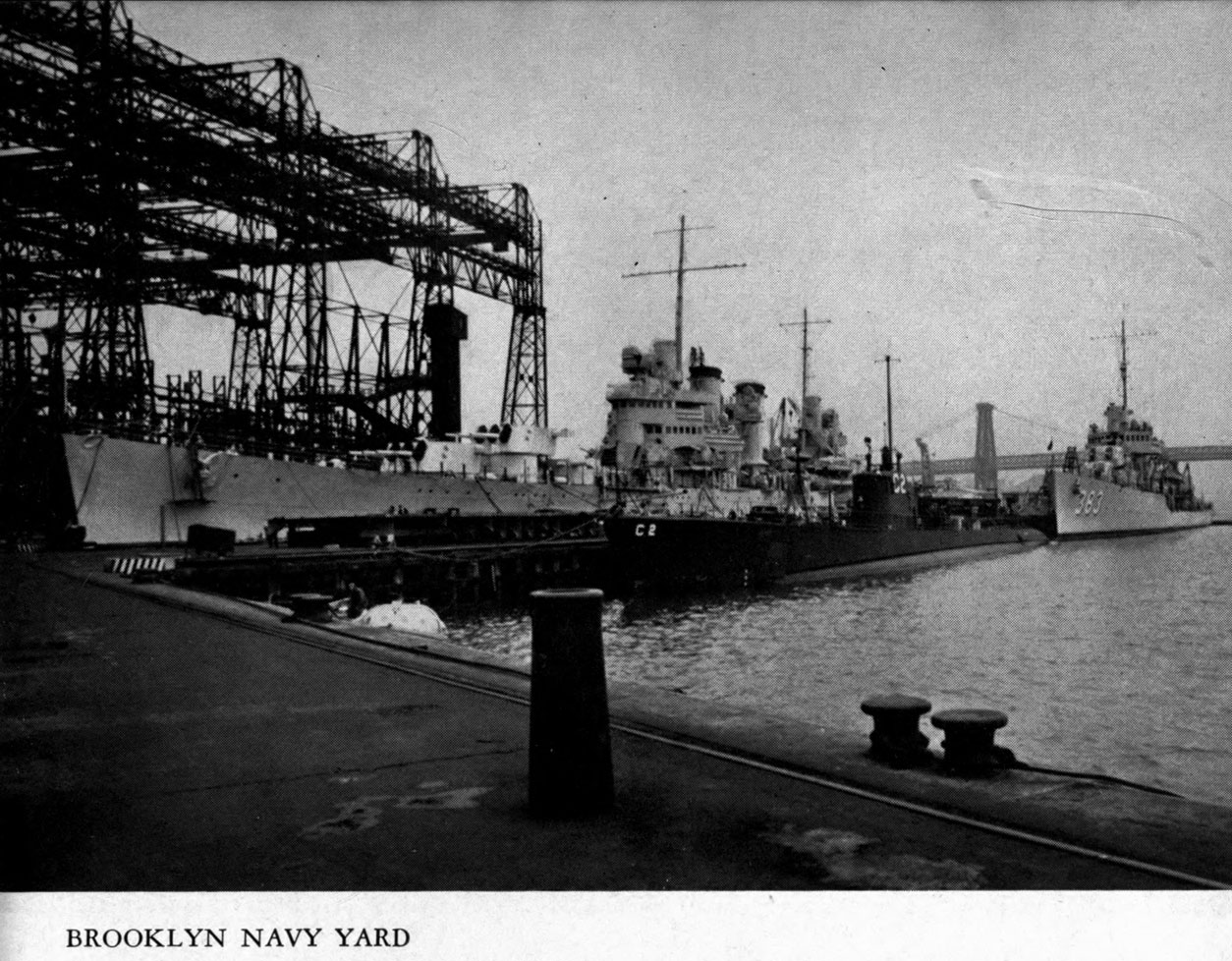
The UNITED STATES NAVY YARD, Navy Street, Flushing and Clinton Avenues, better known as the Brooklyn Navy Yard, skirts Wallabout Bay, a semicircular elbow of the East River opposite Corlear's Hook, Manhattan. (Open weekdays 9 a.m. to 5 p.m.; Saturday, Sunday, and holidays 1 to 4 p.m.; for admission apply at Flushing Avenue and Cumberland Street entrance.)
This busy naval city covers a total of 197 acres, 118 on land, 79 on water, and is surrounded by forbidding brick walls with massive iron gateways.
The yard is traversed by more than five miles of paved streets, and contains four drydocks ranging in length from 326 to 700 feet, two huge steel shipways, and six big pontoons and cylindrical floats for salvage work. In addition to the numerous foundries, machine shops, and warehouses, it has barracks for marines, a power plant, a large radio station, and a railroad spur. The activities of the yard in 1938 required the services of about ten thousand men, of whom one-third were WPA workers.
At the south end, facing Flushing Avenue are the officers' quarters, two-story buildings of painted brick, scrupulously neat despite their age (some were built before the Civil War), and bordered by gardens, tennis courts, and carefully kept walks. The commandant's house, oldest structure in the yard, built in 1807, is near the foot of Navy Street at the river. This threestory clapboard building, with peaked roof and encircling porches, is said to have been designed by Charles Bulfinch, the architect who completed the Capitol at Washington.
The site of the Navy Yard originally formed a segment of the Remsen estate, which after the Revolution came into the hands of John Jackson. Here he constructed a dock, and subsequently built a merchant ship, the Canton, and a frigate, the John Adams. Federal authorities purchased the property for forty thousand dollars in 1801.
Brooklyn Navy Yard is also associated with the early days of the steamboat: the Fulton was constructed here in 1814-15 from the inventor's plans. In 1890, the Yard's ways delivered to the sea the ill-fated Maine. The Yard Pontoon Service was instrumental in raising the submarines S 51 and S 4.
The most curious item in the Navy Yard is an iron cigar-shaped vessel, near the Sands Street entrance, one of the first submarines ever built. It was constructed in 1864 at a cost of sixty thousand dollars and originally called Halstead's Folly, after one of the builders. Subsequently it was given a more flattering title, The Intelligent Whale. The craft proved impracticable and was condemned in 1872.
Near the garden of the commandant's house, and at several other points, are guns and trophies captured in the Spanish-American War. At the Sands Street entrance, in the triangular plot known as Trophy Park, a simple marble shaft commemorates twelve American seamen who were killed in 1856 in a battle at Canton, China. At the base of the monument are guns seized with the British frigate Macedonian during the War of 1812, and also the iron prow of a Confederate ship captured during the Civil War.
Point of interest from New York City Guide (1939), shown as printed.