Brooklyn Botanical Garden
1000 Washington Ave, Brooklyn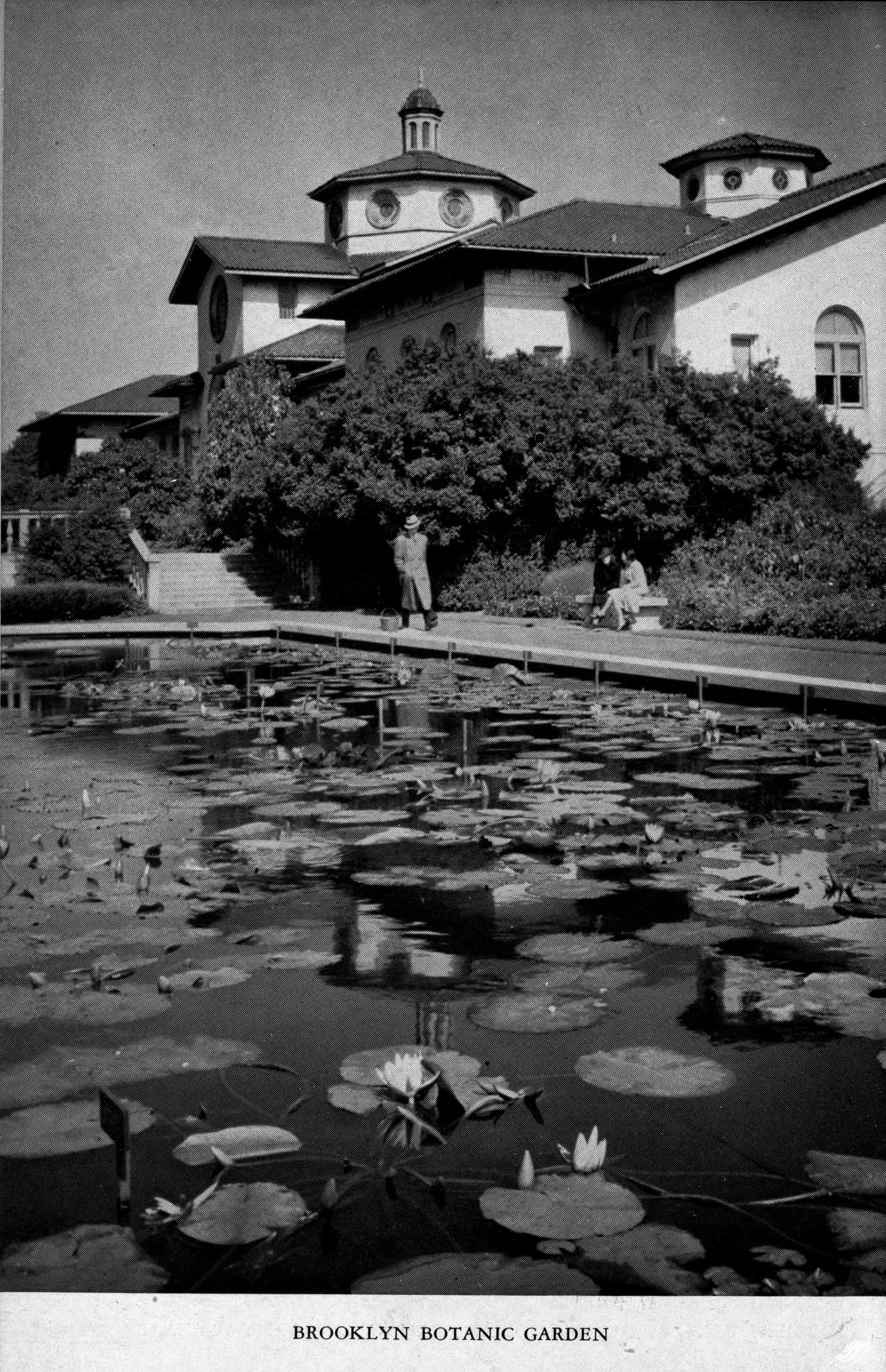 BROOKLYN BOTANIC GARDEN, Eastern Parkway, Washington and Flatbush Avenues, is known for its floral displays, and pioneer research and educational work. (Open daily from 8 a.m. to dusk, except Sunday and holidays, when the gates open at 10 a.m.; admission free.)
Founded in 1910 as a department of the Brooklyn Institute of Arts and Sciences (see page 453), it now occupies a fifty-acre plot, opposite the eastern edge of Prospect Park. The plot is enclosed by tall poplars and shrubs. The Horticultural Garden on the Eastern Parkway side leads to the Overlook, from which the rest of the grounds may be viewed. There are two entrances on Washington Avenue (south of Eastern Parkway), one at the conjunction of Flatbush and Washington Avenues, and one at Eastern Parkway, near the Brooklyn Museum.
The outdoor plantations include a general Systematic Section showing botanical relationships; special gardens including the Japanese, Rose, Rock, Ecological, Native Wild Flower, Water, Wall, Iris, Children's, Shakespeare, and Herb Gardens; horticulture collections and plantings. The Laboratory Building contains the herbarium with some two hundred thousand specimens, an excellent reference library on plant life, and (in the conservatories) a display of economic or tropical plants and other groups, such as those tracing the evolution of plant life.
Probably the most celebrated feature is the Japanese Ntwa, or landscape garden. Designed and cared for largely by Japanese gardeners, it covers about an acre in the northeast corner just above the Laboratory Building. A typical example of the Japanese talent for condensation, the Niwa embodies aspects of four kinds of gardens steeped in religious or social tradition palace, tea cult, Shinto, and Buddhist temple. It is built around a lake shaped like the Chinese letter meaning "heart" (the center of meditative calm) and is bordered by Japanese iris. The East Indian lotus in the lake is the Buddhist symbol of immortality ; its root, flower, and seed pod which symbolize the past, present, and future appear at one time. This concept is the basis for the chief Buddhist doctrine, "The Covenant of the Eight Years." The torn, or bird-perching gate, in the lake, marks the approach to a Shinto shrine on the rise beyond, where three distinct levels, representing the trinity of Heaven, Man, and Earth, are divided by a gorge and waterfalls. On the path to the shrine is a Kasuga stone lantern with elaborate ornaments and carvings of the zodiac animals, modeled after one in Kasuga Temple Yard in Nara, the ancient capital of Japan.
The Tea House, which has a circular latticework opening on one side, affords a dramatic panorama of the garden. From the north wing a path runs beyond a rustic torn to the Moon View House or Waiting Pavilion across the lake. Here, in Japan, guests would await the melodious gong calling them to tea. Just beyond the pavilion is a drum bridge leading to an island with stepping stones, beach, and cave for aquatic birds.
The garden is planted for the most part with hardy specimens such as mountain laurel, azalea, wistaria, and mulberry trees, to insure the proper year-around display. Except for the open lakeside, the whole is enclosed by a bamboo fence.
North of the Japanese Garden is the Herb Garden with varieties of medicinal and culinary herbs. To the west, under the Overlook, are Cherry Walk, popular in May; the esplanade with Norway maples on either side; the lilac collection, of some two hundred varieties, and the Rose Garden, in full flower in June.
Near the Eastern Parkway entrance rests a huge boulder with a bronze tablet memorializing Andre Parmentier, who in 1825, at Atlantic and Carleton Avenues, established the first botanic garden in Brooklyn. This and twenty-eight other boulders scattered throughout the grounds were unearthed in the excavation of the ridge, the second highest ground in Brooklyn, and part of the terminal glacial moraine deposited during the Ice Age and extending from the Narrows to Montauk Point. Other glacial rocks are utilized in the Wall Garden, running 385 feet along the Mt. Prospect Park embankment, near Eastern Parkway, and in the Rock Garden lying to the south near Flatbush Avenue.
The Rock Garden, built in 1916, contains eight hundred species of Alpine and rock-loving plants from all parts of the world. In the Native Wild Flower Garden, between the Lilac Triangle and Wall Garden, a large number of species found wild within one hundred miles of New York City grow in profusion.
Most of the remaining outdoor area is devoted to the Systematic Section, which winds north to south along the banks of a brook coursing through the grounds. The algae, mosses, and ferns on the south shore of the lake, are succeeded by various classes of gymnosperms (plants with naked seeds) including the conifers. Last come the vast array of angiosperms, or flowering plants, with seeds enclosed in an ovary. In this section the exhibits are arranged in a sequence of plant families from the simpler to the more complex forms.
West of the Laboratory Building and conservatories is the Laboratory Plaza, a formal garden of magnolias and stone vases, and in Conservatory Plaza are two water-lily pools, one containing tropical varieties and the other, hardy specimens. The white stone and stucco Laboratory Building, completed in 1918, was designed by McKim, Mead, and White. Its central and wing sections, two stories high, each surmounted by an octagonal cupola, contain research, lecture, and assembly rooms, and administrative offices, as well as the herbarium and library. In the rotunda of the central section are bronze busts of Linnaeus, Darwin, Mendel, Asa Gray, Robert Brown, and John Torrey the work of WPA sculptors and two symbolic figures by Isabel M. Kimball. Southwest of the conservatories are the Children's House and Garden, pioneer project of its kind, where each year hundreds of boys and girls study nature and practical gardening under supervision. Near by, a Shakespeare Garden exhibits many of the plants mentioned in the poet's plays.
The Botanic Garden is a semi-public institution. The city, which furnished the land and most of the buildings, provides maintenance; the Brooklyn Institute of Arts and Sciences supplies the administrative personnel and scientific material. Garden members are entitled to previews, free decent and technical service, reduced tuition rates and free copies of publications.
Point of interest from New York City Guide (1939), shown as printed.