Coney Island
Surf Ave & W 12th St, Brooklyn· Located to the block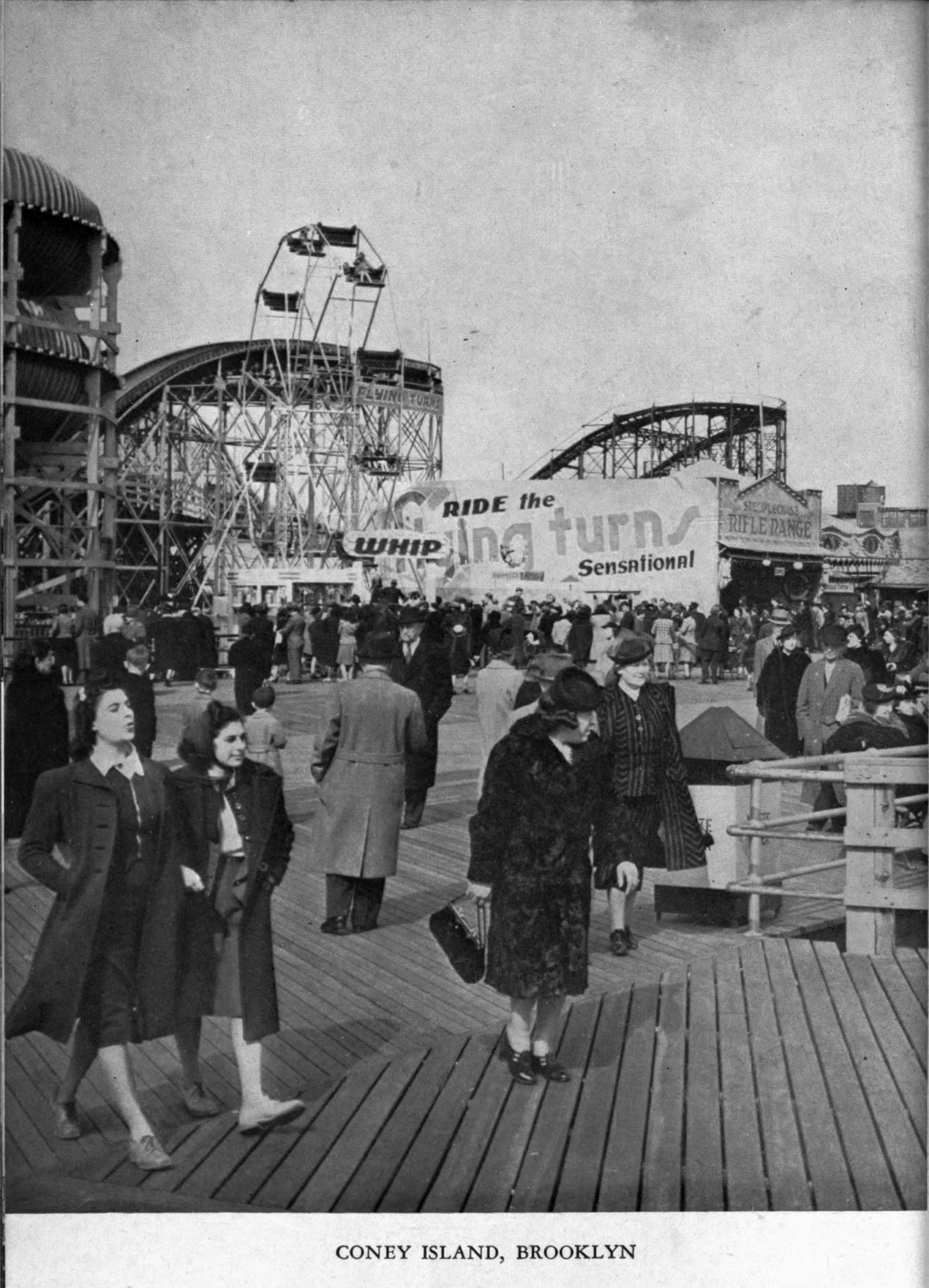
CONEY ISLAND, the sand bar that became the "world's largest playground," fronts a six-mile-long beach on the Atlantic Ocean. (Season open May 30, ends at close of Mardi Gras, second week after Labor Day; fireworks every Tuesday at 8:30 p.m.; transportation by BMT Coney Island subway, or bus from Times Square, or boat from the Battery, Manhattan; numerous automobile parking lots.)
It is an island in name only, for most of the old tidal Coney Island creek that separated it from the rest of Brooklyn has long been filled in. Though geographically Coney Island includes the whole peninsular strip of land, the name is now applied only to that portion between Ocean Parkway and West Thirty-seventh Street the Coney of crowds, amusements, noise, and hot dogs. This section is terminated on the west by the high wire fence of Sea Gate, a restricted residential community; guards at the gate do not permit visitors to enter unless so instructed by a resident.
On the east is Brighton Beach (named for the famous resort in England), a densely populated year-round residential area, with closely packed apartment houses. Beyond Brighton are Manhattan and Oriental beaches, where the building of apartment houses is prohibited. Brighton and Manhattan have large bathing pavilions, and their surroundings and accommodations are superior to those of Coney Island and more expensive.
Into Coney proper are crammed rows of flimsy shacks, modern apartment houses, two-story residences, an occasional cottage surrounded by lawns, and a wild array of bathhouses, dance halls, freak shows, fun houses, carrousels, roller coasters, penny arcades, assorted game booths, waxworks, ferris wheels, shooting galleries, souvenir shops, restaurants, tearooms, chop suey parlors, hot dog stands, and custard counters to feed and divert the millions.
Two miles of excellent boardwalk, a steamboat pier, two large amusement parks, and a number of famous restaurants maintain the popularity of the resort. Surf Avenue, the main thoroughfare, separates the bazaar from the drab community to the north where some one hundred thousand persons live the entire year.
The true origin of Coney's name has never been definitely established, though the most convincing theory holds that Dutch settlers named it Konijn Eiland (Rabbit Island) because of its rabbits. In 1829 the first hotel, the Coney Island House, was built at Norton's Point in Sea Gate, and other hotels soon sprang up.
In 1844, Eddy and Hart erected the pavilion and bathhouse which began the spectacular career of the place as a summer resort. White paddle boats made regular trips from Manhattan the water route is still very popular with cargoes of picknickers. Elegant hotels and restaurants were built along the water front and patronized by New York's wealthy families.
A less genteel, but even more prosperous, period of expansion came during the iSyo's under the rule of John Y. McKane, political boss of the township of Gravesend. Large land grants were made by McKane at ridiculously low prices. Several railroads and two boulevards to the island were built.
Race tracks opened in Brighton Beach and in near-by Sheepshead Bay, and gambling flourished openly. Championship prize fights starring Jim Jeffries, Tom Sharkey, and Bob Fitzsimmons attracted the sporting set. "Diamond Jim" Brady and Lillian Russell were familiar figures in the dining rooms at Feltman's, Stauch's, Henderson's. In the wake of this gaiety came the three-card monte man, the prostitutes, and the peep shows of the alley called the Bowery. A reform movement in 1910 brought this lush period to a close.
With the introduction of "rides" the island began to take on the aspects of a true amusement park. The Ferris Wheel, a device introduced at Chicago's Columbian Exposition in 1893, carried passengers to great heights; the first scenic railroad, built by LaMarcus Thompson, was one of the wonders of the time ; and the roller coaster, designed by Stephen E. Jackman, hurtled crowds over its "gravity road." Steeplechase Park opened in 1897, Luna Park soon followed, and in 1905 Dreamland Park, later destroyed by fire, opened its exhibits of the "Creation," the "End of the World," and the "Fall of Pompeii."
Coney entered its present phase when the extension of the subway in 1920 made the beach available to millions of lower-income New Yorkers. The beach was widened, and breakwaters and jetties were constructed for its preservation; in 1921 the boardwalk was opened. A plague of hot-dog stands and cheap amusements followed. Coney Island was now a playground of the people, the "empire of the nickel."
Summer crowds are the essence of Coney Island. From early morning, when the first throngs pour from the Stillwell Avenue subway terminal, humanity flows over Coney seeking relief from the heat of the city. Italians, Jews, Greeks, Poles, Germans, Negroes, Irish, people of every nationality; boys and girls, feeble ancients, mothers with squirming children, fathers with bundles, push and collide as they rush, laughing, scolding, sweating, for a spot on the sand.
The mass spreads southward in the direction of the beach and boardwalk and the numerous bathhouses. The bathhouses range from large establishments with sports facilities, swimming pools, and restaurants to minute back-yard dressing rooms. One of the largest is the Municipal Baths, Surf Avenue and West Fifth Street, where lockers rent for ten and twenty-five cents each. From the boardwalk the whole beach may be viewed: bathers splash and shout in the turgid waters close to the shore; on the sand, children dig, young men engage in gymnastics and roughhouse each other, or toss balls over the backs of couples lying amorously intertwined. Luncheon combines the difficulties of a picnic with those of a subway rush hour; families sit in wriggling circles consuming food and drinking from thermos bottles brought in suitcases together with bathing suits, spare clothing, and water wings.
A moving throng covers the boardwalk from the outer rail to the food and amusement booths. The air is heavy with mixed odors of frying frankfurters, popcorn, ice cream, cotton candy, corn-on-the-cob, and knishes (Jewish potato cakes). Skee ball, ping pong, beano and other amusements and games of chance are played and watched by hundreds.
After sunset the Island becomes the playground of a mixed crowd of sightseers and strollers. On the Bowery, wedged between Surf Avenue and the boardwalk from Feltman's to Steeplechase, the shouts of competing barkers become more strident, the crowds more compact. Enormous paintings in primitive colors advertise the freak shows, shooting galleries, and waxworks "Chamber of Horrors." Riders are whirled, jolted, battered, tossed upside down by the Cyclone, the Thunderbolt, the Mile Sky Chaser, the Loop-o-Plane, the Whip, the Flying Turns, the Dodgem Speedway, the Chute-theChutes, and the Comet. Above the cacophony of spielers, cries, and the shrieks and laughter, carrousel organs pound out last year's tunes, and roller coasters slam down their terriffic inclines. In dance halls and honky-tonks, dancers romp and shuffle to the endless blare of jazz bands.
About midnight, the weary crowds begin to depart, leaving a litter of cigarette butts, torn newspapers, .orange and banana peel, old shoes and hats, pop bottles and soiled cardboard boxes, and an occasional corset. A few couples remain behind, with here and there a solitary drunk, or a sleepless old man pacing the boardwalk. The last concessionaire counts his receipts and puts up his shutters, and only the amiable roar of the forgotten sea is heard.
An annual event in Coney is Mardi Gras, the week of high jinks ending the season in mid-September, a tradition since 1903. It is a spectacular occasion with carnivals, baby and beauty contests, parades of floats, brass bands, merrymakers in bizarre costumes, and showers of confetti and streamers.
A Coney Island of the future has been projected by Park Commissioner Robert Moses. Less room for the midway and more for bathers is planned: the beach will be widened and the boardwalk lengthened. Landscaped play areas and ten acres of parking space will be provided and a cleaner and more orderly recreation center is foreseen.
Point of interest from New York City Guide (1939), shown as printed.