The Battery
Battery Park, 1 New York Plaza, New York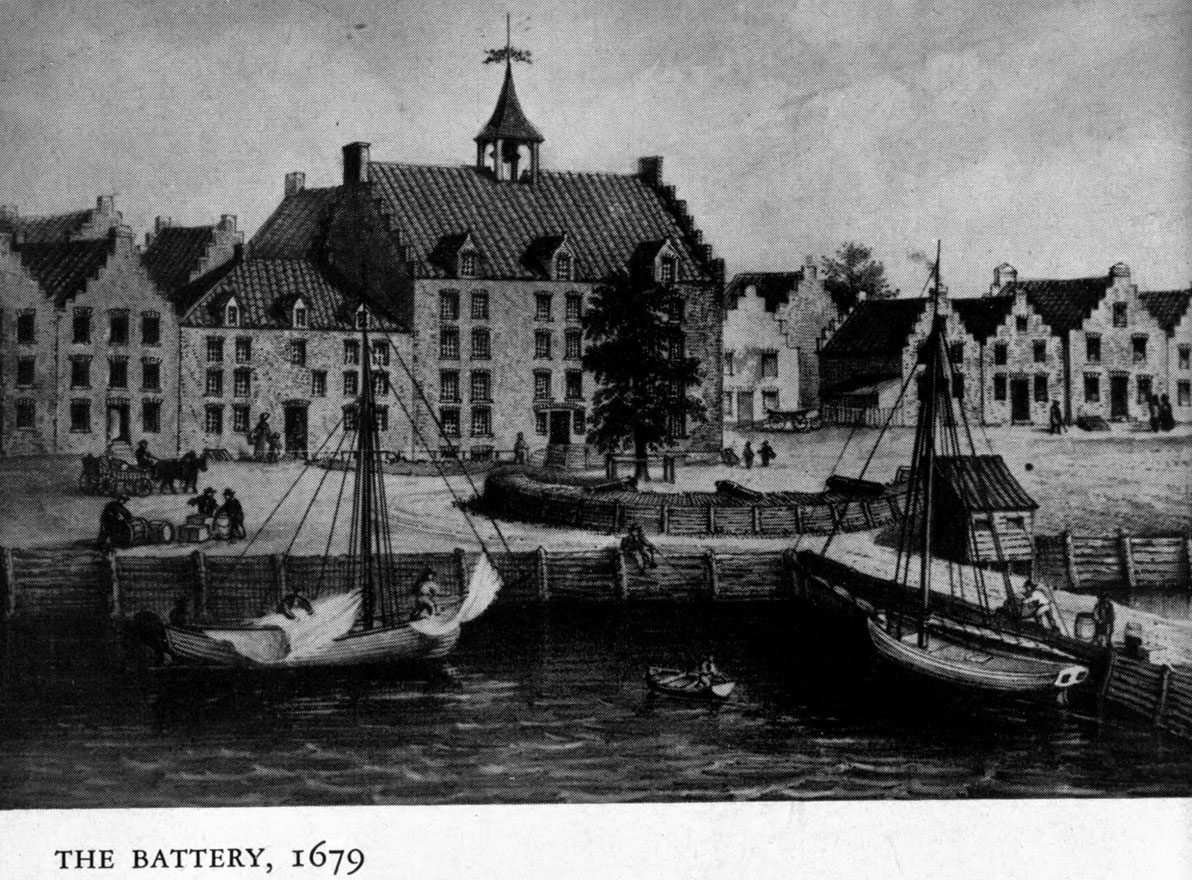 The BATTERY is as attractive to water gazers now as when Herman Melville wrote of "Men fixed in ocean reveries... Landsmen: of week days pent up in lathe and plaster tied to counters, nailed to benches, clinched to desks. Nothing will content them but the extremest limit of the land. They must get just as nigh the water as they possibly can without falling in. And there they stand. Inlanders all, they come from lanes and alleys, streets and avenues--north, east, south, and west. Yet here they all unite."
But the park is more than a Sunday and holiday attraction; it is a welcome breathing space in an area dominated by marine commerce. From the sea wall that bounds its twenty-one acres can be viewed the busy traffic of the North River--liners, tugs with tows of barges and scows, lowriding Diesel cargo boats from the Barge Canal, passenger steamers of the Hudson lines, and ferries plying cross-river and cross-harbor from the row of terminal rail and marine docks on the Jersey shore. Only one railroad has entry for its freight into Manhattan by land; the bulk of the railroad freight must be transshipped by tug and barge.
Southwest appears the Statue of Liberty on Bedloe Island (see page 411), and beyond it is Ellis Island and the great immigrant station (see page 415). Five miles down the bay rise the abrupt hills of Staten Island. South by southeast lies Governors Island (see page 413), military reservation, with Castle Williams, twin fort to Castle Clinton the present Aquarium standing grimed and grim on its highest headland.
Between Staten Island and Brooklyn is the Narrows, the strait connecting the Upper Bay with the Lower Bay and the sea. Plans for a suspension bridge, between the Battery and Hamilton Avenue, Brooklyn, were approved by the City Council early in 1939. The estimate of the cost was $41,200,000.
Central in popular attraction as well as in prominence among the buildings of Battery Park is the Aquarium (see page 307), set close beside the river. At one time it served as an immigration station.
Point of interest from New York City Guide (1939), shown as printed.