City Hall
Office of the Mayor of New York, City Hall, New York· Approximate: located to the area, not the building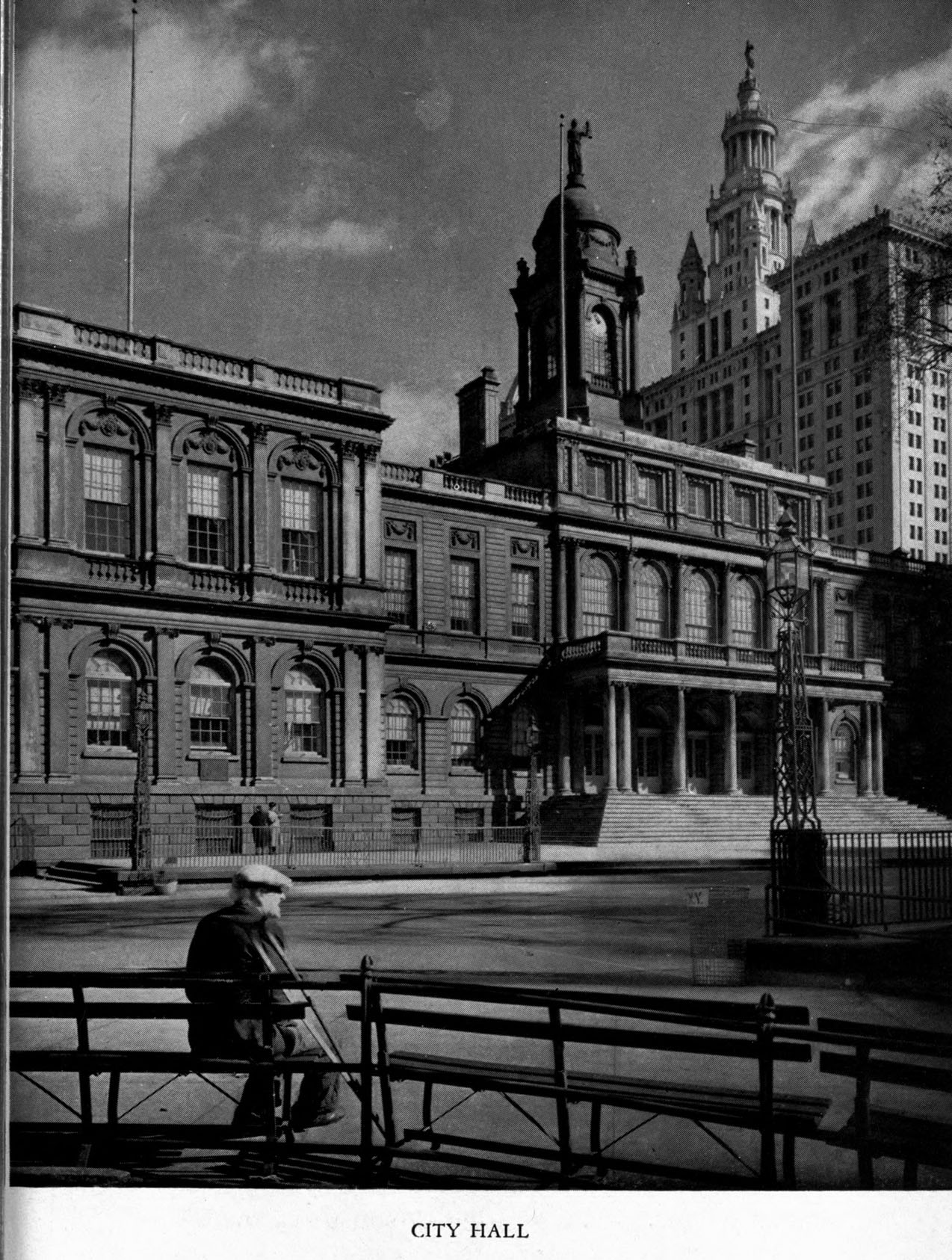
CITY HALL houses the offices of the Mayor, chief executive and magistrate of the city, and his staff; the City Council, the municipal legislative body; the Board of Estimate, the general administrative body; and the Art Commission, the agency that passes on the designs for all public buildings and works of art.
Architecturally, City Hall is an exceptionally well-executed design of the post-Colonial period showing clearly the fact, noteworthy in its day, that professional rather than amateur architects planned it. The design, a beautiful adaptation of French Renaissance and American Colonial influences, was essentially the work of Joseph F. Mangin, a Frenchman, but his partner and co-winner of a competition for the commission, John McComb, a Scotsman, supervised the work in New York and received most of the contemporary credit.
He was paid six dollars a day, a very good salary at the time. Construction was under way for nearly a decade; it took three years to settle on the plan alone. To save $15,000 the city fathers, tempering their recklessness in spending a half million dollars for the structure, insisted that brownstone be used for the rear. City Hall was completed in 1811.
Reminiscent of the Hotel de Ville of the eighteenth century, the dignified marble structure, chastely embellished with Louis XVI pilasters between arched windows, is noteworthy for its unusual grace and delicate scale. The two wings are balanced on either side of a central portico that is surmounted by a cupola. Its finial is a figure of Justice, said to have been executed by John Dixey. The interior is marked by McComb's fine attention to detail, especially in the rotunda, in the superb double curve of the self-supporting marble stairway with its delicate wrought-iron railings, and in the slender columns of the upper gallery.
Portraits of former governors crowd the walls of the corridors, and mayors' portraits are hung in the mayor's antechamber and reception room on the first floor. Over the mantelpiece in the mayor's office is a portrait of Lafayette, painted by Samuel F. B. Morse on the occasion of the general's visit to America in 1824. The Governors' Suite, on the second floor, was originally intended for the official use of the State's chief executive when in New York, but its three rooms have been converted into a museum. (Open Monday to Friday 9 a.m. to 4:30 p.m., Saturday 9 a.m. to 12 m.)
A mahogany writing table used by George Washington during the first days of his Presidency is exhibited along with other historic pieces of furniture. In the Governors' Room of the suite are Trumbull's portraits of such noted personages as John Jay, Alexander Hamilton, and George Washington (valued at more than a quarter of a million dollars), and in the other two rooms are hung paintings by John Wesley Jarvis, Henry Inman, John Vanderlyn, Thomas Sully, George Catlin, and others. The portrait of Henry Hudson is the work of Paul van Somer, a seventeenthcentury Flemish master; the identity of the subject is doubtful, however, for there is no authenticated portrait of the navigator. This valuable collection is under the care of the Art Commission.
The mahogany-lined City Council chamber, once the aldermanic chamber, on the second floor, contains portraits of Henry Clay and George Washington, a statue of Thomas Jefferson by Pierre Jean David (d' Angers), and a pretentious ceiling mural, New York City Receiving the Tributes of the Nations, by Taber Sears, George W. Breck, and Frederic C. Martin. The adjoining committee room is decorated with portraits of General George B. McClellan, by William H. Powell, and of William Bainbridge, by John Wesley Jarvis.
The former Common Council chamber, on the second floor, is now the meeting place of the Board of Estimate. Corinthian columns and pilasters give the room an atmosphere of dignity. A bust of John Jay, on the north side, is the work of John Frazee; that of John Marshall, on the south side, is by an unknown artist.
The steps of City Hall are worn smooth by official public receptions and ceremonies. Here the mayor welcomes distinguished visitors, awards promotions to members of the fire, police, and sanitation departments, and makes contributions opening charity campaigns.
Point of interest from New York City Guide (1939), shown as printed.