Municipal Building
Centre St & Chambers St, New York· Located to the block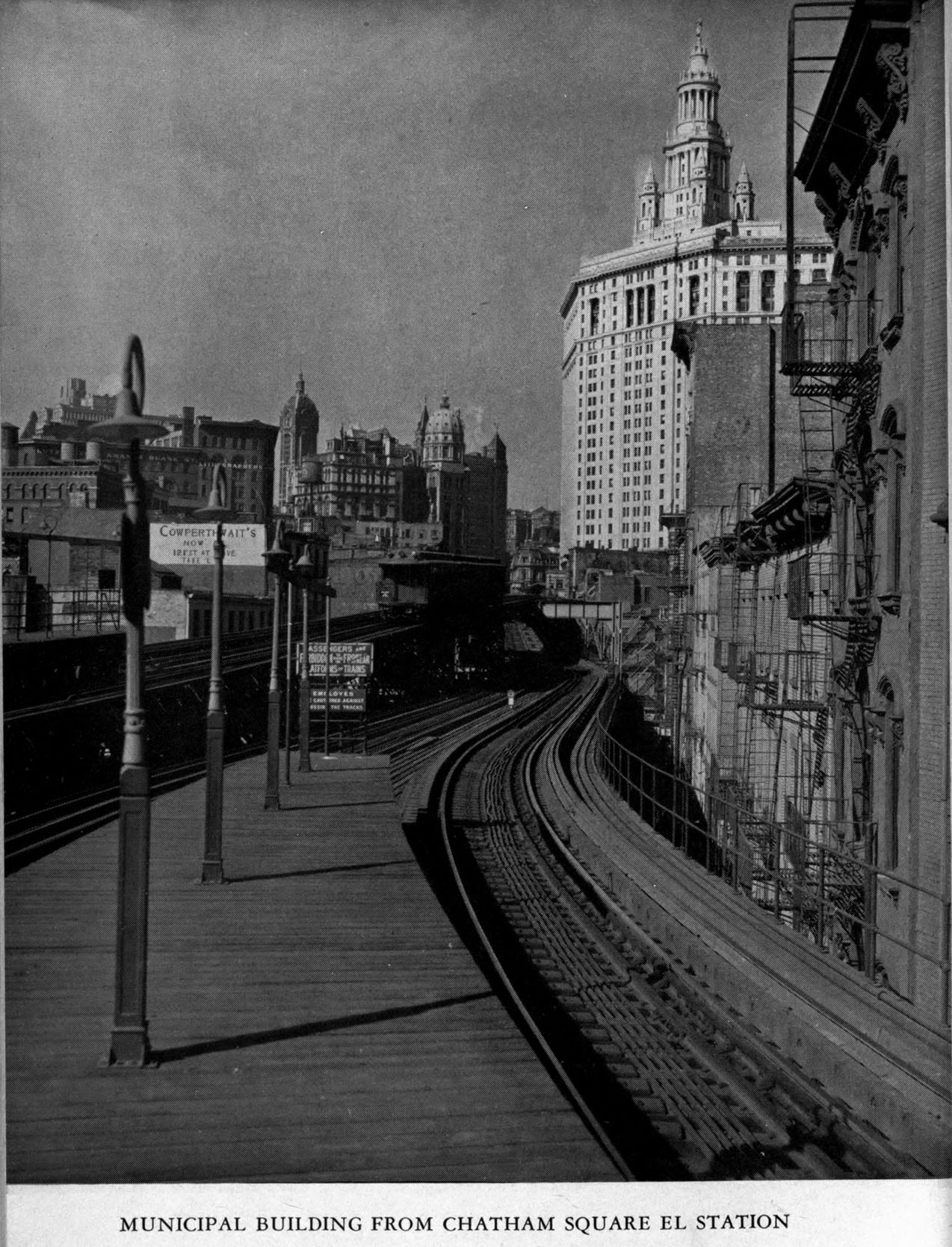
Despite the northward expansion of the city, the vicinity of the City Hall has remained the center of governmental activities in New York. This concentration of official business municipal, State and Federal occurs in an impressive group of buildings erected within the past decade in and around Foley Square, the neighborhood northeast of City Hall Park.
On the two triangular blocks bounded by Park Row, Centre, and Duane Streets, and looking down on City Hall, is the forty-story MUNICIPAL BUILDING, designed by McKim, Mead, and White. It straddles Chambers Street, forming an arcade through which flows west-east vehicular traffic; this passageway has been called the "Gate of the City," the title of an oil painting of the scene by William Jean Beauley.
The building has a flattened U-shaped plan, with its open side toward Centre Street. It gains dignity through the bold treatment of the intermediate stories, despite the poorly related tower and the disturbing character of the Corinthian colonnade at the base. In themselves the elements are well designed, but their combination lacks unity. It is surmounted by a heroic figure of Civic Fame, by Adolph Alexander Weinman, who was also the sculptor of the relief on the lower part of the building.
The building, opened in 1914, cost about twelve million dollars. Despite its size (650,000 square feet of floor area), it has proved inadequate, and several departments have been housed in buildings on Foley Square proper. The municipally owned and operated RADIO STATION, WNYC, on the twenty-fifth floor, broadcasts no commercial programs; performers are supplied by government agencies and educational institutions.
The MUNICIPAL REFERENCE LIBRARY, on the twenty-second floor, a branch of the New York Public Library, contains documents, pamphlets, maps, directories, and reports from all important cities. On the second floor, across the hall from the marriage license bureau, is the MARRIAGE CHAPEL, a sunny room decorated with flowered wallpaper and potted palms.
Point of interest from New York City Guide (1939), shown as printed.