St Paul's Chapel of Trinity Parish
209 Broadway, New York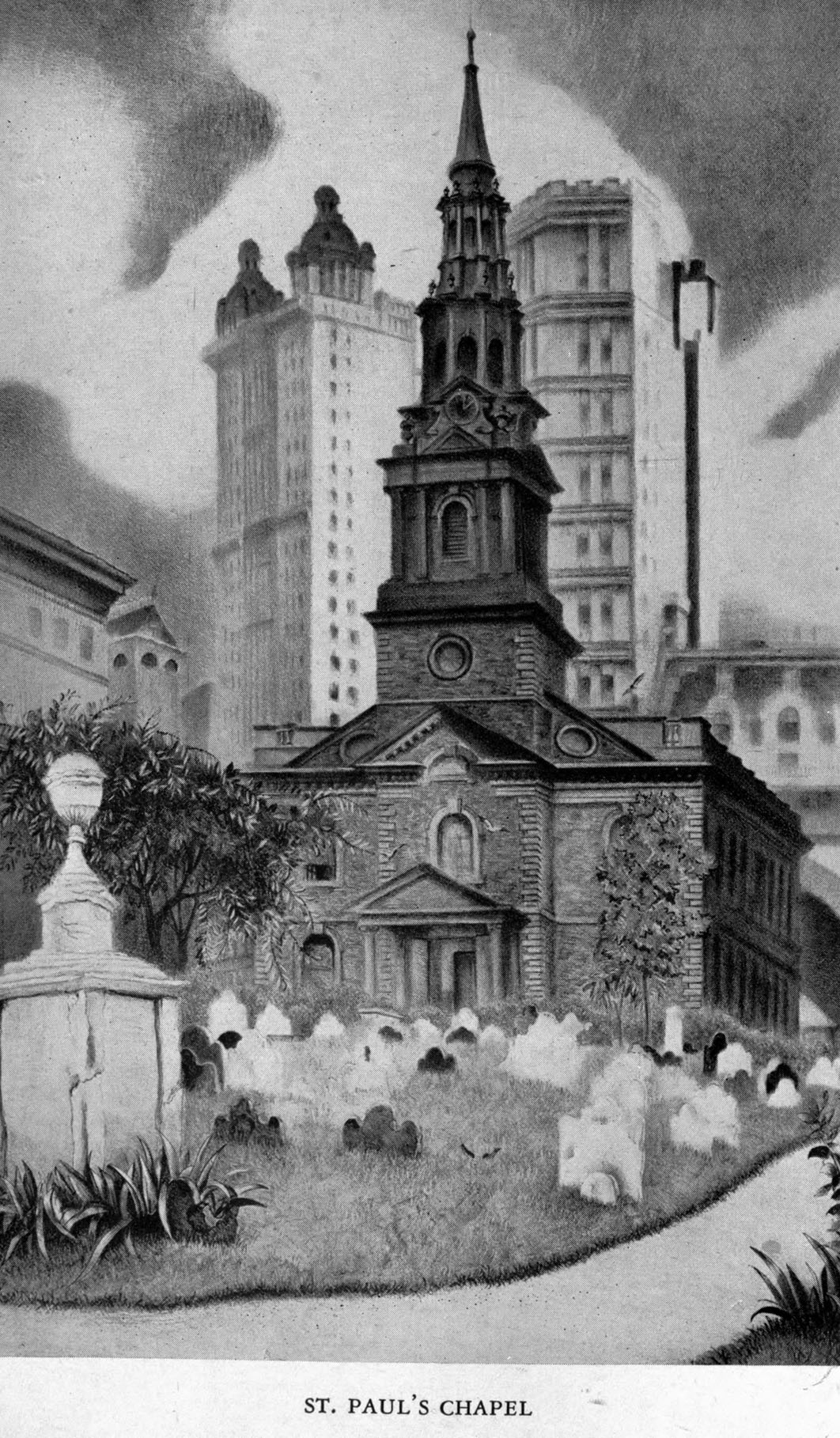
Below the Woolworth Building, on Broadway between Vesey and Fulton Streets, is ST. PAUL'S CHAPEL OF TRINITY PARISH, the oldest church building in Manhattan. Its cornerstone was laid May 14, 1764, in a field sloping to the Hudson River. The architect, James McBean, a Scot, is said to have been a pupil of James Gibbs. Gibbs designed the Renaissance church of St. Martin's-in-the-Fields, in London, which greatly influenced the design of St. Paul's.
The church was constructed of stone quarried from the site which is now the graveyard. Its original, lovely warm color has been greatly dulled by age. The church is surmounted by a tower at the west end, to which a wooden spire, more elaborate than the rest of the church but of excellent design, was added in 1794. At the east end, facing Broadway, is a carriage portico with a pediment and slender but well-proportioned Ionic columns. The light, spacious interior is handsomely decorated, with a barrel vault carried on slender columns, and a gallery on each side.
On the north side of the interior a painting of the arms of the United States marks George Washington's pew; opposite, on the south, the arms of New York State mark Governor Clinton's pew. Immediately after Washington's inauguration, April 30, 1789, both houses of Congress accompanied him to St. Paul's, where Bishop Samuel Provoost conducted a service.
On the Broadway side is a monument to Major General Richard Montgomery, killed in the attack on Quebec, December 25, 1775. It was executed by J. J. Caffieri, French sculptor, on order from the Continental Congress. Montgomery's grave is beneath the monument. Among the memorials on the west wall of the interior is a bust of John Wells (1770-1823) by John Frazee, the first known portrait bust by a native American sculptor.
The graveyard, which flanks the church on three sides, is a favorite noonday retreat of office workers in the neighborhood. It contains the weatherbeaten tombs of many historic personalities. The churchyard gates are closed during the two days preceding the Feast of the Conversion of St. Paul, as they have been since the chapel's founding, to remind the public that the property belongs to Trinity Parish, and that it is open only by the courtesy of that body.
Point of interest from New York City Guide (1939), shown as printed.