Patchin Place and Milligan Place
Patchin Pl, New York· Located to the block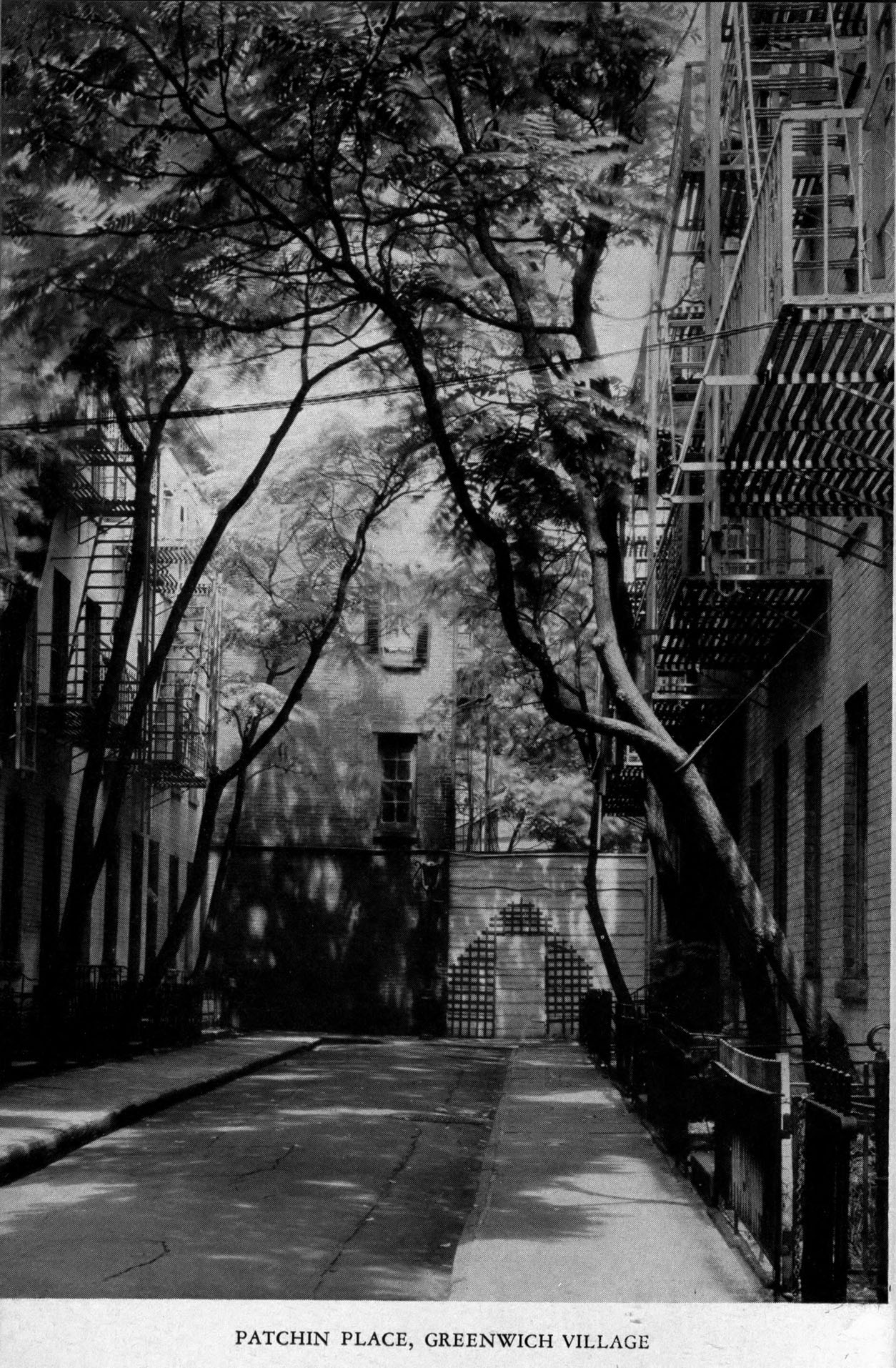
The oversized, odd-shaped block just north of the court, bounded by West Tenth Street, Sixth Avenue, West Eleventh Street, and Greenwich Avenue, is the result of the meeting at a slight angle of two gridiron systems of streets.
To utilize the interior of the property the owners developed the land in an unusual way. From West Tenth Street and from Sixth Avenue blind alleys PATCHIN PLACE and MILLIGAN PLACE run into the block at right angles to the street, and give access to the houses which front on them. Patchin Place resembles a bystreet in Old London.
In its modest little brick houses, only recently modernized, have lived Theodore Dreiser, John Masefield, Dudley Digges, John Reed, John Howard Lawson, and e. e. cummings. Milligan Place, whose houses were built in the 1850's, was named for Samuel Milligan, who acquired the property, part of the Warren farm, in 1799.
His granddaughter married Aaron Patchin, to whom was deeded what became Patchin Place in 1848. George Cram Cook and Susan Glaspell lived here, and Eugene O'Neill came frequently when the three worked on his play, The Emperor Jones. Here, as throughout the Village, grows the ailanthus the "back-yard" tree, indigenous to India. It is a city tree, one that flourishes with little soil, water, and light. In the days of the pestilence it was believed that the tree absorbed "bad" air.
Point of interest from New York City Guide (1939), shown as printed.