New York Stock Exchange
Wall St & Nassau St, New York· Located to the block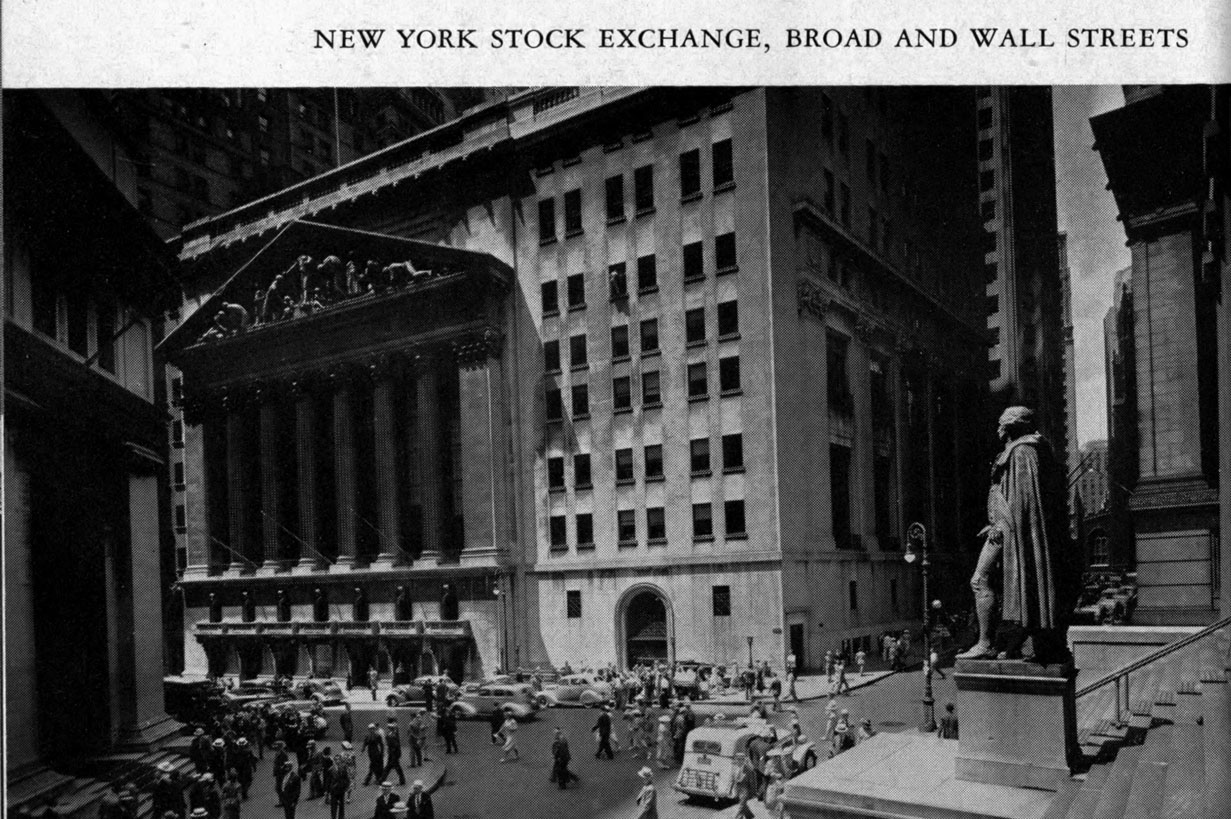
The four buildings of the famous NEW YORK STOCK EXCHANGE cover the area between New, Wall, and Broad Streets and Exchange Place one block east of Broadway. The original building, designed by George B. Post, was finished in 1903, and the twenty-two-story addition, in 1923, from the plans of Trowbridge and Livingston. The adjoining BLAIR BUILDING and COMMERCIAL CABLE BUILDING were bought in 1928.
The Exchange building proper, with its well-proportioned Corinthian order and sculptured pediment, shows an expressive use of the "temple" form of facade. The Exchange is owned and administered by 1,375 member brokers, each of whom possesses a "seat." In the boom year of 1929, seats sold for as much as $625,000; the top price in 1938 was $85,000. During 1937, the Exchange had on its trading list some 1,200 stock issues, valued at almost sixty billion dollars, as well as 1,400 bond issues valued at more than forty-two billion dollars.
The Exchange was established shortly after the formation of the United States. In 1790, the first Congress authorized the issue of eighty million dollars in bonds. Three large banking institutions were incorporated about this time, and for the public sale of their stock, a market was developed under a buttonwood tree at what is now 68 Wall Street. Here, in 1792, a group of twenty-four brokers drew up a trading agreement.
Financing the next war, in 1812, gave the exchange a new importance and the New York Stock and Exchange Board was organized with offices at 40 Wall Street. It was as a result of financing the Civil War, however, that the board began to approach its full power. The organization was combined with the Open Board of Brokers and the Government Bond Department to form the present New York Stock Exchange early in 1863.
There followed a half-century of unprecedented expansion. Money was needed for railroads, telegraph lines, factories, for building cities over night and exploiting the resources of the West. Financial titans arose: Jay Gould, Jim Fisk, Daniel Drew, Jim Hill, E. H. Harriman, and the elder J. P. Morgan. After Gould, Fisk, and Drew, with the help of bribed New York legislators, had succeeded in their struggle with Commodore Vanderbilt for the control of the Erie Railroad, Gould and Fisk conceived the plan of cornering the gold market, counting on the United States Treasury not to sell from its gold reserve.
But when the price of gold reached 162 on Black Friday (September 24, 1869), President Grant ordered the Treasury to sell, breaking the corner. The panic of 1869 resulted, followed by a depression which lasted ten years. Banks, brokers, merchants suspended business; nearly one hundred railroads failed, and the Stock Exchange closed its doors.
With the fall of men like Fisk came the rise of Morgan, Harriman, and others, unbridled expansion, larger fortunes, and further battles for personal financial dictatorship. It was in this period that Morgan's and Harriman's struggle over the great Northern Pacific Railroad was followed by the collapse of the market and the nation-wide panic of 1901. Again, in 1907, Morgan's struggle with the Knickerbocker Trust Company brought about the failure of that and other institutions.
The World War brought further prosperity to the Exchange and necessitated the erection of a twenty-two-story addition to its building. After the war, except for the depression of 1920-22, the market rose to new heights, and with it the expectations of an expanding nation. The panic of October, 1929, and another depression were the inevitable reactions.
One radical result of this depression was the creation of the Securities and Exchange Commission (SEC) in 1934, which for the first time attempted governmental regulation of the influential Stock Exchange.
The function of the Exchange is to provide a liquid market where securities can at all times be disposed of or acquired virtually without delay. Trading in America's greatest securities market is conducted on the floor of the Great Hall, one of the largest rooms in the world.
Orders to buy or sell, telegraphed and telephoned from all over the world, are relayed through brokerage houses to their active members on the floor, who transact business orally with traders stationed at numerous horseshoe trading posts. Despite the informal nature of these transactions, they are quickly recorded in meticulous detail on the Exchange's ticker tape and are communicated by telegraph and cable to other markets.
Trading operations may be viewed from the visitor's gallery. Admission was comparatively easy until 1933, when a visitor unkindly deposited a tear gas bomb in the ventilating system. Today admission is available only to guests of an Exchange member firm.
The visitor, standing in front of Trinity Church (see page 310), Wall Street and Broadway, shortly before nine o'clock in the morning, will see the empty "street" fill suddenly with swift-moving clerks, tellers, stenographers, and office boys pouring from subways, ferries, and elevated trains ; while bankers and brokers arrive almost as promptly in chauffeured automobiles or by planes landing at a ramp near the foot of Wall Street.
Point of interest from New York City Guide (1939), shown as printed.