American Museum of Natural History
American Museum of Natural History, New York· Approximate: located to the area, not the building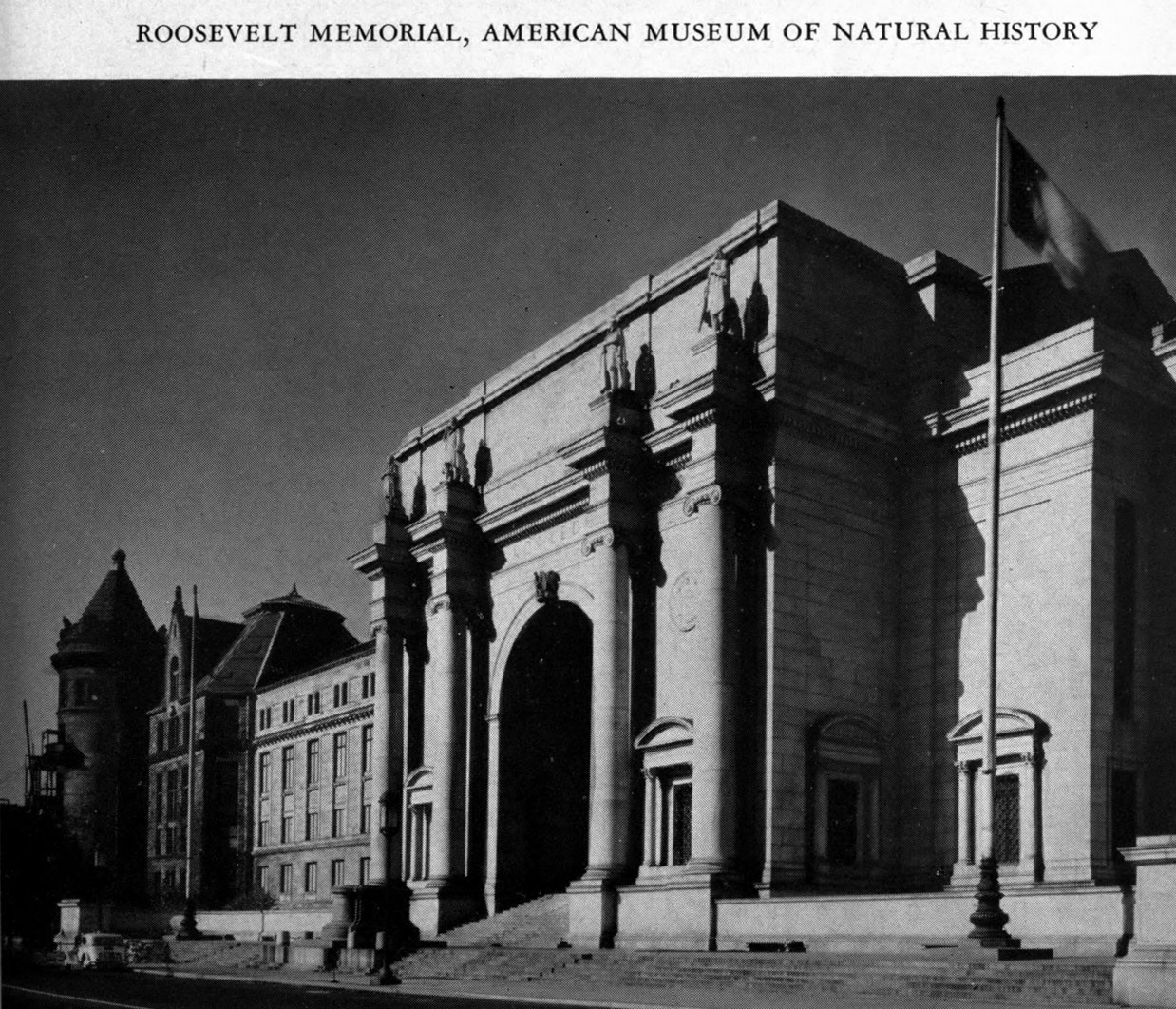
Besides being one of the world's largest institutions devoted to natural science exhibits, the American Museum of Natural History is also a research laboratory, a school for advanced study, a publishing house for scientific manuscripts, and a sponsoring agency of field exploration expeditions.
The incorporation of the museum in 1869 was an expression of the surge of interest in natural science stimulated by great advances, such as the use of the spectroscope, Mendel's law of heredity, Darwin's theory of evolution, the law of the conservation of energy, and the identification of light as an electromagnetic phenomenon. Its first collections were housed in the old Arsenal building in Central Park.
The cornerstone of the first among the present structures was laid in 1874 by President Grant, and the museum was formally opened by President Hayes in 1877. Since then, new buildings for exhibition and study have been added, including the Theodore Roosevelt Memorial and the Hayden Planetarium; the occupation of the whole area of Manhattan Square, between Seventy-seventh and Eighty-first Streets, from Central Park West to Columbus Avenue, is projected.
From the beginning noted scientists, educators, and civic leaders have been associated with the museum. Among them are Professor Albert S. Bickmore, who in 1880 was largely responsible for the inauguration of a system of popular education in conjunction with the schools of the city; Morris K. Jesup, philanthropist, who was president of the institution for more than a quarter of a century; Henry Fairfield Osborn, paleontologist and geologist, who was also its president for many years; and the present director, Dr. Roy Chapman Andrews, naturalist and explorer.
Founded by subscriptions from private individuals, the museum has been supported by additional bequests, income from endowments, sale of corporate stock, and a membership fund, as well as by contributions from the city. It is governed by a self-perpetuating board of thirty-five trustees, with the mayor, comptroller, and park commissioner as ex-ofncio members. It employs a staff of 554. In 1936, more than 250 WPA workers were added to various departments, indicating the scope of the museum's work and its needs.
The museum's architecture is unhappily marred by a gross disparity of styles. The first building, facing Seventyseventh Street, designed by J. C. Cady and Company, is a good example of the robust use of stone as structural material, a use developed by Richardson and his followers in the years before the Chicago Fair of 1893. The entrance on this side is vigorously indicated by the expressive massing of the dark salmon granite masonry and by a great monumental carriage-way. It leads directly into the older Memorial Hall with its busts of early American scientists and temporary exhibits. Later wing additions by Trowbridge and Livingston are in general conformity with the older part, but flatter and less positive in treatment.
The Roosevelt Memorial building facing Central Park West, completed in 1936 from designs by John Russell Pope, has, however, occasioned much adverse comment for its lack of relation to the adjoining structure and its pretentious Roman style. Nor have the murals in the high-ceilinged Memorial Hall on the second floor, by William A. Mackay, been too well received, the general impression being that their design is weak, and that the depiction of incidents from the life of Theodore Roosevelt lacks imagination.
On the other hand, the Hayden Planetarium, which is connected by a corridor with the Roosevelt Memorial, is among the most interesting examples of modern functional architecture. The architects were Trowbridge and Livingston. Particularly notable is the imaginative design of the Hall of the Sun, on the first floor, where form, light, and color have been ably handled.
Akeley Memorial Hall
The most spectacular exhibit, perhaps, is that in the Akeley Memorial Hall of African Mammals, entered from Roosevelt Memorial Hall. It illustrates an interesting exhibition technique the use of life-like habitat groups in place of mounted single figures. Few exhibits match the wildlife drama presented in this hall.
Animals, settings plains, jungles, and mountains the weather, the day and night of Africa are recreated not only with objective accuracy but with imaginative insight. The lion, gorilla, antelope, buffalo, giraffe, rhinoceros, wild dog, boar, and many other creatures are represented in characteristi actions that give an amazing impression of vitality and reveal something of their mental nature. The vegetation is excellently simulated; in some cases actual rocks and bushes have been brought from the place represented. Paintings in perspective and curved skies give the illusion that the landscape extends into the far distance. Large-scale maps of Africa may also be studied here; and there are sculptures, by Malvina Hoffman, of native human types.
Mammals
South Asiatic mammals, chiefly from the Indian peninsula, are exhibited in Vernay-Faunthorpe Hall, second floor, east wing, to the left of Roosevelt Hall. Two large elephants stand in the center of the hall. Large and small game, tigers, deer, leopard, and gibbon are shown amid their native fields and forests. A new hall of North Asiatic mammals, featuring the Siberian tiger, the Marco Polo sheep, and the giant panda will adjoin this exhibit (1939).
North American mammals are at present displayed in Allen Hall, second floor, southeast wing. Many of these have been given naturalistic settings as in Akeley Hall, notably a group of timber wolves on the trail of deer, and a scene showing beavers at work. On the first floor of the African wing, a new hall is at present under construction (1939), which may be entered from New York Hall, the first floor of the Roosevelt Memorial building. In the New York Hall are four large habitat groups, the DutchIndian, Roosevelt Ranch, Conservation of Wild Life in the Adirondacks, and Bird Sanctuary.
The phylogenetic interrelationship of the highest order of mammals is presented in the Hall of Primates, third floor, south pavilion. Here are shown all the types from lemur to man in characteristic surroundings, posture, and activities. A series of skeletons permits a comparative study of structural changes in the process of man's evolution. There is also an excellent collection of wild animal photographs.
The presentation of the synoptic series of mammals, which adjoins the Hall of Primates, leads still deeper into the background of the evolutionary process. Here mammals have been arranged in the order of their development from the egg-laying platypus (the duckbill) to man. Especially emphasized is the fact that the internal structure, not the external appearance determines the position of an animal in the line of evolution. A family tree of the orders of animal life from which mammals stem is also shown. A life-size model of a sulphur-bottom whale, the world's largest mammal, hangs from the ceiling (this particular one is seventy-six feet long). There is also the skeleton of Jumbo, the largest elephant ever brought to this country, presented to the museum by Phineas T. Barnum, the circus promoter.
Darwin Hall of Evolution
A basic exhibit of evolutionary processes is in the Darwin Hall of Evolution, first floor, south pavilion. Devoted chiefly to the orders of invertebrates, animals without backbone, it is arranged to illustrate developments in structure and function from the lowest form of animal life, the singlecelled protozoa, through the plant-like sponges and polyps; flatworms and roundworms; exquisite rotifers; sea mats and lamp shells; the sea stars; the ringed worms ; arthropods, crustaceans, and insects ; mollusks, to the first chordates, or animals with a central nervous system. There are synoptic charts, family trees, and wax and glass models many times magnified, of the inhabitants of the invisible society so vital to our existence. Even more picturesque are reproductions of animal and plant groups, one enlarged one hundred diameters, or cubically a million times, in their characteristic rocky sea cave, wharf pile, tide pool, bay bottom, and pond homes.
Other exhibits in the hall illustrate laws of natural science discovered by Darwin and other biologists Specimens of dogs, pigeons, and fowl show the variation under domestication ; a collection of mollusks illustrates color variation ; while the coat-color of a family of rats presents the simpler features of Mendel's law of heredity.
Aquatic Life
The Hall of Fishes on the first floor, east wing, with its models and mounted specimens, is a chart of evolution undersea. Lowly "cartilage fishes" such as sharks and rays are succeeded by those of a higher, vertebrate structure. Here also are the terrible hags and blood-sucking lampreys, skates and electric rays, fishes with lungs and flappers, and a multitude of finned creatures whose brilliant colors rival those of birds. In a darkened inner room is a startling reproduction of a habitat, where deepsea fishes gleam with their ownlight under tons of water. The hall also exhibits fresh-water fish.
Big game fishes, tuna, tarpon, sailfish, swordfish, and devilfish victims of hook or harpoon adorn the walls. Some are posed in mid-air, as if leaping out of the water as they try desperately to tear the fatal hook out of their mouths.
Near by, in the southwest court, is the Hall of Ocean Life. Skeletons and models of dolphins, porpoises, and other marine animals are displayed, among them the giant squid, right whale and blackfish, the narwhal and the terrible killer whale, which causes even the great sperm whale to flee in terror. There are habitat groups of seals, manatee, sea lions, and walrus, and a reproduction of a Bahama coral reef, showing sky, land, sea surface, and multitudinous undersea life. The Lindberghs' exploration plane, Tmgmhsartoq, and Dr. Beebe's bathysphere, collections of shells, and large paintings of sperm whaling and undersea life are other temporary features of the hall.
Birds
A hall in the south pavilion on the second floor is devoted to a number of habitat groups showing the birds of the major faunal areas of the world. Scenes of bird life in the American tropics, the Antarctic, the Andean zone, North Temperate and Palaearctic Alpine zone, the Gobi Desert, and other regions are presented with the same dramatic beauty that distinguishes the collections of African and Asiatic mammals.
The general collection of birds is in the near-by Hall of Birds of the World in the south central wing. Suspended overhead is an exhibit of birds in flight: condor, eagle, brown pelicans, asprey, albatross, and ducks and geese in formation. Several cases contain a synoptic arrangement of birds, the 13,000 known species being represented by examples from the principal groups, according to their structural relationships. The other exhibits are grouped in relation to their geographic origin. Specimens of now extinct birds may be seen, such as the passenger pigeon, once bred in North America by the millions, and the dodo, represented by a skeleton and a life-size reproduction copied from an old Dutch painting. There are also collections of birds' eggs and plumage, as well as exhibits dealing with structural adaptation.
North American birds are housed on the third floor, south central wing. The habitat groups were prepared under the immediate direction of Dr. Frank M. Chapman, curator of ornithology, and are masterly evocations of the landscape, flora, and fauna of every region of the continent. Eagles, herons, pelicans, swans, flamingos, grouse, and duck hawks are only a few of the magnificent birds seen in habitat groups either perched on inaccessible icy heights, standing on river banks by the thousands, feeding their young, or sweeping down from the Palisades of the Hudson River to pounce on living prey.
Specimens of local birds, resident and migrant, found within fifty miles of New York City, are in the first floor corridor of the Roosevelt Memorial.
Amphibians and Reptiles
The Hall of Reptile Life is on the third floor, east wing. Habitat groups, including those of Gila monsters, iguanas, giant salamanders, and the common bullfrog, are displayed. Cases contain specimens of alligators, crocodiles, king cobras, and turtles. Various educational exhibits accompany these, dealing with the evolution and habits of amphibians and reptiles, as well as the treatment of snakebite.
Near by, in the southeast pavilion, is the Hall of Insect Life. The biology of these small but powerful creatures, and their benefit and danger to man, are presented by live specimens in habitat groups and in detailed charts and diagrams. A live beehive, made of glass, enables the spectator to observe the activities of domestic honeybees.
Problems relating to insects are further treated in the Hall of Biological Principles and Applied Biology, first floor, west central wing. Exhibits in this hall deal with general questions of food and water supply, sewage disposal, and the relation of insects, rats, and parasites to public health. Models of disease carriers, showing the characteristic conditions for the spread of epidemics, with methods of cure and prevention, form part of this educational display.
On the first floor, southeast wing, is the Hall of the Woods and Forests of North America, containing an almost complete collection of native trees presented by Morris K. Jesup. The numerous members of great tree families such as beech, oak, pine, and palm, are represented by cross sections of the trunk. The accompanying reproductions of the leaf and flower or fruit of each tree were prepared in the museum laboratories.
In the center of the hall is a forty-five foot remainder of a fossil tree trunk, several million years old. Another exhibit is a cross section of one of the California Big Trees, sixteen feet in diameter, whose seed was planted in 597 A.D.
The Morgan Memorial Hall of Minerals and Gems, fourth floor, southwest wing, contains collections rivaling those of the British Museum and the Jardin des Plantes. The minerals are arranged according to species, and their qualities and use to man are described. The subject of crystallization is introduced by series of structural models. Notable gems are included here, such as the "Star of India," the largest cut sapphire in the world, the De Long star ruby, the Morgenthau blue topaz, and the Vatican cameo, a carved garnet.
In the southwest tower is the Drummond collection of carved Chinese jade and amber, and Japanese ivory, and sword guards.
Anthropological Exhibits
The museum is also noted for the quantity and quality of its ethnological material, particularly that pertaining to the North American Indians. The Indian exhibits are in the south central wing, the north corridor, and in the southwest and western pavilions and wings on the first floor. The nine great Indian culture areas are represented, each with extensive displays of craft work, charts of cultural and tribal distribution and social and political organization, as well as models showing home life in tents, houses, and villages, physical environment, labor, and ceremonies. Exhibits pertaining to the Central and South American Indians are on the second floor, west wing.
From the North Pacific Coast came the many wonderfully carved totem poles, house posts, grave monuments, and masks, works of the highest aesthetic quality, which excite the admiration of modern artists. A great war canoe occupies the center of the hall.
Eskimo life is represented by implements, clothing, decorative carved objects, and a model of a characteristic ice fishing scene.
The Hall of the Indians of the Woodlands is filled with examples of the dome-shaped huts of Long Island, long rectangular Iroquois bark houses, and the conical wigwams of the Ojibways, together with beautiful bead, quill, and textile work.
The Plains Indians, most of whom depended upon hunting for their existence, had implements and decorative motifs closely related to this pursuit. Interesting examples of their picture writing on skins are to be seen.
The organization of the religious Dance Societies, the famous Sun Dance and other activities and rituals of the plains are dealt with in detail.
The Southwest Indians are represented by collections of the craft work of their three main divisions, the village inhabitants of the Pueblos and the nomad Apache and Navajo. Silver and turquoise work, pottery, woven blankets and baskets, ceremonial costumes, masks, and images are the chief exhibits. Recesses have been built into the walls for group exhibits showing the daily life of the natives. A special exhibit with models of caves and objects fashioned by the Basket Makers is devoted to the prehistoric culture of the Southwest.
The ancient cultures of Mexico and Central America are depicted in the southwest wing, second floor. Examples are displayed of superb sculpture, jewelry, pottery, ideographic writing, and scientific achievements, notably in astronomy.
In the west wing, South American Indian culture is summarized mainly by exhibits from the culture center, Peru, although craft work from Ecuador, Colombia, Venezuela, and Brazil is also displayed. The Peruvians excelled in pottery, metal work, and textiles. Their belief in immortality is manifested in the "mummy bundles," or fabric wrappings around the dead, and in hundreds of beautiful and useful objects placed in graves for the use of the deceased.
Similar anthropological collections in the western sections of the third and fourth floors are devoted to an exposition, with characteristic objects and models of common and ceremonial life, of the cultures of Africa, Asia, the Pacific Islands, New Guinea, the Philippines, and Malaysia. Ivory, bronze, and ironwork of Africa, costumes and implements of the Siberian tribes, Chinese and Japanese handicraft, a cast of one of the huge monolithic images of Easter Island, and masks and weapons of the Malay Peninsula are only a few of the displays which reveal the high development of these peoples.
In the southwest pavilion on the second floor are exhibits of prehistoric arts and industries as developed by European cave and lake dwellers and North American shellmound dwellers and mound builders. Models of caves, reproductions of cave drawings, and objects illustrating the evolution of domestic and hunting implements predominate.
The Hall of the Natural History of Man in the southwest wing, third floor, deals with human anatomy, showing the physical characteristics, development and growth of the races of mankind. The mechanics, anatomical history, genealogy, embryology, and evolution of the skeletal structure, muscular system, nervous system, and brain of man are the subjects of this exhibit. Another section of this hall, not yet completed (1939), will contain material on individual growth and development, racial classification, human genetics, population problems, and the techniques of physical anthropology.
Fossils
Most prized, perhaps, of all the museum's exhibits are the collections of fossil vertebrates in the eastern and southern sections of the fourth floor. Here, taken out of bogs, swamps, long-closed caves, and ancient geologic strata, or released from thousands of years' imprisonment in frozen ground or stone, are the skeletons of animals that lived from 30,000 to 200,000,000 years ago. Their petrified remains help scientists to reconstruct their lives and times.
First come the great Jurassic and Cretaceous reptiles, the dinosaurs, or "terrible lizards," some vegetarian, but the greatest of them, Tyrannosaurus, a beast of prey, swift and fierce. The Brontosaurus weighed between twenty-five and thirty tons, while Ankylosaurus is called "the most ponderous animated citadel the world has ever seen," its head and body being protected by thick plates of bone.
The Hall of Mongolian Vertebrates exhibits fossils obtained by the Central Asiatic expeditions of the museum, among them the dinosaur eggs that created an international sensation when they were found, and a low relief model of the largest of the baluchitheres, ancient cousins of the rhinoceros this one, seventeen feet nine inches high at the shoulder.
A chart in the Bashford Dean Memorial Exhibit of Fossil Fishes illustrates the development of 500,000,000 years of ocean life. Sharks used to be much larger than they are now, as the nine-foot model of the jaw of the modern man-eater's ancestor demonstrates.
The evolution of the horse is featured in the Osborn Hall of the Age of Mammals. Among other animals of the Tertiary Period are, surprisingly enough, the camels and rhinoceroses of Nebraska. There are also remains of the first mammals as they began to emerge in the preceding period, the Age of Reptiles.
Early man and his contemporaries, mammoths from France and Siberia, mastodons, one from Newburgh, N. Y., and giant South American sloths, are in the Osborn Hall of the Age of Man. Here, too, is a group of skeletons dramatically posed about a model of the renowned Rancho La Brea, a California asphalt pit where so many animals of antiquity met their death. Among them an entrapped saber-toothed tiger is shown about to be attacked by a wolf, who thus involuntarily contributed his share to a knowledge of the principles of evolution.
A hall devoted to geology and invertebrate paleontology contains models of caves and mines and of the structural and historical geology of fifteen selected areas within the United States.
Finally, a corridor is devoted to the modern domesticated horse. Skeletons of Shetland ponies and race and draft horses are compared for structural modifications through breeding.
Hayden Planetarium
The Hayden Planetarium, whose equipment was a gift of the philanthropist, Charles Hayden, has an entrance on Eighty-first Street, and forms a separate architectural unit in the group of museum buildings.
In this fine domed building, science and art are brought together. In the Hall of the Sun on the first floor, an overhead Copernican Planetarium, more than forty feet in diameter, shows the relative sizes and speeds of the planets and their satellites by means of globes revolving around a central sun.
The second floor holds the Theater of the Sky where stars of all seasons and of past, present, and future time appear projected on a great hemispherical screen overhead. The performance is preceded by music, and a lecturer operates a control board for the Zeiss projector, a complex instrument for reproducing the light images of all visible stars. During 1935, the first year of the planetarium's existence, more than 700,000 persons came to see their favorite constellations, the heavens as they appeared over Bethlehem at the birth of Christ, or as they will look to future citizens of the world. Monthly programs treat different aspects of astronomy.
In the corridors throughout the building are photographic transparencies showing heavenly phenomena, a number of famous meteors among them the 361/2'ton mass brought by Robert E. Peary from Cape York, Greenland a reproduction of the Aztec calendar stone, and the chronometers used by renowned aviators.
A course in celestial navigation is given at the planetarium to aviators and navigators in co-operation with New York University and the Weems System of Navigation in Annapolis.
Museum Activities
As someone has observed, a museum is like an iceberg: only one-eighth of it is visible on the surface. This museum is no exception. Neither the vast amount of research and educational work performed by its explorers, technicians, artists, and teachers, nor its influence throughout the world can be estimated by a casual observer. Behind its exhibition halls are hundreds of classrooms, laboratories, editorial offices, libraries, lecture halls, studios, study collections, and files of vital data. And from the museum go explorers, educators, astronomers, and geologists to increase man's knowledge of the external world and to help him win victories over his environment.
The fifth floor of the museum is given over to the administrative offices, the scientific departments, and the library. The workrooms are used for the preparation of fossils, models, and other exhibits. The main library contains more than 117,000 volumes. A second library, founded by Henry Fairfield Osborn, is devoted to vertebrate paleontology.
The museum issues technical publications on its researches and expeditions, and on timely discoveries and theoretical questions. Its popular publications include the general guide, school service series, the journals Natural History and Junior Natural History, guide leaflets on the collections, and a number of handbooks which may be used as textbooks on subjects illustrated by collections in the museum.
Enormous study collections of hundreds of thousands of specimens in all branches of the natural sciences are available to students and research workers. An idea of their extent may be had from the fact that the insect collection alone consists of more than one million specimens ; that of fishes, 10,000; of birds, 750,000, the largest in the world; of fossil mammals, 30,000 catalogued, and of fossil invertebrates, 700,000 specimens catalogued. A fully equipped printing plant is constantly employed.
Lastly, and of tremendous importance, are the educational services of the museum in the form of lectures to children in the public and high schools and to students in colleges and universities, classes and guide services, sponsorship of scientific societies, motion-picture and lantern slide services, circulating collections, radio broadcasts, and nature hikes. The number of people affected by these activities reaches in one year the almost incredible number of 43,000,000.
Point of interest from New York City Guide (1939), shown as printed.