Central Park
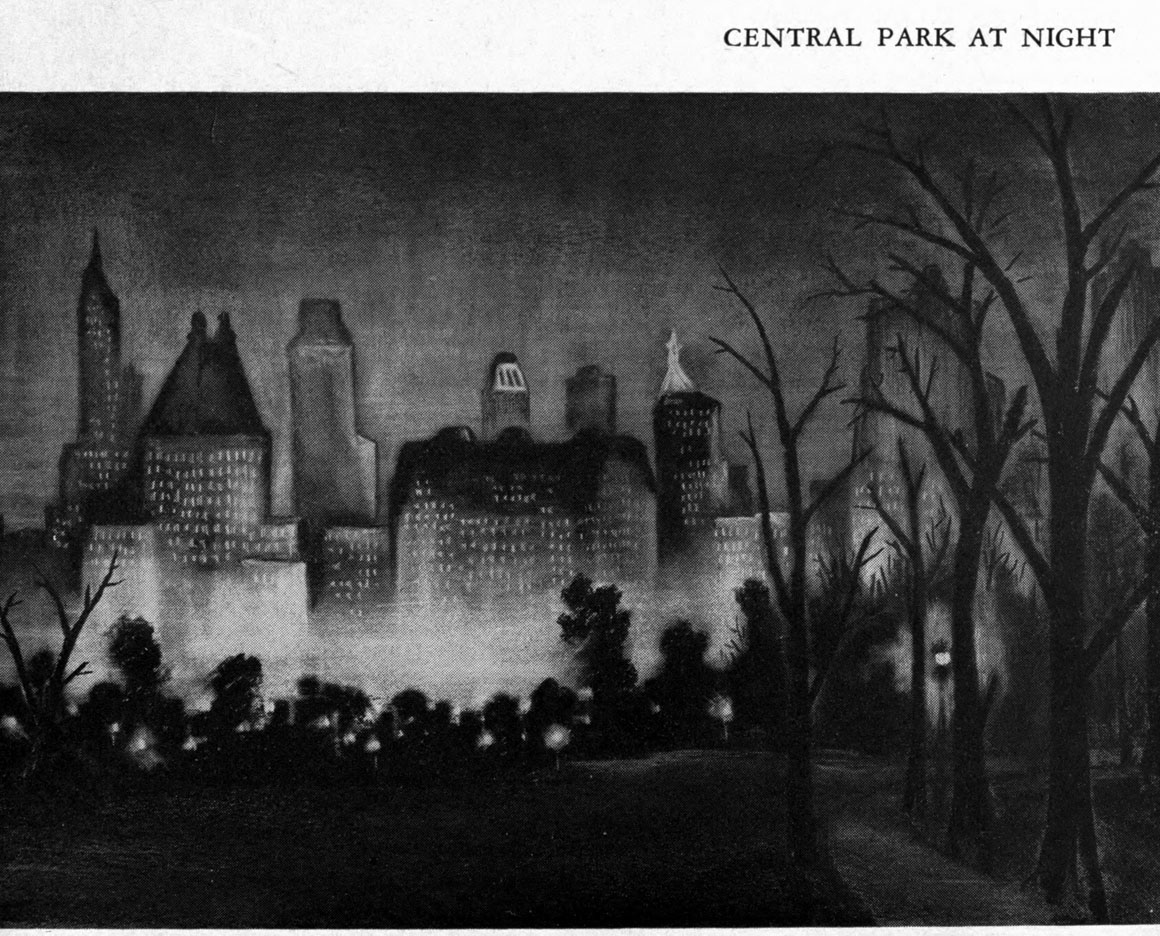
From the upper floors of an apartment hotel on its southern border Central Park appears as a vast irregular terrain marked by outcropping rock formations, wooded areas, and many bodies of water. Deep green marks it, summer and spring, and fall brings to it a variety of color that changes day by day.
The park is enclosed by stone walls, with entrance gates at frequent intervals. It has two longitudinal boulevards, East Drive and West Drive, and four transverses depressed below the park's level East Sixty-fifth to West Sixty-sixth, East Seventy-ninth to West Eighty-first, East Eighty-fifth to West Eighty-sixth, and Ninety-seventh Street east to west.
Intersecting roads for motor traffic, thirty-two miles of winding footpaths, and a four-mile bridle path make up an informal pattern. An 84O-acre tract, two and one-half miles long and a half mile wide, Central Park extends from the solid border of hotels and apartment buildings of West Fifty-ninth Street to Harlem at north.
The park's setting is the result of more than eighty years of planning and effort. The purchase of the land in 1856 was preceded by ten years' agitation by the press and by such public-minded citizens as Washington Irving, George Bancroft, and William Cullen Bryant, who became members of the first Park Board.
The section was then on the outskirts of the city, and scrubby trees and outcropping rock formations marked the land which barely afforded pasturage for the gaunt pigs and goats of impoverished squatters. Egbert L. Viele was commissioned to make a topographical survey. His difficulties consisted not only in problems arising from the irregularity of the terrain, but in the opposition of the squatters, who saw in his visit the threat of eviction; it is believed that Viele's first attempt was abruptly terminated when the squatters ejected him bodily.
The park was designed by Frederick Law Olmsted and Calvert Vaux, and their general plan has since been followed. Construction began as a relief project under the stress of the panic and depression of 1857.
Changes and improvement have been made in the design through the years; yet it may safely be claimed that under Park Commissioner Moses, of the LaGuardia municipal administration, the park achieved the appearance of a place more carefully tended than at any time in its history.
Besides widespread renovation there has been an unprecedented development of new facilities, most of this the work of such agencies as the Civil Works Administration and the Works Progress Administration.
The visitor to Central Park will find about him innumerable features that elude detailed description: the bird sanctuaries near the Plaza entrance, the Ramble, the Harlem Mere, the arbors shaded with wistaria, and the sloping paths and sudden corners where the noise of the city has been put away for the casual gurgle of a brook.
Besides the statues already mentioned there are Karl Illava's World War Memorial to the Seventh Regiment at the east wall north of the Arsenal; J. Q. A. Ward's Civil War Monument to the Seventh Regiment, north of the Tavern-on-theGreen and facing West Drive ; the statues to Schiller, Webster, Morse, Mazzini, and Thomas Moore; the Indian Hunter; the Eagles; the Falconer; and the Romanesque statue of Commerce that since 1864 has lingered near the Merchant's Gate for which it was originally intended.
Sight and sound mingle in the inventory of a day in the park, gulls wheeling above the reservoir, the whir of motors on the Drive and the backs of couples walking arm in arm toward the subway.
Lakes and roadways today follow much the pattern laid out for them in the Greensward plan. Except for the substitution of the oval curve of the Great Lawn for the rectangle of the old reservoir, the significant changes in the park have come about through the addition of recreational areas, varying from the children's playgrounds bordering the park to roller-skating tracks and horseshoe pitching courts used for championship matches.
This adaptation of the park to planned recreation emphasizes its traditional purpose, to serve the needs of an urban population. Such acts of political vandalism as that practiced by the Tweed Ring which allowed park trees to be cut down because they impeded the view from Fifth Avenue mansions have kept in the public consciousness the importance of protecting its original function, which Olmsted emphasized in his pamphlet, Spoils of the Park.
There is one tablet that might well be added to the sculptural inventory, a bronze replica of the Greensward plan with a quotation from Frederick Law Olmsted. It should be placed near the Plaza entrance, where it could rub elbows with Humboldt. Before going to the Zoo or taking the sloping walk to the Pond to photograph the most photographed pelicans of Manhattan the visitor should read:
"It is of great importance as the first real park made in this country a democratic development of the highest significance and on the success of which, in my opinion, much of the progress of art and aesthetic culture in this country is dependent."
In Central Park
- BaltoCentral Park, New York
- Belvedere TerraceCentral Park, New York
- Bethesda FountainCentral Park, New York
- Heckscher PlaygroundCentral Park, New York
- Memorial BenchCentral Park, New York
- Plaza Entrance5th Ave & W 59th St, New York
- Receiving ReservoirJacqueline Kennedy Onassis Reservoir, New York
- The ArsenalThe Arsenal, 830 5th Ave, New York-7001
- The GreenCentral Park, New York
- The MallThe Mall, New York
- Central Park ZooCentral Park, New York
Overview from New York City Guide (1939), shown as printed.