George Washington Bridge
George Washington Bridge, New York· Approximate: located to the area, not the building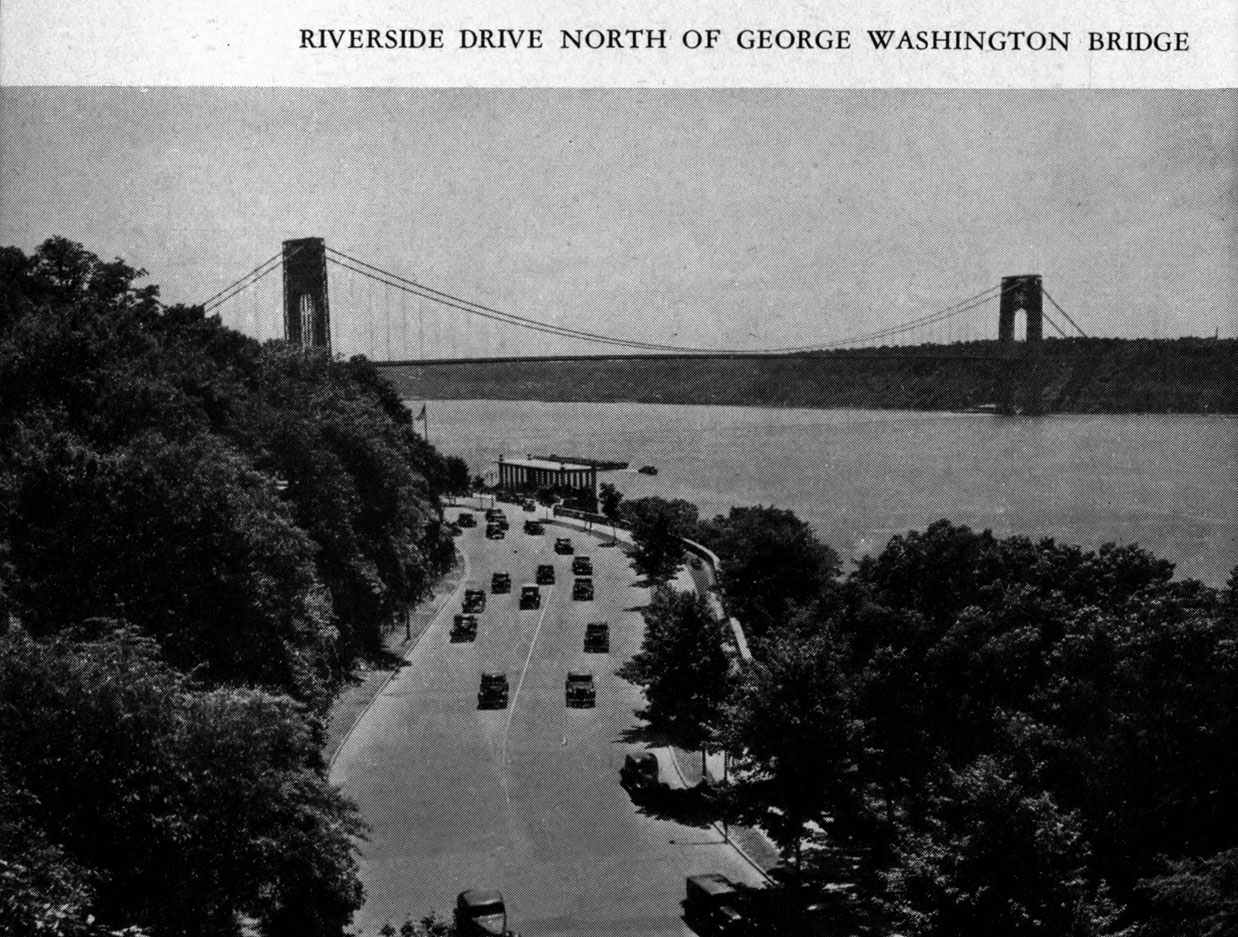
From a distance, George Washington Bridge, most splendid of all Manhattan bridges, is a silver arc above the broad steely plane of the Hudson. Up close the mighty span, linking upper Manhattan and Fort Lee, N. J., dominates the whole setting: the Palisades, the new brick and stone walls of the Riverside cliff dwellers, the wide flood of the river.
Its two great towers, cables, and roadway combine in a form that is graceful, simple, and extraordinarily effective. The design, a superb engineering concept, is based upon function in all its parts, with the exception of the steel arches of the towers arched openings are expressions of masonry rather than of steel construction. As a matter of fact, the towers were originally intended to be encased in stone, but it is more than probable that this will never be done.
Until completion of the San Francisco-Oakland Bay and Golden Gate bridges the George Washington was the longest suspension structure in the world, with a channel span length of 3,500 feet and a total over-all length of 4,760 feet between anchorages. The deck of the bridge, about 115 feet in width and about 250 feet above mean high water, is suspended from four cables.
It has two separate roadways (each with three lanes) for eastand westbound traffic, and space in the center for three additional lanes to meet future traffic demands. Provision has been made for a deck twenty-nine feet below the present one either for additional motor traffic, especially busses, or for interstate railway rapid transit service.
The four steel cables, each composed of 26,474 parallel wires, are three feet in diameter and are arranged in pairs on each side of the roadway. Cable sag at the center of the channel span with the present single deck is 316 feet.
The cables are carried by saddles on top of two steel towers, some 600 feet above the river (about twice the height of the Palisades at the Fort Lee end). Each saddle rests on a bed of forty-one eight-inch diameter steel rollers, bolted to the flanges of steel grillage girders that keep the cables clear of the tops of the towers and help to distribute the load to the tower columns.
The New York anchorage is a U-shaped concrete block. The maximum pull of each cable is 62,000,000 pounds. The anchorage is to have a granite facing, similar to that used in the Henry Hudson Parkway structures.
Built, owned, and operated by the Port of New York Authority, the bridge is a part of the complex system of transport routes by which the nation's busiest island seeks to solve its traffic problems. Completed in 1931, it is linked with Manhattan's marginal highway by a series of extensive approaches which also provide a passage to Long Island by way of the Triborough Bridge.
It also connects with US 1, 46, and 9W at the Jersey end and with US 1 and 9 at the Manhattan end. During 1937 approximately 8,000,000 vehicles paid toll to cross the bridge, and for the same period the gross income amounted to about $4,700,000. The total cost of the bridge, including rights-of-way, was about $60,000,000. O. H. Ammann of the Authority was the chief engineer and designer; Cass Gilbert, the architect, served in an advisory capacity.
On clear days the view eastward from the bridge includes a good part of Manhattan. Riverside Drive and the Henry Hudson Parkway, with their constant stream of cars, are directly below; Fort Washington and Fort Tryon parks skirt the drives.
To the south the ribbons of Manhattan's highways are lost in the thickening cluster of roofs. The funnels of great ocean-going liners in the Hudson River docks, the smoking chimneys of New Jersey industrial towns, the play of the sun about the Himalayan towers of Manhattan are easily discernible.
At night the clear outline of the bridge fades into a fantasy of moving and twinkling lights above the Hudson, while atop the eastern tower the million-candlepower Rogers-Post Memorial Beacon sweeps its reassuring light across fifty miles of darkened sky.
Point of interest from New York City Guide (1939), shown as printed.