RCA Building
Rockefeller Plaza, Rockefeller Center, New York· Approximate: located to the area, not the building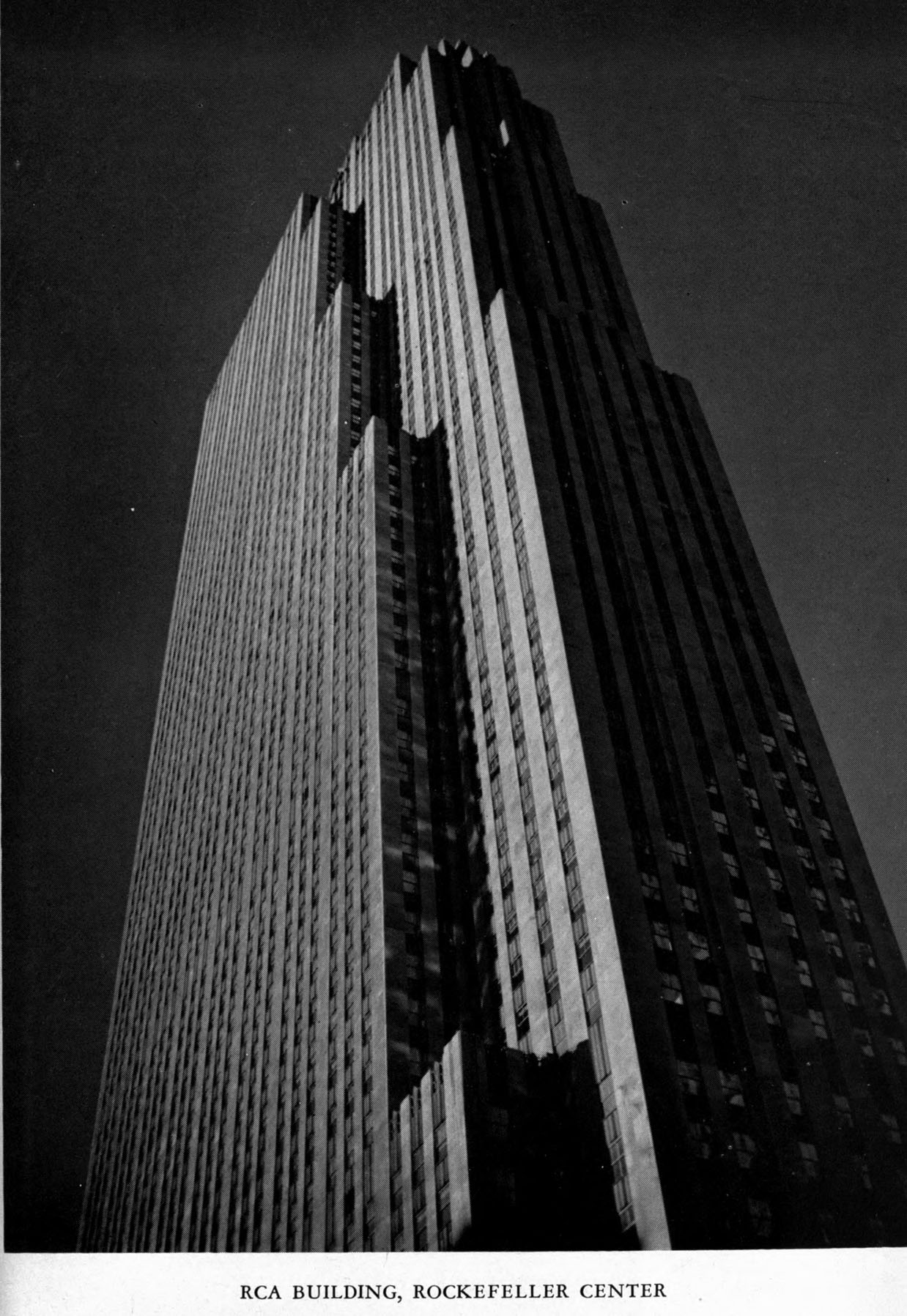
The 850-foot RCA (Radio Corporation of America) Building, the central member of the group, is one of New York's tallest structures and, in gross area, the largest office building in the world (1939). Its huge, broad, flat north and south facades, its almost unbroken mass, and its thinness are the features that impelled observers to nickname it the "Slab."
The entrance is presided over by a rather astonishing bearded giant floating over a compass, in token of "the genius which interprets the laws and cycles of the cosmic forces of the universe to mankind." The side panels represent two of the "cosmic forces": Light and Sound. The whole was sculptured by Lee Lawrie. The screen below, with the appearance of crumpled cellophane, is made of square blocks of pyrex glass.
The walls of the elevator banks in the middle of the two-story lobby are covered by large murals. Those on the south wall are by Jose Maria Sert and represent "man's intellectual mastery of the material universe"; they deal with the evolution of machinery, the eradication of disease, the abolition of slavery, and the suppression of war. Those on the north, by Frank Brangwyn, depict "man's conquest of the physical world," portraying respectively the cultivation of the soil, the development of machinery, and the hope of mankind's salvation the lessons of the Sermon on the Mount.
A mural, painted by Diego Rivera and originally in this lobby, caused an international controversy when the management first screened it and finally destroyed it, contending that the artist had departed from the approved preliminary sketch. Others held that the mural was destroyed because it included a likeness of Lenin. The case became a classic conflict between the artistic rights of a creator and the property rights of a purchaser. The space is now occupied by a Sert mural depicting the triumph of man's accomplishments through the union of physical and mental labor. The Museum of Science and Industry (see page 342) is entered from the lobby.
The Sixth Avenue entrance to the RCA Building is surmounted by a glass mosaic by Barry Faulkner. Industriously assembled of about a million pieces of glass in 250 shades of color, it represents "thought enlightening the world." About thirty feet above the mosaic, in the spaces between windows, are four sculptured panels by Gaston Lachaise, American sculptor of the modern school. They are titled Genius Receiving the Light of the Sun, Conquest of Space, Gifts of Earth to Mankind, and Spirit of Progress.
The most widely known tenants of the RCA Building are the National Broadcasting Company and its parent, the Radio Corporation of America. NBC's twenty-seven broadcasting studios, offices and other facilities occupy about four hundred thousand square feet of space on ten floors. These quarters, air-conditioned, sound-proofed, and equipped for television, are the home of WEAF and WJZ, the key stations of NBC's Red and Blue networks, respectively, and form the largest broadcasting establishment in the world.
In the eastern end of the sixty-fifth floor is the Rainbow Room, a night club, where a color organ throws shifting patterns on a reflecting dome and a crystal chandelier over a revolving dance floor. The Rainbow Grill, at the western end of the same floor, is less formal in decoration and atmosphere.
The seventieth-floor observatory promenade, 200 feet long and 20 feet wide, affords one of the finest views of New York. At the eleventh-floor level, directly over the NBC studios, is the largest of the seven roof gardens in the development. Visitors enter directly upon the International Rock Garden, where specimens from all over the world are arranged along a stream that cascades, winds, and twists for a distance of 125 feet along the terrace. There are a native American garden, with its old rail fence and shaded pool; typical Spanish, Italian, Japanese, Dutch, and aquatic gardens; and, perhaps the most successful of all, an English garden with a sundial from Donnington Castle and fine examples of yew planting.
Point of interest from New York City Guide (1939), shown as printed.