Gashouse District
Area: 14th St. on the south to 27th St. on the north; from 1st Ave. (14th to 18th St.), 3d Ave. (18th to 23d St.), and 4th Ave. (23d to 27th St.) east to East River. Map on page 193.
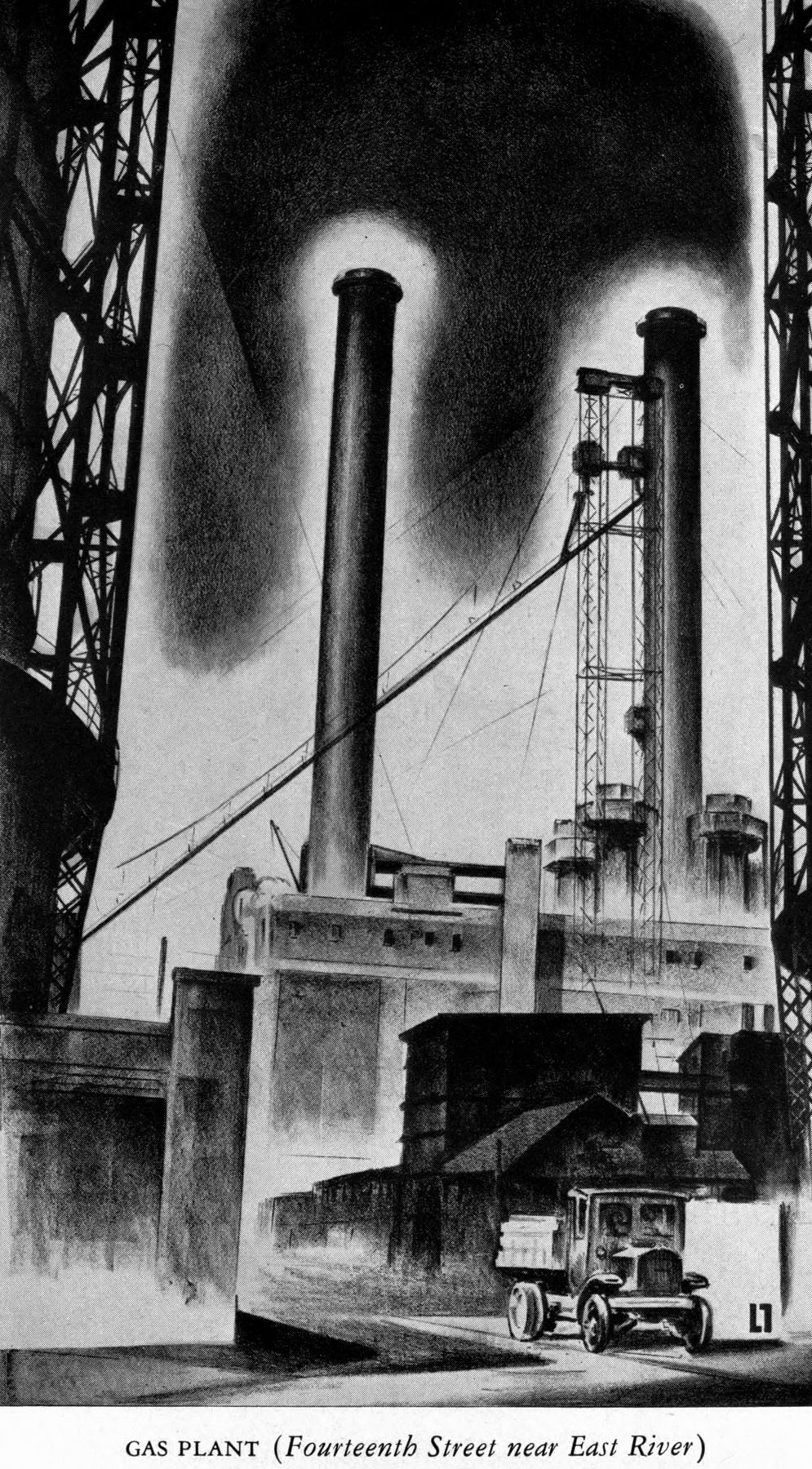
The "gashouse district" today is largely a reminiscent term. Though four large tanks still rise near the East River, their domination of the neighborhood is passing, and the notorious gashouse gangs have gone. The area now is a drab extension of the Lower East Side, a district of "... powerful ugliness and devastation . . . with its wasteland rusts and rubbish, its slum-like streets of rickety tenement and shabby brick, its vast raw thrust of tank, glazed glass and factory building . . . lifted by a powerful rude exultancy of light and sky and sweep and water such as is found only in America." So Thomas Wolfe remembered this neighborhood, particularly that part near the East River.
The first of these great gashouses was raised in 1842 at the foot of East Twenty-first Street; and before long a cluster of giant structures, the skyscrapers of their day, overshadowed the landscape. "Their tracery of iron, against an occasional clear lemon-green sky at sunrise," writes Lewis Mumford, "was one of the most pleasant aesthetic elements in the new order."
Another element in the new order, however, was its disregard for human comfort and health. Gas, leaking from the tanks, made the neighborhood a pesthole. Only the poorest families at first predominantly Irish, later joined by Germans and Jews could be drawn into the district, and flimsy tenements were built to accommodate them. The young men reared in this slum environment formed gangs that terrorized the Gashouse district for half a century. In their lighter moments they organized courageous volunteer fire companies and dallied with "the girls with the swinging handbags" who inspired the song, the Belle of Avenoo A.
One of the original plants now called the O'CONNELL PLANT in honor of an employee of seventy-two years service is still standing, though bigger units have been built in other parts of the city. Slovaks and other East Europeans have largely replaced the earlier settlers. Although old-law tenements are still in the majority and the public baths at Avenue A and Twenty-third Street are still the only bathing facilities available to many, an increasing number of modern apartment houses are being erected and many of the more substantial older buildings are being renovated.
In Gashouse District
- 165th Regiment Infantry Armory68 Lexington Ave, New York
- ASPCAE 23rd St & Asser Levy Pl, New York
- Butler Davenport Theater138 E 27th St, New York
- Columbus Hospital227 E 19th St, New York
- Municipal Lodging House432 E 25th St, New York
- New York Post-Graduate Medical School and Hospital303 E 20th St, New York
- Old Stable Row139 E 24th St, New York
- St. Illuminator's Armenian Apostolic Church221 E 27th St, New York
- Willard Parker HospitalAvenue C & E 16 St, New York
Overview from New York City Guide (1939), shown as printed.