Grand Central District
Area: 42d St. on the south to 47th St. on the north; from 3d Ave. west to 5th Ave. Map on page 193.
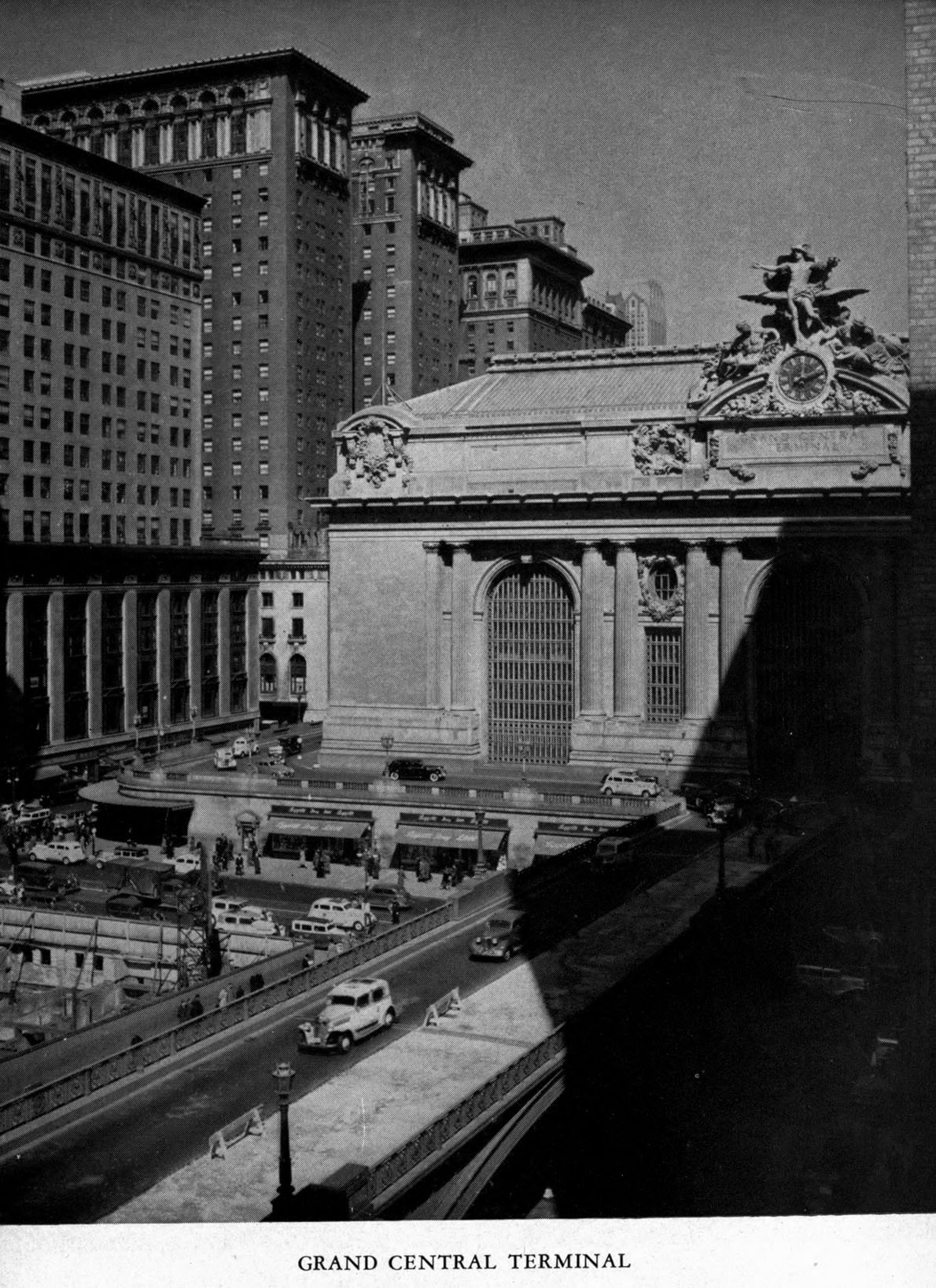
Huge GRAND CENTRAL TERMINAL, set squarely athwart Park Avenue on the north side of Forty-second Street, is one of the great railway passenger terminals of the world. Around it, inevitably, have gathered skyscraper office buildings, large hotels, clubs, stores, and restaurants, until the Grand Central zone has become one of those inner cities that characterize a metropolis.
As the New York end of two important railroads the vast New York Central system, which reaches to the Mississippi, and the New York, New Haven, and Hartford, which serves Boston and New England the terminal is one of the city's two principal gateways, the other being Pennsylvania Station (see page 165).
Not only long-distance travelers use the terminal; many of the more than five hundred trains that enter and leave daily carry commuters who live north and northeast of the city, while on an average of every four seconds during the day three IRT subway lines (Lexington Avenue, the Times Square-Grand Central shuttle, and Queens) discharge and receive passengers in stations connected with the terminal.
The number of people who pass through Grand Central in a year approximates the total population of the United States. Considerable numbers of these, however, use the building as a "short cut," as a refuge from bad weather, or for other purposes not connected with travel.
The terminal covers three blocks between Forty-second and Forty-fifth Streets, but the double-deck railroad yard extends under Park Avenue to a point near Fifty-ninth Street. There the forty-one tracks on the upper level and the twenty-six on the lower level finally narrow to the single-level, fourtrack line that stays underground until it reaches Ninety-sixth Street.
Through trains use the upper level; most suburban trains, the lower; it is only by using two levels that the tremendous volume of traffic can be handled on the forty-eight acres of available land. Trains must be moved out, in most cases, almost as soon as they are unloaded, for Grand Central is a dead end with limited space. Deep under the thirty-four miles of yard track is a power plant.
The monumental Forty-second Street front of the terminal is surmounted by Jules Coutan's massive statuary group, forty-eight feet high, in which figures representing Mercury, Hercules, and Minerva are arranged about a clock thirteen feet in diameter. Park Avenue, blocked by the building, mounts to the second-story level by a bridge over Forty-second Street, divides right and left near the heroic bronze figure of Commodore Cornelius Vanderbilt, to encircle Grand Central, then tunnels through the New York Central Building immediately to the north, and returns to grade at Forty-sixth Street.
This highway is an integral part of the terminal's structure. The space beneath it on the Forty-second Street and Vanderbilt Avenue sides is occupied by stores. The area beneath the highway bridge over Forty-second Street is named Pershing Square in honor of General John J. Pershing. Free information about the city is provided by a municipal office in a building that runs from Forty-first to Forty-second Street beneath the viaduct. This steel and glass-brick structure was built by the city in 1939 to serve visitors to New York.
Although the main entrance is the one directly facing Pershing Square, the corner entrance at Forty-second Street and Vanderbilt Avenue is probably used by most people. Indoor ramps lead from both entrances to the impressive main concourse, 125 feet wide and 385 feet long, that is depressed more than a story below street level.
Around the sides, great square piers rise 125 feet to support a vaulted blue ceiling in which illuminated constellations of the zodiac twinkle. The ecliptic of the zodiac, by an error in painting, runs the wrong way. The enormous size and lavish use of marble on floors as well as walls give the concourse an aspect of grandeur that is emphasized by shafts of sunlight pouring through the seventy-five foot windows. The effect is heightened at Christmas and Easter by soft organ music from one of the surrounding balconies.
Ticket windows line the south wall, while directly opposite are the gates to the track platforms. The circular information booth in the middle of the open floor is one of New York's most popular meeting places.
During the nine o'clock and five o'clock rush hours, this great hall swarms with scurrying crowds in which the red caps of the porters--there are 495 of them--stand out. Shortly before the Twentieth Century Limited leaves for Chicago at six in the evening, a gray and red carpet is unrolled between the gate and the platform.
The lower level concourse is similar to the upper in floor plan, but is prevented by its necessarily lower ceiling from achieving a like grandeur. The two are connected by stairways and broad ramps, and are surrounded on three sides by interconnected passages along which run rows of stores: food, liquor, flower, apparel, book-, and barbershops; restaurants; newspaper and magazine stands; telegraph and theater ticket agencies; lunch and milk bars.
A newsreel theater, an art gallery, Travelers' Aid service, and recreational exhibits are available in the building. All these facilities, reached by underground corridors from adjacent hotels and office buildings, make Grand Central also a neighborhood shopping center.
The terminal was opened by the New York Central Railroad in 1913 to replace the old depot on the same site. The architects, Warren and Wetmore, Reed and Stem, used the available space with such economy that Grand Central is rightly considered an engineering marvel. A plan considered at one time provided for the addition of a third concourse, at street level, to accommodate casual pedestrian traffic; but this has never been built.
In Grand Central District
- Airline Ticket OfficesMadison Ave & E 42nd St, New York
- Biltmore Hotel335 Madison Ave, New York
- Bowery Savings Bank110 E 42nd St, New York
- Chanin Building122 E 42nd St, New York
- Charles and Company48 E 43rd St, New York
- Chrysler Building405 Lexington Ave, New York
- Commodore Hotel109 E 42nd St, New York
- Grand Central PalaceLexington Ave & E 46th St, New York
- Grand Central Post Office450 Lexington Ave, New York
- Graybar420 Lexington Ave, New York
- Lincoln Building60 E 42nd St, New York
- Men's ShopsMadison Ave & E 44th St, New York
- New York Central Building230 Park Ave, New York
- Ritz-CarltonMadison Ave & E 46th St, New York
- Roosevelt Hotel45 E 45th St, New York
- Shelton Hotel527 Lexington Ave, New York
- Yale Club50 Vanderbilt Ave, New York
Overview from New York City Guide (1939), shown as printed.