New York Hospital and Cornell University Medical College
525 E 68th St, New York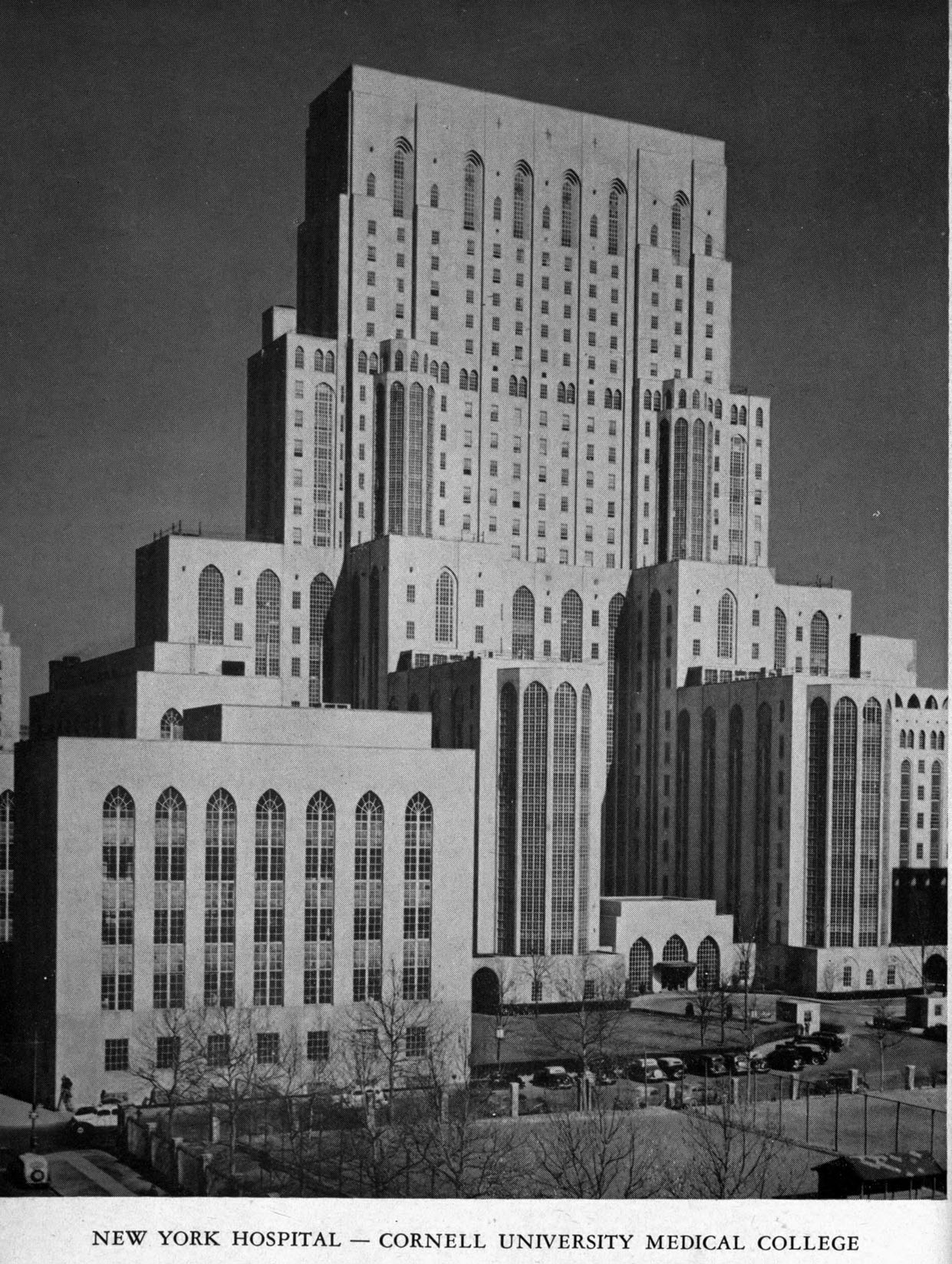
Covering the three blocks (ten and a half acres) between Sixty-eighth and Seventy-first Streets, York and Marie Curie Avenues, the glazed whitebrick buildings of the NEW YORK HOSPITAL AND THE CORNELL UNIVERSITY MEDICAL COLLEGE form one of Manhattan's most striking architectural groups. (Guide service available to visitors Monday, Wednesday, and Friday 2 to 3:30 p.m.; Tuesday and Thursday to 3:15 p.m.)
For the design, the architects, Coolidge, Shepley, Bulfinch, and Abbott, of Boston, received the 1933 gold medal of the New York Architectural League. The fifteen buildings, which cost more than thirty million dollars, are so placed and subordinated to the main tower that they give the effect of a single vast structure. At first glance the mass of this powerful group is reminiscent of the Palace of the Popes at Avignon.
Pointed arch windows that rise to the full height of the eight-story pavilions flanking the main entrance establish a Gothic motif ; yet actually the group is an outstanding example of modern architecture, for its beauty grows out of its functional organization and the aesthetic counterplay of its parts.
In contrast to the Columbia Presbyterian Medical Center, the windows here are skillfully used to express the function of each division of the hospital. The interior lacks the forbidding features associated with older hospitals and is, instead, filled with sunshine and decorated in color.
The second to the ninth floors are given over to pavilions patterned after the wards in the Royal Hospital in Copenhagen. The largest pavilions have no more than sixteen beds and even these are divided into four-bed sections by glass partitions. Each pavilion has a spacious lounge overlooking the East River with Vitaglass windows on three sides.
The adjoining buildings house the Women's Clinic (which includes the Lying-in Hospital), the Children's Clinic, the Psychiatric Clinic, the Out-Patient Building, Cornell University Medical College, staff quarters, a 250-car garage, and a nurses' residence with a capacity of five hundred. The Lying-in Hospital, now the maternity division of the New York Hospital, was organized in 1789 following an epidemic of yellow fever that brought the plight of widowed expectant mothers to the public attention.
After many vicissitudes, in 1892 the hospital society joined forces with a Midwifery Dispensary serving the tenements. Through the interest of J. P. Morgan, the society acquired its own hospital in 1899 in the Stuyvesant Square neighborhood, which it occupied until the move uptown was made.
This newest of Manhattan's medical centers (completed in 1932) shelters the city's oldest hospital. In 1769 Dr. Samuel Bard of King's College (now Columbia University) pleaded for "an hospital for the sick poor of the colony," which incidentally would serve as a medical training school. King George III granted the charter in 1771.
While anatomical instruction was given during the early years and the building was used as an army hospital during the Revolution, the hospital was not opened for civilian service until 1791.
Many prominent men have served as governors of the institution. Among them have been John Watts, John Jay, Robert Livingston, Philip Hone, Aaron Burr, Lindley Murray, John Jacob Astor, Joseph H. Choate, and Isaac Roosevelt.
Cornell University Medical College, founded in 1898, first occupied a building at Twenty-eighth Street and First Avenue. After 1912 the college co-operated with the New York Hospital, and in 1927 the New York Hospital-Cornell Medical College Association was formed. At that time both institutions obtained additional funds, including a gift of more than twenty million dollars from Payne Whitney, two million dollars each from J. Pierpont Morgan and the Laura Spelman Rockefeller Memorial, and one million dollars each from George F. Baker and George F. Baker, Jr.
The hospital, with eleven hundred beds, is one of the largest in the city; the college is one of the smallest in number of students. Both exemplify the highest standards of the medical profession.
The New York Hospital annually treats more than twenty thousand bed-patients and more than forty thousand out-patients, accepting, as it has since 1791, "patients who need its help, without regard to race, creed, or ability to pay." Sixty-five per cent are pavilion patients. Modern equipment and a distinguished medical staff have given the hospital one of the lowest surgical mortality rates in the country.
Unlike many general hospitals, the New York Hospital has always treated mental disorders. As early as 1821 Bloomingdale Asylum was established by the hospital on the site of the present library of Columbia University. It moved to White Plains in 1894 and is now known as the New York Hospital Westchester Division. The Payne Whitney Clinic, an important unit of the center itself, treats only psychiatric cases.
Public interest in the hospital found expression in an unusual way in 1938 when more than one hundred anonymous donors of all denominations contributed a total of one thousand dollars for the removal of swastika designs from the 325-foot chimney. The ancient symbol that had been given a new significance by Chancellor Hitler's rise to power in Germany was replaced by Greek crosses.
Point of interest from New York City Guide (1939), shown as printed.