Jamaica Bay Islands
Broad Channel, Queens· Approximate: located to the area, not the building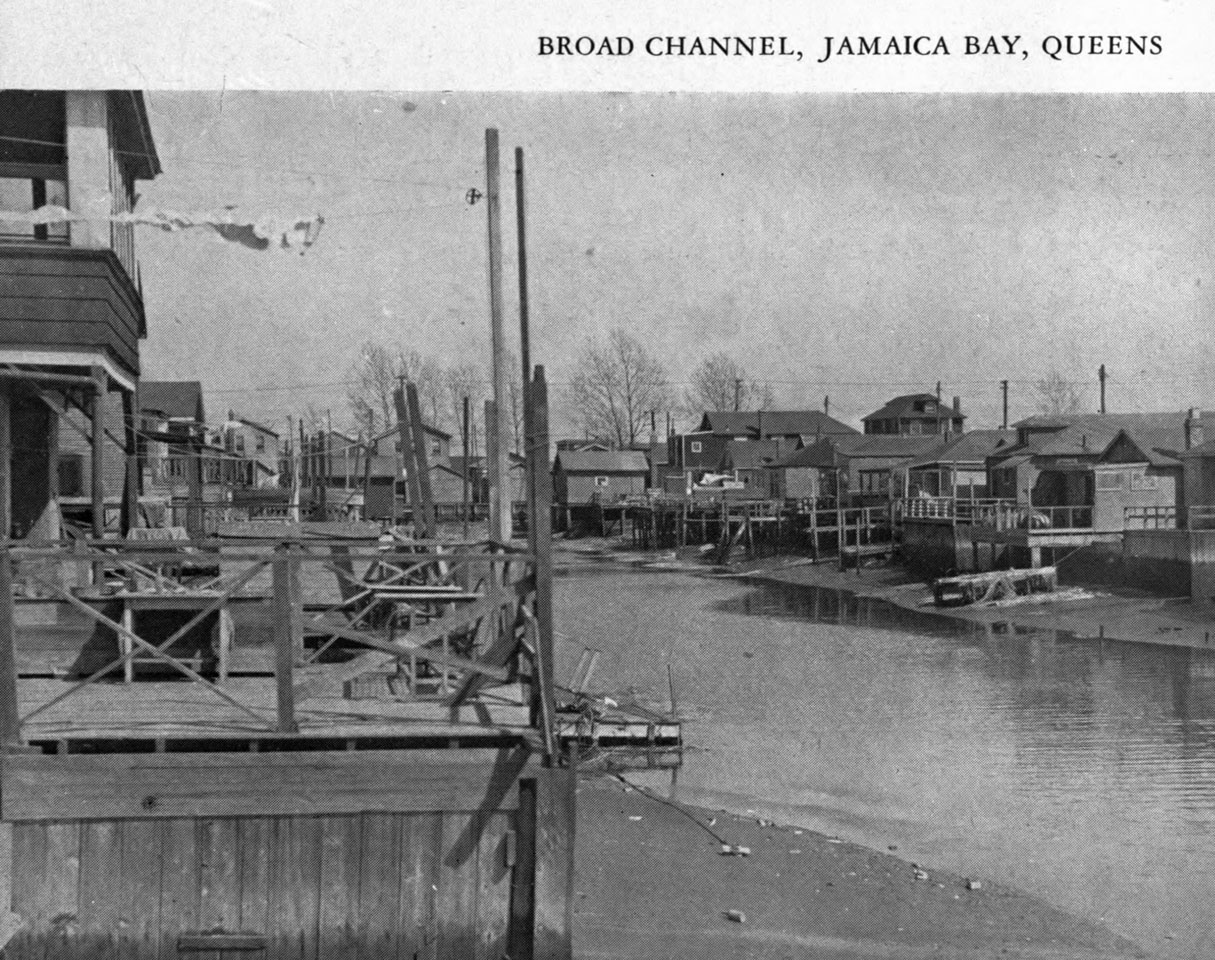 The JAMAICA BAY ISLANDS, sprawled among the twenty square miles of shallow Jamaica Bay, are marshy flats on which about four thousand people dwell in comparative isolation within the corporate limits of New York City. All but two per cent live on Broad Channel island; the remainder are scattered over the Raunt and other tiny islands.
Cross Bay Boulevard and the Long Island Railroad connect the region with the mainland and the Rockaways. Most of the children travel by bus, provided by the Board of Education, to school in the Rockaways.
The few islands that are above high tide were not permanently settled until about 1880, when a fishing village was established on Big Egg Marsh (now known as Broad Channel). Here, before the city's open sewers contaminated Jamaica Bay, fluke, flounder, weakfish, oysters, and clams were abundant.
Modernization of Broad Channel began in 1915, when a drive was started to make Jamaica Bay a great port, and a Mr. Henry A. Meyer and fellow enthusiasts chartered a ship and toured Europe, advertising Jamaica Harbor. Nothing came of this venture and in the meantime Pierre Noel, a realtor, organized the Broad Channel Corporation which leased land from the city for thirty years. Lots were sublet, streets laid out, and electric and water plants built.
When Prohibition came, the island was nicknamed "Little Cuba." Yacht clubs and night clubs opened, and rum running was widespread. A relic of that gay period is the abandoned Enterprise Hotel, a house on stilts, reached with difficulty by climbing a fence and treading a catwalk.
In 1925 Cross Bay Boulevard was built, beaches were developed, and a business district sprang up. At present a great many people stop at Broad Channel in the summer, and fish, mostly with improvised lines, from the two bridges at either end of the island. On the eastern side the shore dips and curves; here the cottages are whitewashed and trim. In other sections long rows of ramshackle buildings lean over the water on their uncertain stilts.
Poverty and decay marks the dirt streets and battered houses whose gardens are decorated with mounds of bleached shells. Men in sailor caps and dungarees tinker with boats, and housewives may be seen working over kerosene stoves. The sea has played many pranks with Broad Channel. Hard northeasters have bashed in fishermen's huts and sent roofs spinning into the bay.
The Raunt, in the middle of the bay, contains only a few dozen jerrybuilt shacks, and the driver of the bus that crosses the bay will stop at this desolate island only upon request. A new wooden footbridge spans the channel between the boulevard and the Raunt. The houses with their crazy catwalks stand above the mud. There is no gas or fresh water. Large tanks used to catch rain water are to be seen everywhere. When the supply runs low, the inhabitants row over to Broad Channel and borrow some.
Feeble attempts at gardening are evident in many places where platforms are raised on stilts and filled with pale gray soil. To be assured of absolute privacy, the colonists only need to pull in the gangplanks which rest like drawbridges on the common duckboard walk.
Beyond the Raunt are many lonely and forbidding islands, some spotted with frail shacks inhabited by such characters as Old Doc. This veteran of the Boer War is sovereign of his island ; he stomps about on his peg leg like a character out of Treasure Island. Visitors are barred by a pack of wolfish dogs. Occasionally, Old Doc rows into Broad Channel for victuals or a chat with cronies.
Point of interest from New York City Guide (1939), shown as printed.