Conference or Billopp House
Billop House, 7455 Hylan Blvd, Staten Island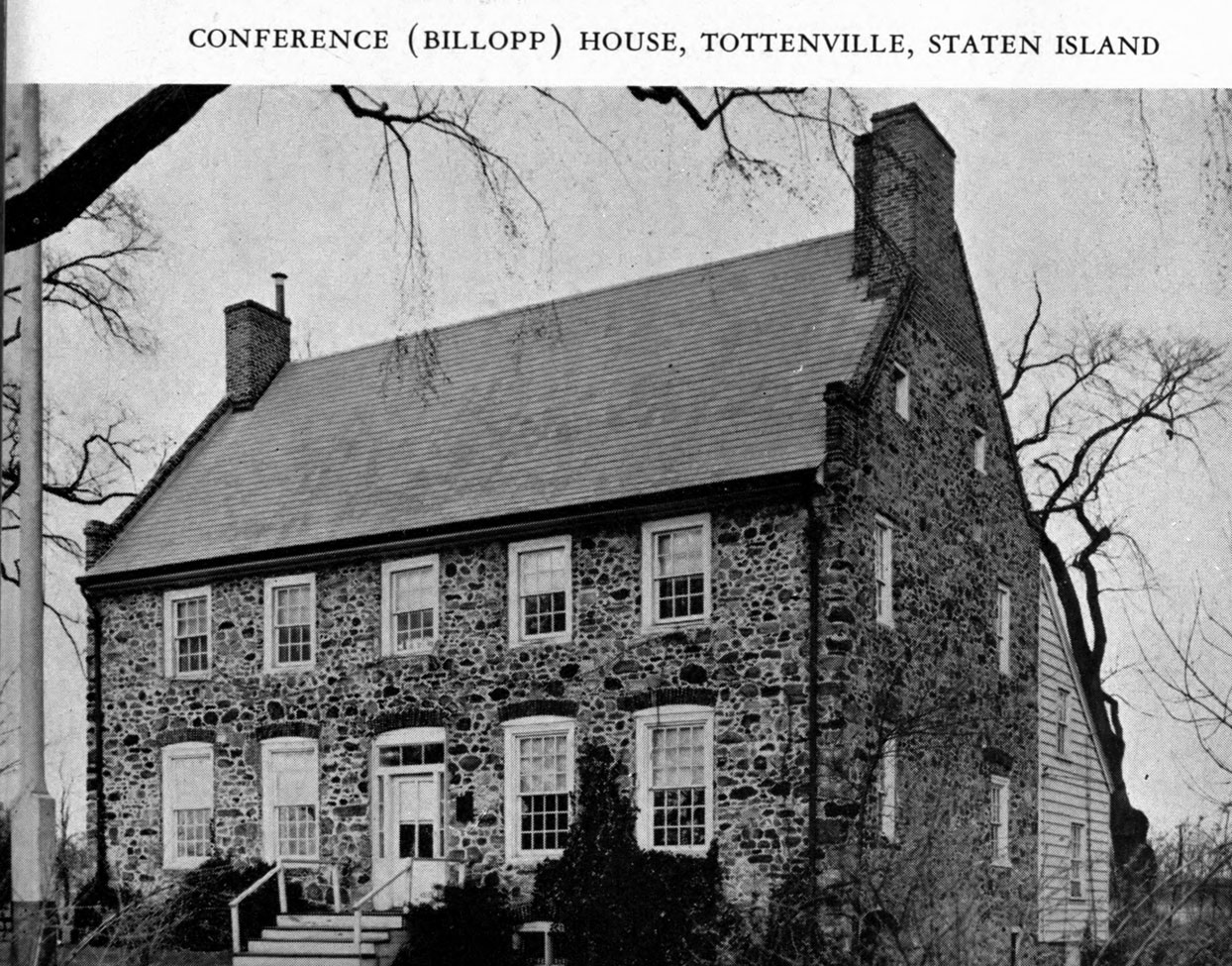
The CONFERENCE OR BILLOPP HOUSE, at the foot of Hylan Boulevard, was the scene of important but futile peace negotiations after the Battle of Long Island. (Open daily, except Monday, 10 a.m. to 6 p.m. May to October; 10 a.m. to 5 p.m. November to April; admission free.)
At the request of Lord Howe, the British admiral, the Continental Congress appointed a delegation of three Benjamin Franklin (a friend of Lord Howe), John Adams, and Edward Rutledge to meet with him on September 11, 1776. The discussion proved fruitless, for the Americans refused to barter for peace unless the British granted independence to the colonies.
The delegation returned to Perth Amboy aboard Howe's barge. As the boat entered the wharf Franklin offered some gold and silver coins to the sailors but the commanding officer intervened. "As these people are under the impression that we have not a farthing of hard money in the country," Franklin later explained to his companions, "I thought I would convince them of their mistake. I knew at the same time that I risked nothing by an offer, which their regulation and discipline would not permit them to accept." The group then traveled to Philadelphia, where its report was submitted to Congress.
The land on which the house stands was included in a patent of 932 acres granted in 1676 to Christopher Billopp, a British Navy captain who two years earlier had come to America with Governor Andros. In 1687 Thomas Dongan, Andros' successor, granted the patent and an additional 668 acres to Captain Billopp as the manor of Bentley.
The house, built by Billopp prior to 1688, was for many years the island's most imposing mansion. The property was inherited by Thomas Farmar, Jr., third son of the captain's daughter, Anne. Under the terms of the will the heir assumed the name of Thomas Billopp. Christopher, Thomas' eldest son, became the next proprietor of the estate. A Tory colonel, he frequently entertained British officers, including Lord Howe, and his house was kept under constant surveillance by the Americans entrenched on the New Jersey shores of the near-by Arthur Kill. At the time of the historic meeting redcoats were quartered in the mansion. Colonel Billopp died in 1827.
The house, subsequently used as a factory, fell into neglect. Many efforts were made to restore it, but none was successful until 1925, when the Conference House Association was organized. The real-estate company that had acquired the property deeded the house and an acre of land to the city in 1926; three years later the Municipal Assembly made the association custodian of the building.
With the exception of a pillared two-story porch which was not replaced, the structure has been restored to its original condition. Two stories and an attic in height, it has exterior walls of local stone. The basement kitchen has been repaired with glazed brick (made in Holland) to simulate the original flooring; at one end of the room is a massive fireplace ; at the opposite, an arched brick vault that was used as a wine cellar. The beams in the Conference Room (left of the entrance), like those in the kitchen, attic, and other parts of the house, are the handhewn originals. The laths, split by hand, are fastened to the beams by hand-made wrought-iron nails.
The interior has been appointed with pieces associated with the Colonial period. The D.A.R. and Philemon rooms on the first floor are noteworthy, as well as the Colonial chamber and the room set aside for a Benjamin Franklin National Museum on the second floor. The restoration was under the immediate supervision of Chester A. Cole.
Point of interest from New York City Guide (1939), shown as printed.