Subways and Els
New York's subway and elevated lines carry about two billion passengers a year over a 281 -mile network of main and branch lines in Manhattan, Brooklyn, Queens, and the Bronx (see subway and el map in pocket). The gaunt trestle-work of the els brings twilight to miles of streets, the tunnels of the subways honeycomb rocks and rivers and skyscrapers. Their trains are the first things a good many New Yorkers observe in the morning and the last things a good many more remember at night.
Subways
About 5,500,000 passengers are carried daily by the three subway systems. Tens of thousands more ride the Hudson Tubes (Hudson and Manhattan Railroad) connecting New Jersey and Manhattan. The bulk of this traffic is borne between eight and nine in the morning and five and six in the evening when the crowd of workers moves to and from the business centers of Manhattan.
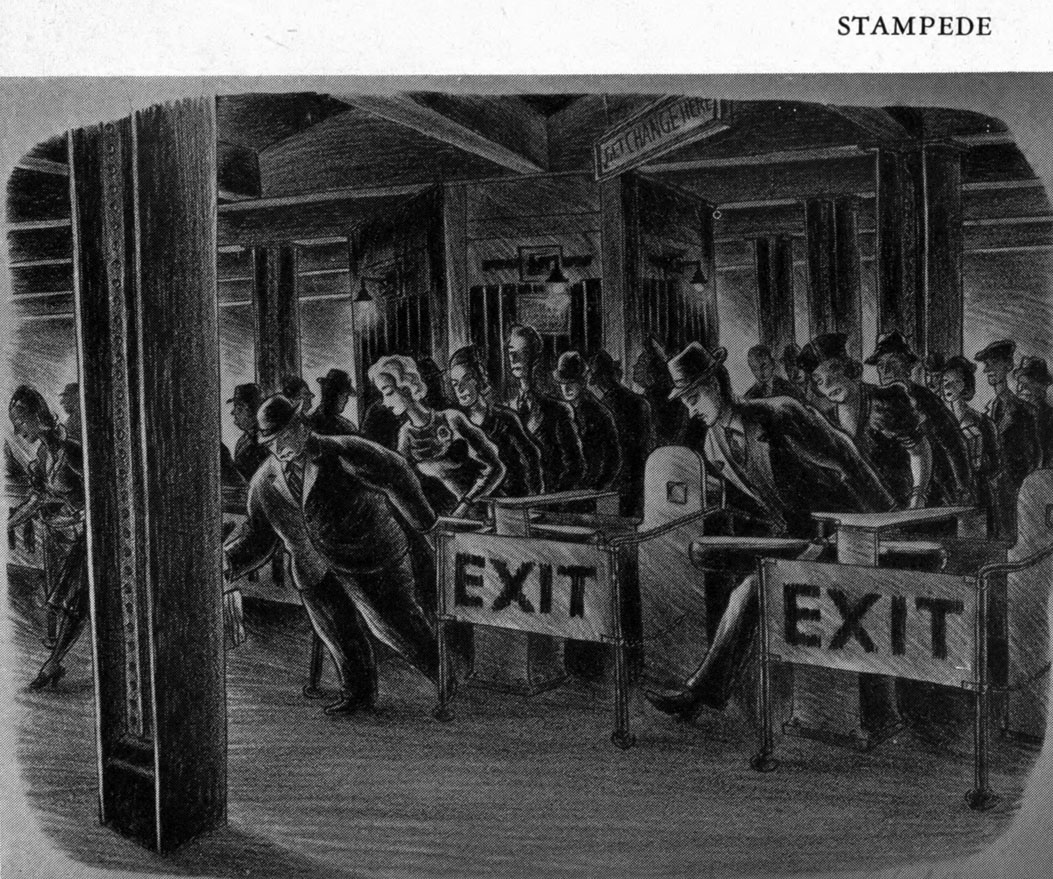
Typical of mid-town and lower Manhattan's rush-hour is the morning crush at IRT's station at Grand Central. While a crowd of commuters just arrived from the suburbs over New York Central and New Haven trains is storming the turnstiles on its way to downtown offices, a greater crowd from the city is pushing the stiles in the other direction, bound for work in the Grand Central district. These intent and humorless hordes cover uptown and downtown platforms, choke narrow stairways, swamp change-booths, wrestle with closing train doors. Crowds well up from the Queens trains on the lower subway level by way of elevators, escalators, stairways, and graded corridors. Nickels jingle, signal bells clang, turnstiles bang until the faint thunder of footsteps on the wooden passageway connecting the Lexington Avenue lines with the Times Square-Grand Central shuttle sounds human and restful. And through it all trains arrive and depart, delivering and removing crowds, lifting gum-papers and clouds of dust, and jarring the sidewalks, buildings, and windows of the city above.
Beneath the sidewalks of New York the subways have created a second city. Some of the thoroughfares between the turnstiles and the streets have lunch counters, barbershops, shoeshine stands, florist shops, phone booths. Through the use of these facilities the New Yorker could live a rather rounded life without once venturing into the street. He could, for example, stay at the Commodore Hotel, transact business in the Chrysler Building, dine at the Cafe Savarin, shop at Bloomingdale's, swim in the indoor pool at the Hotel St. George in Brooklyn, see a movie at the Rialto Theatre and, if romance came his way, marry at the Municipal Building. A few of the homeless use the subway as a flophouse and during the worst winters of the 1930's large numbers of unemployed lived here for days.
The three subway systems represent a total investment of $1,650,000,000, more than half of which has come from the city treasury. These systems are the Interborough Rapid Transit (IRT), Brooklyn-Manhattan Transit (BMT), and Eighth Avenue (Independent). The IRT (station entrances marked by blue lamps) has two major trunk lines: BroadwaySeventh Avenue line, which runs under Manhattan's West Side; Lexington Avenue line, which runs under the East Side. These lines are connected in the mid-town area by a shuttle service under Forty-second Street between Times Square and Grand Central Terminal. Another main trunk line known as the Queens line originates at Times Square and runs east under Forty-second Street and the East River to Long Island City where it forks one branch extending north through Astoria and another northeast to Flushing. Branches of the two major trunks also serve Brooklyn and the Bronx. The BMT (green and white lamps) was originally built to connect distant parts of Brooklyn with lower Manhattan, but now runs as far north as Sixtieth Street and the East River in Manhattan, and also extends into Queens. The Eighth Avenue (Independent) subway system (green lamps), the most modern of the subways, serves the West Side and Lower East Side of Manhattan and runs into Brooklyn, Queens, and the West Bronx. Owned and operated by the city of New York, and one of the largest ventures in public ownership and control in the world, the Independent cost more than seven hundred million dollars.
London witnessed the operation of an underground railway in 1853. Seventeen years later, in New York, a pneumatic-driven railroad car made a trial run in a one-block tunnel extending under Broadway from Warren to Murray Street. With this demonstration as proof of the practicability of subways, E. A. Beach, the promoter, sought permission from the city to construct a line from lower Broadway to the Bronx. While the citizens were solidly behind the plan, petitioning public officials and even marching in a torchlight parade to emphasize their support, Beach had to contend with the skepticism of Broadway property owners, and the venture failed. When plans for the first IRT line (from City Hall to West 145th Street) were announced in 1900, Russell Sage remarked: "New York people will never go into a hole in the ground to ride . . . Preposterous!"
In 1904 the first line was opened running from Brooklyn Bridge north to Grand Central Station, then west under Forty-second Street to Times Square by what is now the Times Square-Grand Central shuttle and from that point north under Broadway to i45th Street. Extensions into the Bronx and Brooklyn by way of tunnels under the Harlem and East rivers were made in the following four years. Construction then lapsed until 1913, but between that year and 1931 the BMT and the present additional lines of the IRT were built and opened. In 1932, after seven years of digging, the Eighth Avenue (Independent) trunk line began operation, and extensions were completed in 1933, 1936, and 1937. At present (1939) additional extensions are being made in Brooklyn and the city is building the Sixth Avenue (Independent) subway line in Manhattan at a cost of $57,000,000. To drive a tunnel through the earth below the intersection of Sixth Avenue and Thirty-fourth Street, engineers constructing the Sixth Avenue Line had to solve the complex problem of how to avoid disturbing the already existing tunnels of the BMT, the Hudson Tubes, and the Pennsylvania Railroad and the underpinning of the Sixth Avenue elevated structure.
With the exception of a few attractive stations, the subways are drab and noisy. Proposals that WPA artists and sculptors decorate the walls of the city-owned stations have been considered. Meanwhile, the romance of the subways of New York may be found in their trajectories, and in the intricacy of their construction and operation.
Elevated Railways
In 1868 when Charles T. Harvey demonstrated a cable-operated elevated train, New Yorkers were confident that the train would plunge into the street below. The trial was a success and subsequent additions to the original half-mile of elevated track from the Battery to Dey Street on Greenwich Street extended the line to West Thirtieth Street.
The trains were undependable: they frequently jammed between stations, compelling nervous passengers to descend to the street by way of hastily erected ladders. Steam locomotives were installed, but their advantages of speed and efficiency were offset by the tons of soot and cinders they poured into streets below, ruining derbies and Prince Alberts, and spoiling the wet wash of housewives, who hurled invective and bricks at the luckless engineers. In 1871, the original company was liquidated.
New companies were formed, and in 1875 the city authorized the construction of the Second, Third, Sixth, and Ninth Avenue elevated lines in Manhattan. Subsequently, el lines were built in Brooklyn and Queens, and electrification, introduced in 1902, aided the practicability of elevated travel.
The antiquated wooden coaches of the els daily carry approximately nine hundred thousand passengers. Owned and operated by IRT and BMT, the els reach into Manhattan, Brooklyn, Queens, and the Bronx. The IRT arteries begin at South Ferry, proceeding northward in parallel routes in Manhattan, then branching into Queens and the Bronx. The BMT lines sprawl across the length and breadth of Brooklyn, and also extend into Queens.
Despite the prevalent idea that "the subway yawns the quickest promise home," the speed of the el is substantially the same as that of the subway. But the el's advantage lies in its rambling trajectory, replete with images of New York which the subway journey (except in brief aerial excursions) lacks. From the vantage point of a window seat, one surveys the slums of Harlem, Ninth Avenue, and the East Side; middle-class Tudor City, Chinatown, and the Bowery; the German and Bohemian quarters of Yorkville ; the Wall Street district ; the flat suburban reaches of Brooklyn ; the hilly jumble of the Bronx; and the quiet tree-shaded streets of Queens. Dingy sweatshops, flophouses, dramatic family groups pass in succession. So, too, do scenes of great beauty: skyscrapers at dusk, glittering rivers, dwindling streets.
Because of the unsightliness of the el structures and the lowered realestate values of streets through which the els run, proposals have been made to abandon the el systems. A major step toward this end was taken in 1938-9 when the city purchased the Sixth Avenue el and razed the el structure. Among the sentimental memories associated with this means of travel will be the station houses, frame structures peaked and gabled in the architectural mode of the Victorian era, heated in winter by big potbellied coal stoves. Meanwhile, the el trains continue to rumble up and down New York.
Transit Safety
The maintenance of this vast transportation network requires an organization of unprecedented scope and perfection. Engineers, trackmen, motormen, conductors, dispatchers, mechanics, porters, change-makers, and platform guards more than 27,000 employees are all part of the unified scheme. Behind the scenes work those responsible for fundamental transit operations. And still more anonymous, and more numerous, are the inanimate servants: signal and safety devices, checks, trippers, and switches.
The New York subway lines are said to be the safest railroads in the world; the els have an almost equally good record. The IRT, for example, has made this security possible by the operation of fifty-six types of safety devices, as well as by regular inspection of track and equipment, and physical examination of motormen. Should a motorman fail to observe the red stop signal, an automatic tripper would instantly halt the train; should he become ill or die, the second his hand falls from the controller the "dead man's button" stops the train.
Accidents, however, have occurred in the rapid transit systems. In 1929, two Ninth Avenue el trains collided at 110th Street and Eighth Avenue about fifty-five feet above street level killing one passenger. Seventeen persons were fatally injured in 1928 when a crowded subway train smashed into a retaining wall just south of Times Square station. But most accidents are of trifling extent, and involve nothing more than the loss of time. Suicides, too, may upset the routine of subway and elevated commerce, but their number is small.
Minor adventures are not infrequent. Strangers get lost in the maze of stations and transit lines, although maps are conspicuously posted in cars and on platforms, and New Yorkers vouchsafe information (at times somewhat incomprehensibly). A small boy, avid for adventure, may set out on a journey to the Bad Lands, and arrive at New Lots Avenue, Brooklyn (which is not bad at all). Or a honeymooning couple, visiting the big town, may be swept apart by the rush of crowds and, as once reported, spend several hours of horrible anxiety before being reunited by the police.
Greater drama resides in the endless flow of activity that crowds the cars and platforms. Beggars, singers, banjo-players, and candy-butchers vie for a few pennies, howl bargains, or stumble silently past the apathetic passengers. Occasionally, a particularly bright singing troupe or an unusually pathetic cripple will meet with warm response. At large stations, pitchmen attract crowds with infinite ease, and disappear before the greenhorn realizes he has been duped.
The five-cent fare a recurring issue in municipal politics is not likely to be increased in the immediate or distant future. The New Yorker is extremely sensitive on this point.
Essay from New York City Guide (1939), shown as printed.