Negro Harlem
 Area: W. 110th, 120th, and E. 125th Sts. on the south to 155th St. on the north; from Morningside Ave. and St. Nicholas Ave. (125th to 155th St.) east to Lenox Ave. (110th to 120th St.), Madison Ave. (120th to 125th St.), and the Harlem River. Map on page 255.
Negro Harlem, into which are crowded more than a quarter of a million Negroes from southern states, the West Indies, and Africa, has many different aspects. To whites seeking amusement, it is an exuberant, original, and unconventional entertainment center; to Negro college graduates it is an opportunity to practice a profession among their own people; to those aspiring to racial leadership it is a domain where they may advocate their theories unmolested; to artists, writers, and sociologists it is a mine of rich material; to the mass of Negro people it is the spiritual capital of Black America.
Negroes began to move into Harlem in 1901 as a result of a deflated boom in real estate there. Because of the lack of adequate transportation facilities, fine apartments erected by speculative real-estate promoters were left tenantless. A Negro agent, Philip A. Payton, persuaded landlords to accept Negro tenants, and hundreds of families soon deserted old tenements in the crowded West Fifty-third Street and San Juan Hill (west of Columbus Circle) sections and poured into Harlem. Their infiltration was at first bitterly resisted by white tenants, landlords, and bankers.
During the World War Negroes from the South, from the British West Indies, and even from the neighboring Spanish- and French-speaking islands flocked to the North spurred by promises of highly paid industrial jobs. By 1919 the Negro population of Harlem had quadrupled. Race riots in southern cities in the postwar period caused a further large migration to the North. Though they did not succeed in escaping economic insecurity and race discrimination, the Negroes were able to build within the metropolis a city of their own, a cosmopolitan Negro capital which exerts an influence over Negroes everywhere.
Although the community possesses fine residences and wealthy churches, wide boulevards, theaters, hotels, and cafes, its dreadful slums are among the most notorious in New York. Barred from most residential areas in the city, Negroes pay rents 50 per cent higher than those charged for comparable living quarters elsewhere.
Under these circumstances social and health conditions are, of course, extremely poor. In 1934 a survey of Negro Harlem showed that among twenty thousand persons chiefly from the relief rolls, 3 per cent suffered from pulmonary tuberculosis. One block in particular, from Lenox to Seventh Avenue between 142d and 143d Streets, was referred to because of its congestion as the "lung block," the rate of death from tuberculosis being twice that of white Manhattan. Maternal and infant mortality rates are more than double those of the city. A mayor's commission appointed to study the causes of a riot there in 1935 revealed that tuberculosis and other diseases were widespread, and that medical and clinical care were dangerously inadequate.
Those who live in Harlem know it as a number of little worlds, represented by such titles as the "Valley," the "Golden Edge," "Sugar Hill," and the "Market." Each is descriptive of a different stratum of the community. The Valley is the slum area, extending from 130th to 140th Street, east of Seventh Avenue. Apartments along the Golden Edge, the part of the neighborhood facing Central Park, house the professional class. On Sugar Hill, the affluent live in dignity and comparative splendor. The Market is the name given with ironic accuracy to the stretch from noth to 115th Street on Seventh Avenue, which is frequented by streetwalkers. Sharp divisions exist between the dwellers in these various sections.
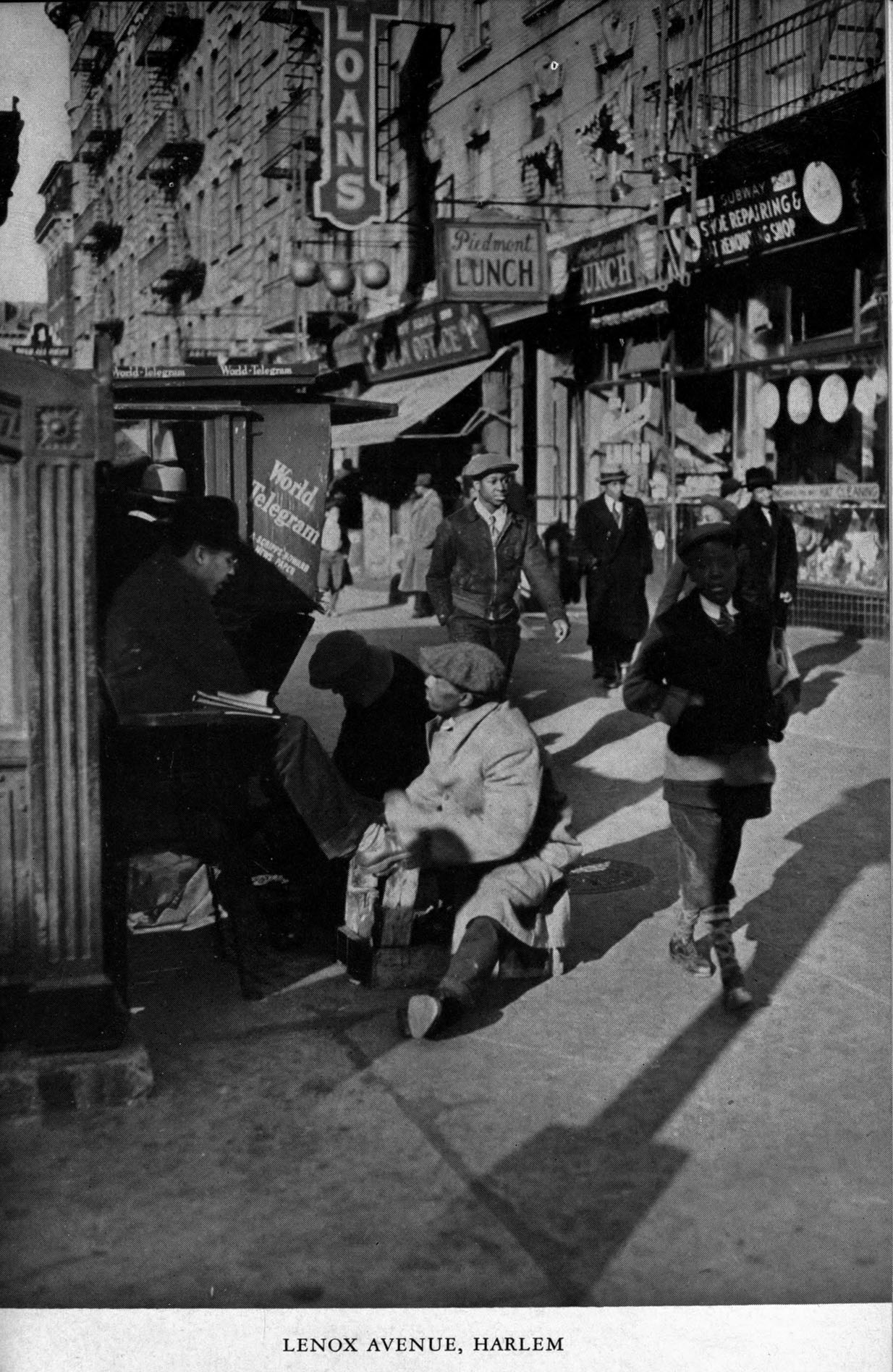
Two main thoroughfares cut through the district. Seventh Avenue, Harlem's widest street, with islands in its center, runs from West noth to West 155th Street, and is one of the chief bus routes through Harlem and to Washington Heights. This avenue is lined with apartment houses, retail stores, beauty parlors, restaurants, and corner saloons. Lenox Avenue, a block to the east, is generally regarded as Harlem's principal boulevard. It is a wide, shabby avenue, flanked by cheap shops, bars, lunchrooms, pool parlors, and "gin mills." Peculiar to the avenue are the mobile lunch-stands which appear in the afternoon and early evening. These are usually operated by elderly men and women, and serve popcorn, baked sweet potatoes, peanuts, jam, sausages, and other popular tidbits. Most of these carts are old and rickety and the food is heated over kerosene lamps.
One Hundred and Twenty-fifth Street, a key crosstown traffic artery leading directly to the entrance of the Triborough Bridge (see page 390) at Second Avenue, is Harlem's chief business thoroughfare. Although Negroes live along the streets north and south of it, West 125th Street is not predominantly a Negro center; white residents of Morningside Heights and Manhattanville have used it as a shopping center for years. Two 125th Street hotels the THERESA, at Seventh Avenue, and the TRI-BORO, at Fifth Avenue still have white managements and clienteles. From Third Avenue to St. Nicholas Avenue are many stores, movie houses, real-estate offices, banks, and eating places, the overwhelming majority being owned and operated by whites. That no Negroes were employed in these businesses was always resented by Harlemites, who are the majority of customers. In 1935 an incident in one of these shops developed into a riot of alarming proportions. In recent years picketing and pressure by labor unions and citizens' groups have compelled the larger 125th Street stores to employ Negro help.
In Negro Harlem
- Tree of Hope7th Ave & W 131st St, New York
- New York Public Library Branch103 W 135th St, New York
- NAACP224 W 135th St, New York
- New York Urban League202 W 136th St, New York
- 369th Regiment Infantry Armory5th Ave & W 143rd St, New York
- Abyssinian Baptist Church132 W 138th St, New York
- Apollo Theatre253 W 125th St, New York
- Beale Street7th Ave & W 133rd St, New York
- Central Harlem Health Center5th Ave & W 136th St, New York
- Commandment Keepers' Congregation87 W 128th St, New York
- Finnish Hall13 W 126th St, New York
- Gathering PlaceLenox Ave & W 135th St, New York
- Harlem Branch of the YMCA180 W 135th St, New York
- Harlem Community Art Center290 Lenox Ave, New York
- Harlem HospitalLenox Ave & W 136th St, New York
- Harlem River HousesHarlem River Houses, New York
- Kingdom of Father Divine152 W 126th St, New York
- Kings Chapel Pentecostal Assembly2143 5th Ave, New York
- Lafayette Theater7th Ave & W 131st St, New York
- Little Gray Shop2465 7th Ave, New York
- Metropolitan Baptist Church151 W 128th St, New York
- Monterey2339 7th Ave, New York
- New York Age230 W 135th St, New York
- Paul Laurence Dunbar Apartments7th Ave & W 150th St, New York
- Philip A. Payton Real-Estate OfficeLenox Ave & W 133rd St, New York
- Plantation Club644 Lenox Ave, New York
- Savoy BallroomLenox Ave & W 140th St, New York
- Small's Paradise2294 7th Ave, New York
- St. Philip's P. E. Church214 W 134th St, New York
- Strivers' Row7th Ave & W 138th St, New York
- Sugar HillW 145th St & Convent Ave, New York
- The Amsterdam News2271 7th Ave, New York
- Yeah Man2350 7th Ave, New York
Overview from New York City Guide (1939), shown as printed.