Roger Morris Park and Jumel Mansion
Edgecombe Ave & W 160th St, New York· Located to the block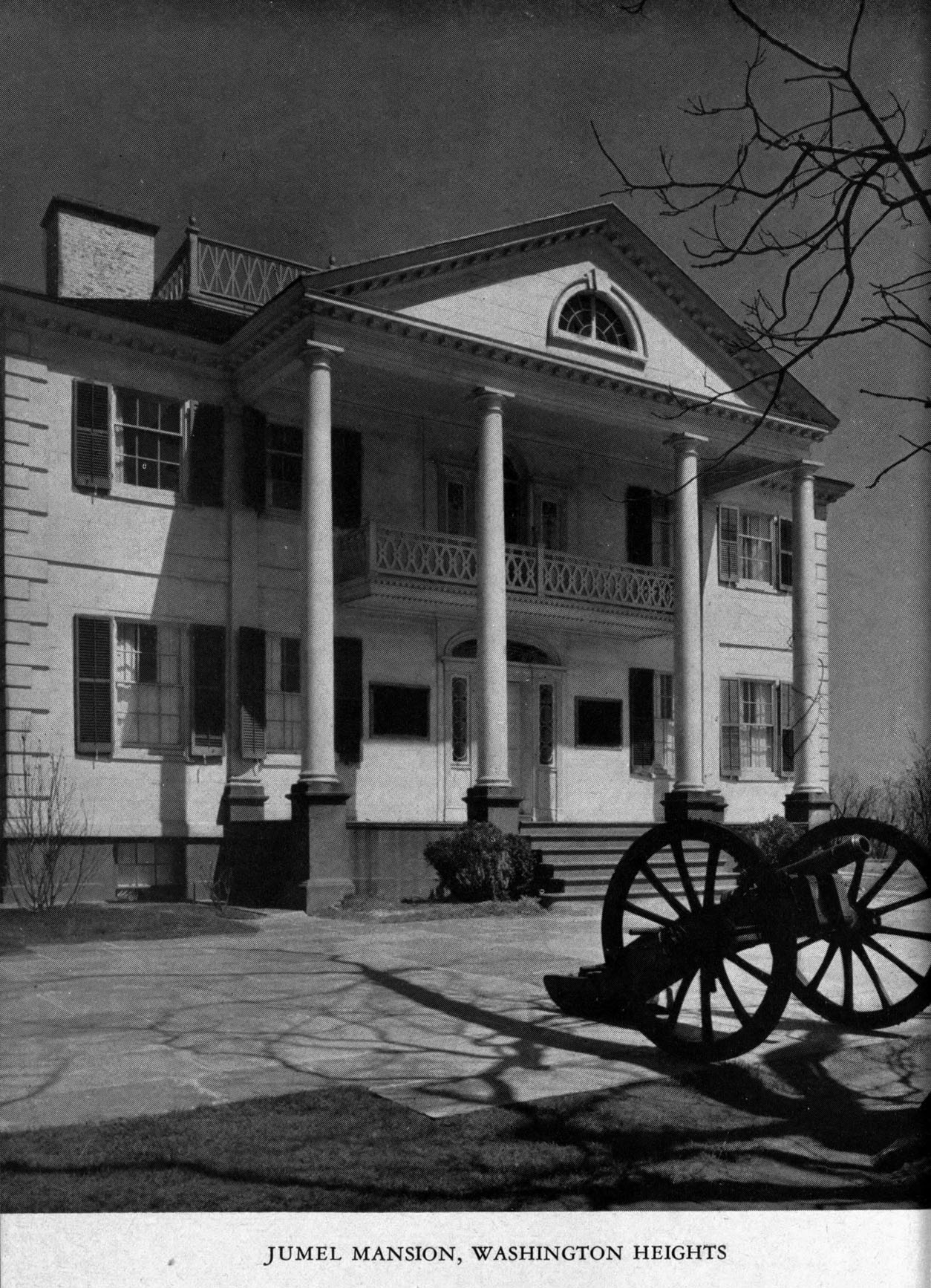 Immediately west of the Polo Grounds Edgecombe Avenue climbs the crest of Coogan's Bluff and affords a view, across the Harlem River, of Queens and the Bronx.
The vista is most sweeping from ROGER MORRIS PARK, on a rise above Edgecombe Avenue between 160th and 162d Streets. The entrance to the park is on Jumel Terrace near 160th Street.
The JUMEL MANSION--in Roger Morris Park--one of the most interesting Georgian Colonial houses in New York City, was built by Roger Morris, a Royalist sympathizer, about 1765, and occupied by him until 1775, when he left for England. His wife's name, before her marriage, was linked romantically with that of Washington.
The estate stretched from river to river with "Fishing, Oystering and Claming at either end." The house was used as headquarters successively by General Washington (September 14-October 18, 1776) and Colonel Magaw, and after the defeat of the American forces, by the British command. After 1783 the house passed through various hands, becoming a tavern in 1796.
Stephen Jumel, a wealthy French merchant, purchased the property in 1810 and restored it. In 1832 Stephen Jumel died and in the following year Aaron Burr, then almost eighty, came to live in the mansion as the husband of Madame Jumel. The marriage lasted but a year; Burr died in 1836, Madame Jumel in 1865.
The city acquired the property in 1903, and in 1907 the house was opened as a museum under the auspices of the Daughters of the American Revolution and the Washington Headquarters Association. (Open daily, except Monday, from 11 a.m. to 5 p.m.; admission free.)
The mansion is a Georgian Colonial wood structure with some details, such as corner quoins, in imitation of stone construction. A two-story portico is a feature that is rare in New York. The slim columns and the fineness of execution of the iron balcony and of the railing atop the hipped roof give an effect of unusual elegance.
An example of the economy employed by Colonial builders is revealed on the northeast side of the house, the side that was least likely to be seen by important visitors; the wall here was built of shingles, less expensive than boards. The interior is thoroughly Georgian Colonial in character.
The moldings are strong and simple in treatment, and the hallways are decorated with semielliptical archways. The furnishings preserved by Madame Jumel during her long lifetime, as well as such pieces as Aaron Burr's desk, are on display.
Sylvan Terrace, a short private street that approaches the Jumel Mansion from the west, is still lined with old frame houses.
Point of interest from New York City Guide (1939), shown as printed.