New York Police Headquarters
240 Centre St, New York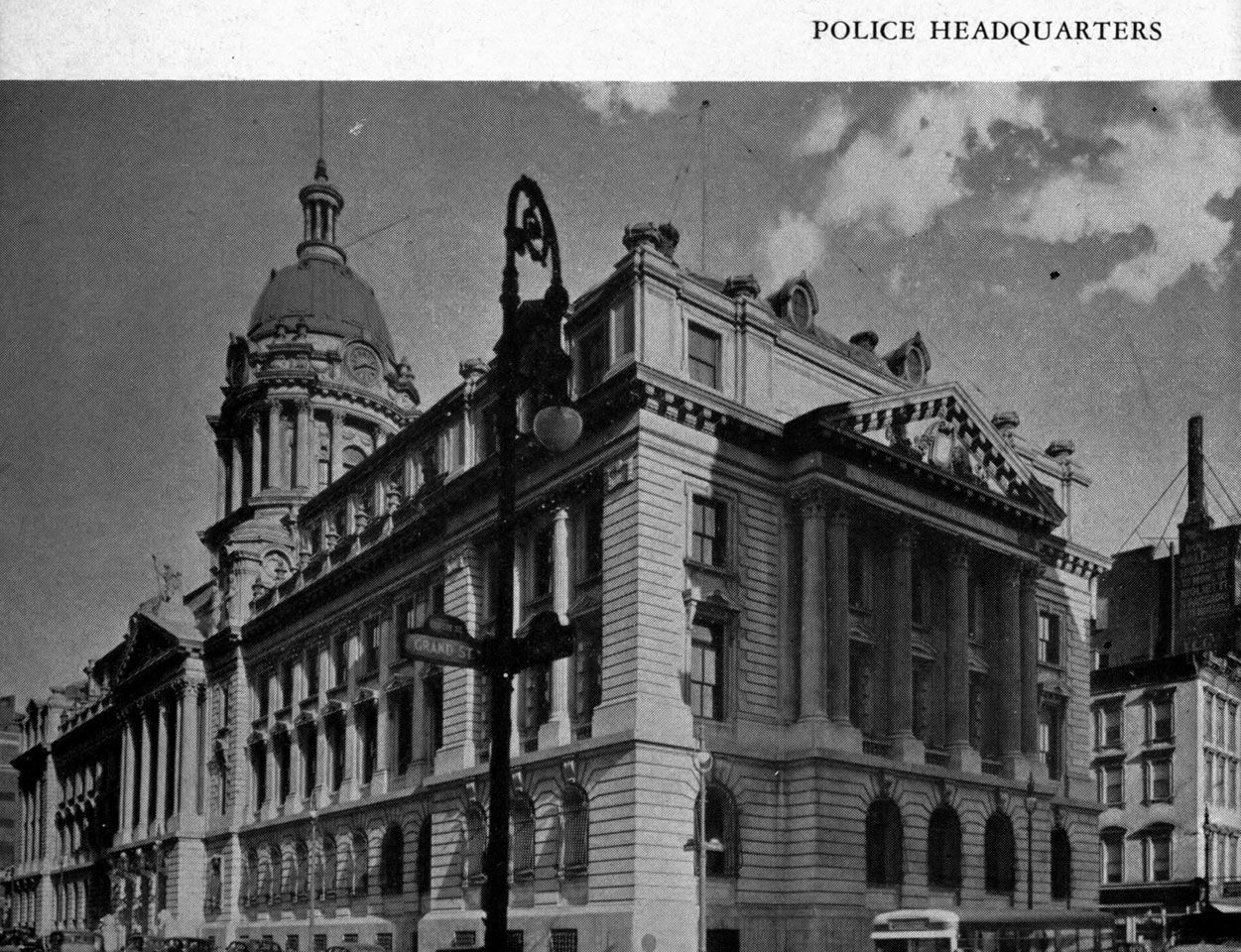
At 240 Centre Street, between Grand and Broome Streets, is NEW YORK POLICE HEADQUARTERS, a large stone building designed by architects Hoppin and Koen in the French Baroque manner of the nineteenth century. A profusion of carved ornament gives it a somewhat pretentious aspect. Until this building was completed in 1909, headquarters was at 300 Mulberry Street.
From offices on the second floor, the Police Commissioner and his deputies direct the activities of 19,346 police officers operating from eighty-three precinct houses scattered throughout the five boroughs. Detectives, patrolmen, policewomen; a great fleet of radio cars, three motorcycle divisions, twenty emergency squads, two mounted squads, thirteen traffic and two bridge traffic units, and a flotilla of launches are controlled from this building by means of an intricate system of telephone, telegraph, teletype, and radio communication. Three short-wave radio stations, WPEE, WPEF, and WPEG, provide almost instantaneous contact with all units.
The daily "line-up" of arrested criminals takes place in a large, semidarkened room on the fourth floor. Offenders parade across a brilliantly lighted stage to be questioned through a public address system, while detectives memorize their appearance and mannerisms. Criminologists from many countries come to witness the procedure. The building also houses the Traffic Division, the Surgical and Medical Bureau, the Traffic Safety Bureau, the Legal Bureau, the Missing Persons Bureau, the Headquarters Detective Division, a law library, and a disciplinary trial room.
In the Police Academy, directly across Broome Street, police specialists give elementary training to rookies and advanced instruction to veterans of the force. Also housed in this building are the Criminal Identification Bureau (fingerprints and photographs), the Technical Research Laboratory, and the offices of a number of specialized detective squads. The Bureau of Equipment is maintained on the ground floor where members of the Department may buy all kinds of police equipment, from guns, nightsticks, and "nippers," to uniform caps, shirts, and shoes.
Point of interest from New York City Guide (1939), shown as printed.