The Bowery
Delancey St & Bowery, New York· Located to the block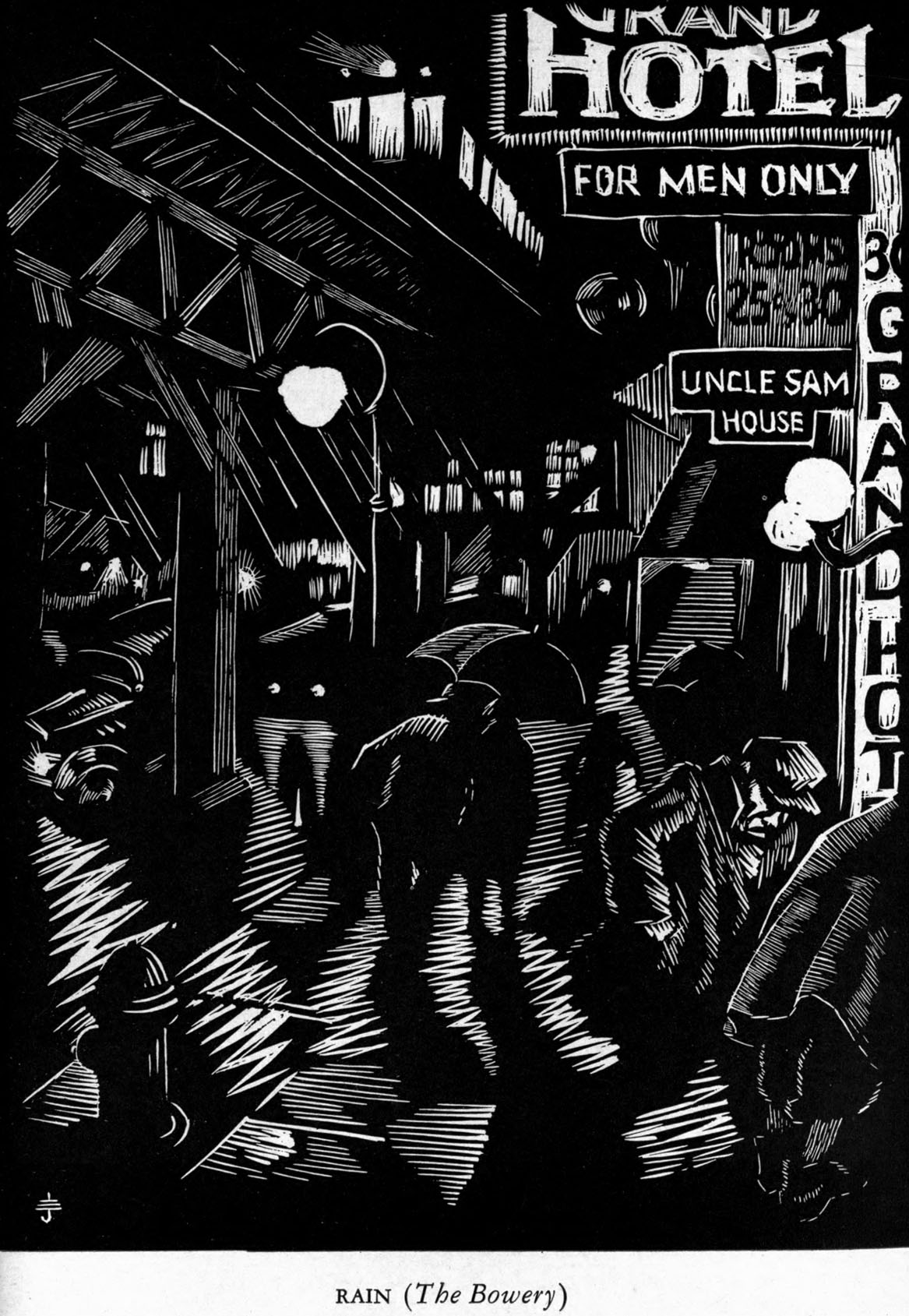
THE BOWERY, dividing line between the Jewish Quarter on the east and Little Italy on the west, was once an Indian trail used by aborigines in their expeditions against New Amsterdam. In the days of the Dutch it became known as "the road to the bouwerij (farm)," Peter Stuyvesant's country estate. The street was later part of the highroad to Boston and figured in many a Revolutionary incident as the only land entrance to New York City.
From 1860 to 1875 the city's theatrical life centered here. At the Bowery Amphitheatre (37 Bowery), the first blackface minstrel group made its appearance. At the National Theatre (104 Bowery) Frank S. Chanfrau, actor-manager, appeared with his brother in a long series of plays about Mose, the Bowery Paul Bunyan, an epic slugger, eye-gouger, and hobnail-stamper in New York's rowdy history. The legendary Big Mose was eight feet tall, with hands as big as hams. In his belt was thrust a butcher's cleaver, and in summer a keg of beer hung there for his refreshment. He loved to lift a streetcar off its track and carry it on one hand as a waiter carries a tray, the horses dangling from their harnesses; and Big Mose laughing thunderously at the terrified passengers. Another of his favorite jests was to stand in the East River, and blow back approaching vessels with a few puffs from his mighty lungs. The first stage version of Uncle Tom's Cabin appeared at the National on August 23, 1852.
Harrigan and Hart with their idealized pictures of East Side life, Weber and Fields, George M. Cohan, and Eddie Cantor are a few of the many actors who first succeeded in Bowery theaters. The Jewish theater in the United States had its beginnings here, and the well-known Eli, Eli by Jacob Sandier was first sung in a Yiddish play at the old Windsor Theatre in 1896.
After 1870 came the period of the Bowery's celebrated degeneration. Fake auction rooms, saloons specializing in five-cent whisky and knockout drops, sensational dime museums, filthy and rat-ridden stale-beer dives, together with Charles M. Hoyt's song, "The Bowery, the Bowery! . . . I'll never go there any more!" fixed it forever in the Nation's consciousness as a place of unspeakable corruption.
The Bowery today is chiefly given over to pawnshops, restaurant equipment houses, beer saloons, and miscellaneous small retail shops. Here flophouses offer a bug-infested bed in an unventilated pigeonhole for twenty-five cents a night, restaurants serve ham and eggs for ten cents, and students in barber "colleges" cut hair for fifteen cents. Thousands of the nation's unemployed drift to this section and may be seen sleeping in all-night restaurants, in doorways, and on loading platforms, furtively begging, or waiting with hopeless faces for some bread line or free lodging house to open. No agency, at present (1939), provides adequate food, shelter, and clothing for these wanderers. Missions furnish food and lodging for a few, and try by sermon and song to touch the souls of the downand-outers and the sympathies of generous tourists.
Point of interest from New York City Guide (1939), shown as printed.