Beekman Place and Sutton Place
 Area: 48th St. on south to 59th St. on north; from 1st Ave. east to East River. Map on page 193.
The small area centering around Beekman and Sutton Places offers an extreme example of New York's flair for making Mrs. O'Grady and the Colonel's Lady close if uncommunicative neighbors. Here drying winter flannels are within fishpole reach of a Wall Street tycoon's windows, and the society woman in her boudoir may be separated only by a wall from the family on relief in a cold-water flat.
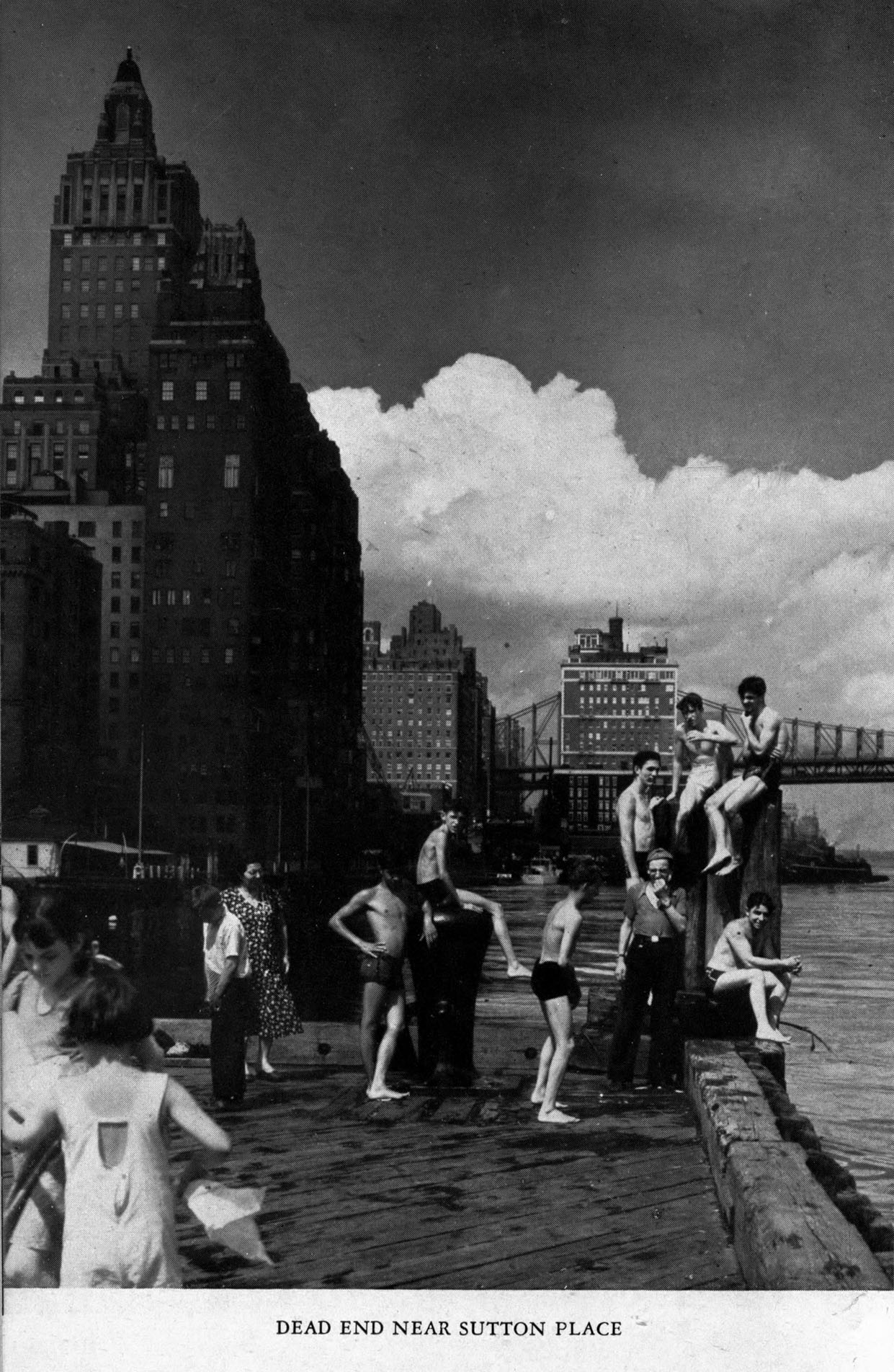
The neighborhood extends for eleven blocks along two East River bluffs grooved by dead-end streets. The narrow channel between Welfare Island and the bluff brings freighters within hailing distance. Millionaires' yachts dock close to gravel barges. Gulls skimming the surface mark the sewage outlets into the river; but from a penthouse window, at night, there is only the impressive stretch of dark water and the lights of the metropolis.
Beekman Place, which runs for two blocks along the south bluff (from Mitchell Place, the north side of East Forty-ninth Street, to East Fifty-first Street), was named for a descendant of William Beekman, who came from Holland with Peter Stuyvesant. Sutton Place, which extends from East Fifty-seventh to Sixtieth Street along a similar high, rocky formation over the river, was named in 1880 for a family owning a line of clipper ships.
In 1875, Effingham Sutton and James Stokes had purchased property in the vicinity for a real-estate development. Sutton Place South, a later extension, runs from Sutton Place to East Fifty-fourth Street, and is separated from the Beekman Place neighborhood by the blocks in the valley between East Fifty-fourth and Fifty-second Streets.
In the brownstone decades of the last century the district was the home of the well-to-do, but as the slums moved northward, tenements were erected and most of the brownstones were abandoned to the poor, many of whom worked in the packing and slaughterhouses and coalyards along the river.
The wealthy, drawn by the river setting, began to reclaim the neighborhood in the 1920's, in large part through the initiative of the late Elisabeth Marbury, internationally famous literary agent, Miss Anne Morgan, and Mrs. W. K. Vanderbilt.
In Beekman Place and Sutton Place
- Beekman Tower Hotel3 Mitchell Pl, New York
- Canon PointE 53rd St & Sutton Pl S, New York
- Hale House39 Beekman Pl, New York
- One Beekman Place1 Beekman Pl, New York
- River House435 E 52nd St, New York
- Riverview TerraceE 59th St & Riverview Terrace, New York
- Site of Beekman House1st Ave & E 51st St, New York
- SundialE 50th St & Beekman Pl, New York
- The Ark and Peter Doelger BreweryE 55th St & Sutton Pl S, New York
Overview from New York City Guide (1939), shown as printed.