Central Park South, The Plaza, and Fifty-seventh Street
12 places in Central Park South, The Plaza, and Fifty-seventh Street ↓
Area: 57th St. on the south to Central Park South on the north; from Broadway east to Fifth Ave. Map on page 277.
From Columbus Circle's whirlpool of noisy workaday confusion, presided over by a statue of Isabella's adventuresome ambassador, Central Park South emerges as a resplendent thoroughfare. Terminating at Grand Army Plaza and Fifth Avenue, it traverses three long blocks from the Circle to Fifth Avenue, with smart hotels some of them more than forty stories high on one side, and the two-and-a-half-mile vista of the park on the other (see page 350). Central Park South's sister-street in importance, Fifty-seventh, is one of opulent shops and stores, concert halls and schools of art, dancing, and music. Fifty-eighth Street is the comparatively poor relation.
The plaza from Fifty-eighth to Sixtieth Street provides a formalized entrance to the park; it also serves as an impressive forecourt for the stately hotels surrounding it. The official name, seldom used, is Grand Army Plaza. In the northern half is the STATUE OF GENERAL WILLIAM TECUMSEH SHERMAN, and in the southern half, the PULITZER MEMORIAL FOUNTAIN. The Sherman statue, which brought fame to Augustus SaintGaudens when it was unveiled at the Paris exposition in 1900, was placed in the plaza in 1903. Modeled with fine precision, this bronze and gilt equestrian statue is one of the city's most impressive monuments. The Pulitzer Memorial, called the Fountain of Abundance, consists of two shallow pools and four basins rising in steps to a height of more than twenty feet. In the top basin is a pedestal that supports the bronze figure of a young woman holding a basket of fruit. The symbolism of abundance is further carried out by two marble cornucopias at the base. The sculptor was Karl Bitter, and the architects were Carrere and Hastings. Funds were provided by the will of Joseph Pulitzer.
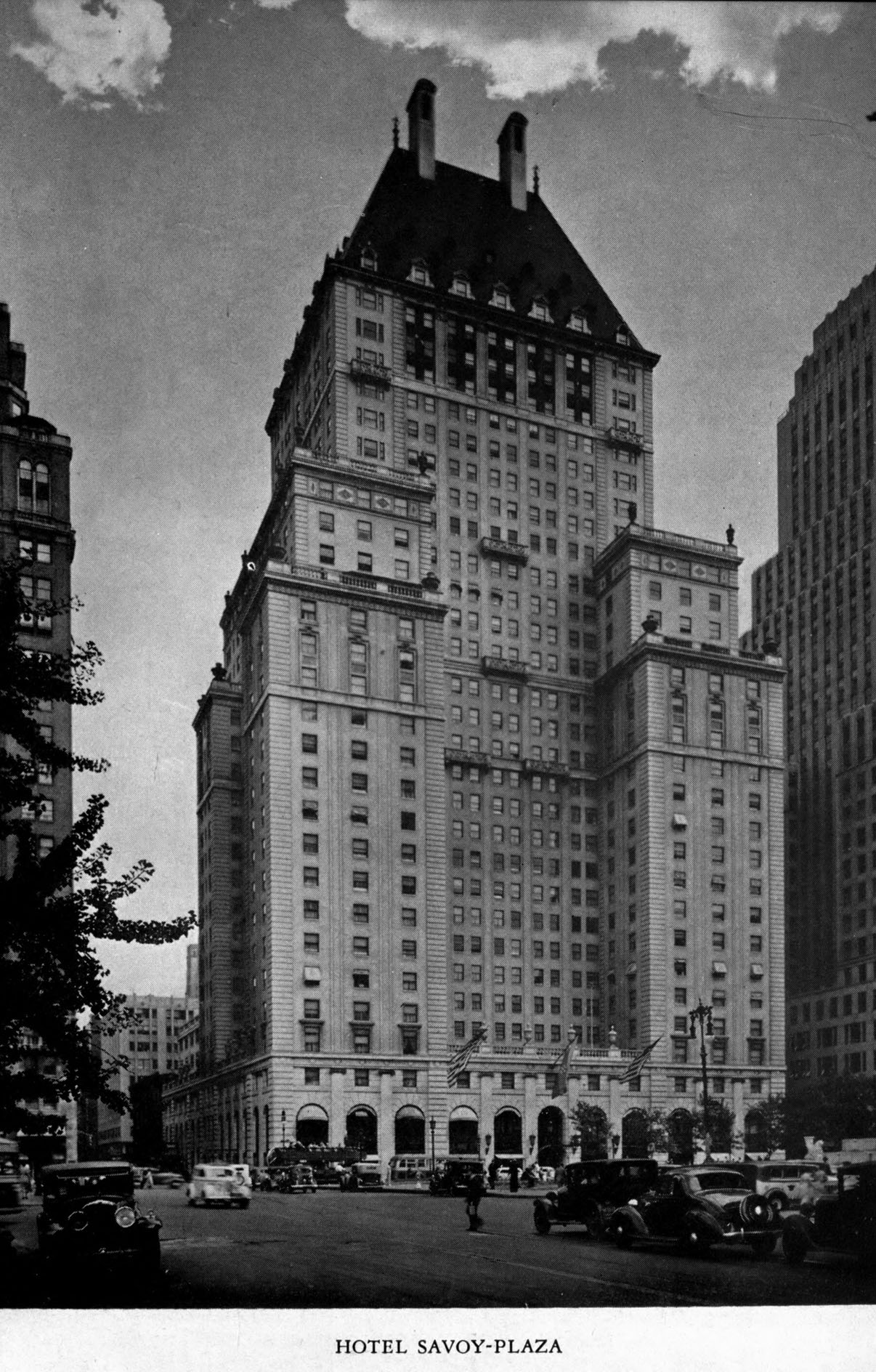
The buildings around and near the plaza display an extraordinary unity, growing out of a harmony of color, material, and scale. Their roofs are picturesque, some tiled, others copper, but nearly all in various shades of green. This harmony extends to architectural treatments. The PLAZA HOTEL (opened in 1907) on the west side was designed by Henry J. Hardenbergh in French Renaissance style, and the later buildings, east and south of the plaza, were carefully related to it: the HECKSCHER BUILDING (1921) by Warren and Wetmore; the SHERRY-NETHERLAND HOTEL (1927) by Schultze and Weaver; the SAVOY-PLAZA HOTEL (1928) by McKim, Mead, and White; the HOTEL PIERRE (1930) by Schultze and Weaver; the BERGDORF-GOODMAN and DOBBS BUILDINGS (1928) by Buchman and Kahn; the SQUIBB BUILDING (1930) by Ely Jacques Kahn; and the NEW YORK TRUST COMPANY BUILDING (1930) by Cross and Cross.
All the hotels of the plaza group are alike in their luxurious appointments, yet each attracts a special clientele. The Plaza Hotel is patronized by the well-established older groups of society, though to a war generation it was a rendezvous of youth, as recorded in F. Scott Fitzgerald's novel, The Great Gatsby. The Hotel Pierre has become popular with the Park Avenue crowd for coming-out parties. The Savoy-Plaza and Sherry-Netherland are residential hotels. In the walls of the entrance of the latter are two sculptured panels from the W. H. Vanderbilt mansion. They were designed by Richard M. Hunt.
In Central Park South, The Plaza, and Fifty-seventh Street
- 57th Street Shops6th Ave & W 57th St, New York
- Carnegie Hall7th Ave & W 57th St, New York
- Essex House160 Central Park S, New York
- Federal Art Project Gallery225 W 57th St, New York
- Fine Arts Building215 W 57th St, New York
- Gainsborough Studios222 Central Park S, New York
- Hampshire House150 Central Park S, New York
- Hansom Cabs6th Ave & Central Park S, New York
- Metropolitan Club5th Ave & E 60th St, New York
- New York Athletic Club7th Ave & Central Park S, New York
- St. Moritz and Barbizon Plaza50 Central Park S, New York
- Steinway Hall113 W 57th St, New York
Overview from New York City Guide (1939), shown as printed.