Union Square District
Area: 14th St. on the south to 18th St. on the north; from 3d Ave. west to 6th Ave. Map on page 193.
Union Square district belongs to the working people of New York. It is an amusement center, but its ornate moving-picture theaters, glittering marquees, and gaily lighted buffets are fewer in number and less persuasive than those of Times Square.
It is a shopping mart, but few of its stores have the fine goods and appointments of the Fifth Avenue fashion center: instead, their bare floors may be filled with racks holding scores of garments, many models of a kind, and their show windows, in many cases, are packed with cheap merchandise. The movie houses, likewise, offer the most for the money--double features and "screeno"; the dining places are cafeterias and lunchrooms, where large portions of plain food are dispensed for nickels, dimes, and quarters.
Before these cheap stores, cheap movies, cheap restaurants passes a ceaselessly moving crowd of men, women, and many children, of all nationalities. Hawkers and pitchmen find this street easy pickings among customers who can afford the little luxuries of Union Square pretzels, sliced cocoanut, gloves, scarves, neckties, and popular song sheets. They buy magic "roots" which sprout fullblown artificial gladiolas, peonies, or regal lilies; prophecies from a turbaned seer; risque cartoons; or a dozen low-quality socks for fifty cents. Many beggars--legless beggars on rollerskate platforms, footless, handless, or blind beggars; playing the saxophone, the guitar, singing move slower-paced through the crowd. The poor, they know, give to the poor. Passers-by stop at the busy newsstands for political literature, and along the curb newsboys hawk the Daily Worker and other radical newspapers of every shade. Youths and girls rattle collection boxes for the benefit of many causes--the Chinese people, Jewish refugees, political prisoners, or workers on strike.
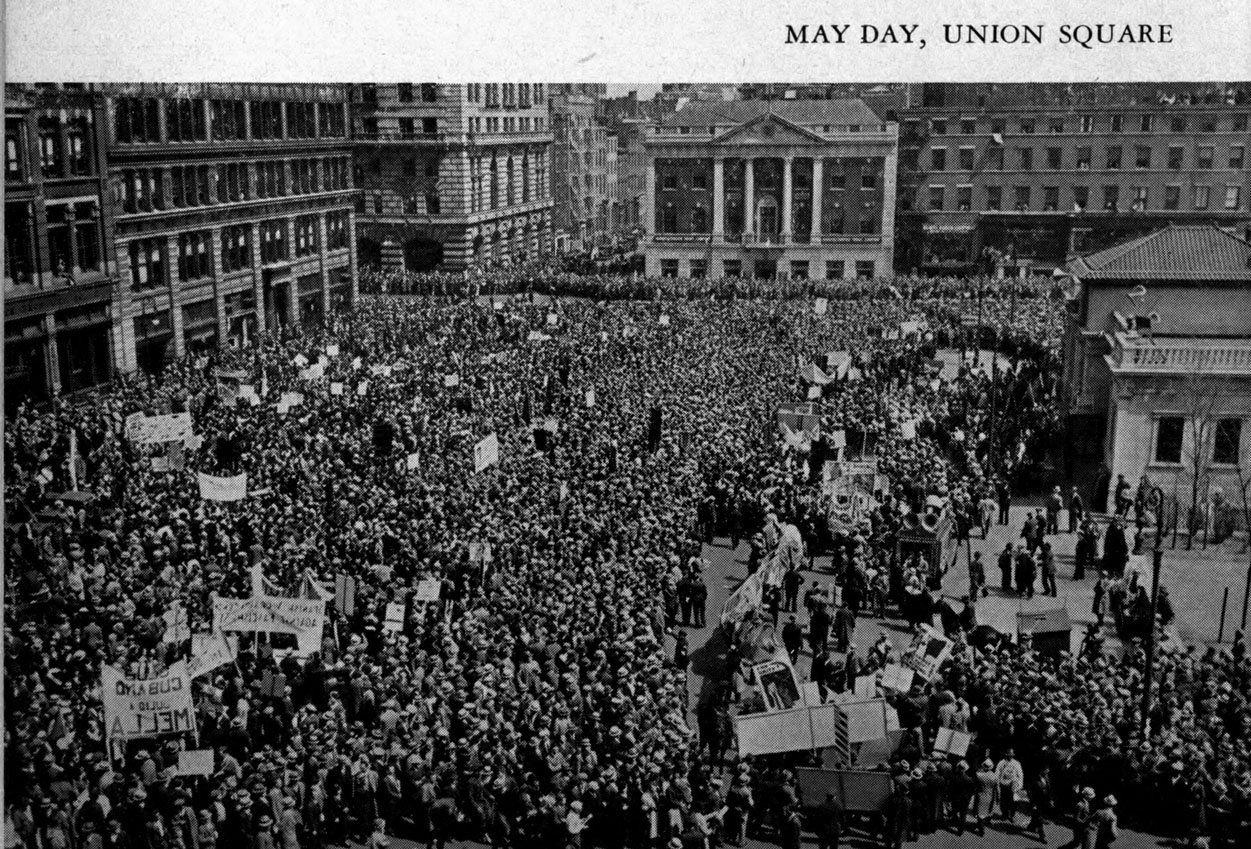
Touched with a bit of Coney Island, democratic, with a robust and loquacious vitality, Union Square derives its peculiar identity from its international reputation as the center of America's radical movement. The tradition of Union Square as a forum for mass protest was not born until the first decade of the present century. The Flour Riots of 1837 centered about City Hall; in the 1870's the battleground moved north to Tompkins Square. During the Civil War, Union Square took on significance when the Union cause was commemorated in meetings, reviews, and parades of departing troops and in the torchlight processions of the proLincoln "Wide Awakes," the Young Republicans of that day. In 1873 unemployment protests were staged, but it was not until the numerous meetings of Anarchists, Socialists, and "Wobblies" (members of the Industrial Workers of the World) were held there during the years preceding the World War, that the square began to assume its importance as a gathering place.
Meetings and occasional clashes with the police continued with increasing frequency. On August 22, 1927, the night set for the execution in Boston of the anarchists, Nicola Sacco and Bartolomeo Vanzetti, a shoemaker and a fish peddler, machine guns were mounted on the roof of the six-story building now occupied by Klein's famous dress emporium, at 28-30 Union Square East, and were trained on a compact mass of more than five thousand tense, silent men and women, part of the angry crowd that had packed the square throughout the day. A little after midnight a sign was thrust outside the Daily Worker windows: "Sacco Murdered." Some minutes later another sign appeared: "Vanzetti Murdered." A throaty wail of anguish arose. A small procession that immediately formed was dispersed by police, and several marchers were injured.
On May 18, 1929, the Communist Party led an "anti-police brutality" demonstration and again the police charged. Many heads were broken and twenty-seven demonstrators, including nine children, were arrested.
With the mass unemployment that followed the financial crisis of October, 1929, the square became the gathering place for the jobless. On March 6, 1930, the largest gathering ever held in Union Square occurred: more than thirty-five thousand unemployed workers and sympathizers crowded around a number of speakers' stands. When the demonstrators started to march toward City Hall, the police broke up the parade. A hundred persons were injured and thirteen arrested.
This mass meeting ushered in a new period in the history of labor demonstrations in Union Square. Public reaction against police interference won the right of assembly in this park. It became accepted in New York City that the May Day Parade was privileged to be reviewed at the north end of the square.
Recent years have seen the development of many protest centers throughout the city, diminishing the former concentration of such activities in Union Square. The soapbox speaker's old stamping grounds, the traffic triangles at the corners of the square, are now islands of verdure. Nonetheless, Union Square is likely to continue as the heart of the city's radical activities, for in its neighborhood are headquarters of many of New York's radical and progressive groups and labor organizations: the Socialist Party and its newspaper, the Socialist Call, the Communist Party and its newspaper, the Daily Worker, the Rand School of Social Science, the International Workers Order, the International Labor Defense, the American Civil Liberties Union, the American League for Peace and Democracy, the League for Mutual Aid, the International Ladies Garment Workers Union, the Amalgamated Clothing Workers of America and a host of others.
It would seem that Union Square was appropriately named; the aptness of the title, however, was accidental. The square was laid out in 1811 as Union Place, the name deriving from the connection of the extended Bloomingdale Road (now Broadway) and Bowery Road (now Fourth Avenue). Shortly after the neighborhood became one of New York's most sedate and exclusive suburbs, inhabited by the city's wealthiest citizens. Among its residents were James Roosevelt, Robert Goelet, and Daniel Drew. The small park was surrounded by a heavy iron fence, the gates of which were locked at sundown. The fence was not removed until the 1870's when Union Place had become Union Square.
By 1900, with the city's steady growth northward, the character of the district had definitely changed. Some of the restaurants and theaters had moved to Madison Square; the business center had shifted, or rather split, leaving a great gap between uptown and downtown New York, into which, during the next decade, the young needle trades rushed like a tide. Besides cheap rents--real-estate values had fallen rapidly--the neighborhood offered two great advantages to the industry: it was on the outskirts of the fashionable shopping center, and it was near a plentiful and cheap labor supply--the immigrant families of the Lower East Side. The old Union Square homes were soon converted into tenements to house thousands of needle trade workers.
Artists made studios of the great attic rooms in the few mansions still standing, and the south side of Fourteenth Street became virtually an extension of Greenwich Village. Such men as Max Weber, Walt Kuhn, Reginald Marsh, Emil Ganzo, Joseph Stella, Ernest Fiene, Walter Pach, Alfred Dehn, and Art Young made their homes here. In the 1920's came Raphael Soyer, Morris Kantor, Louis Lozowick, and Yasuo Kuniyoshi; and in the 1930's, William Gropper, Arnold Blanch, William Zorach, and Doris Lee. Ambrose Bierce wrote some of his famous short stories on Fourteenth Street. Later Michael Gold, Joseph Freeman, and Albert Halper, author of Union Square, came there to live and write.
The years 1910 to 1921 saw this district at its most depressed level. It was an area of burlesque houses, shooting galleries, and shoddy businesses. Real-estate values sank to a new low and in 1921 many parcels of property were sold at foreclosure. S. Klein, operator of a dress establishment, bought three of these dilapidated buildings on the east side of the square and began a program of expansion. (The ground floor of the one at the Fourteenth Street corner had been occupied by Joe's, a saloon that was used by Hugh A. D'Arcy as the setting for his sentimental poem, The Face on the Barroom Floor. The verse first appeared in the New York Dispatch, August 7, 1887.) OHRBACH'S followed suit and these two establishments, dealing in women's apparel, gave the impetus from which developed today's substantial shopping center.
As a retail district Union Square, more strictly Fourteenth Street, is perhaps the city's largest outlet for low-priced women's merchandise. KLEIN'S, doing a tremendous business in women's apparel, employs a minimum of sales people, and customers help themselves in cafeteria fashion. The presence of store detectives inhibits shoplifting. HEARN'S DEPARTMENT STORE, between Fifth and Sixth Avenues on Fourteenth Street, has shared in the general retail rejuvenation of the section. The stores of Fourteenth Street no longer draw their clientele exclusively from the East Side. Women from near-by cities, from the suburbs, and from every part of New York come bargain hunting here. In line with the district's labor character, most of its business houses are either unionized or in process of becoming so. The shoppers here are probably the most union-conscious consumers in the country. An everyday sight on Union Square is the picket line, whether it be in front of a restaurant, an orangedrink stand, or a shoe shop.
In Union Square District
- Amalgamated BankE 15th St & Union Square W, New York
- Brentano's Literary EmporiumUnion Square W & E 17th St, New York
- Consolidated Edison BuildingE 14th St & Irving Pl, New York
- Delmonico'sE 14th St & 5th Ave, New York
- Luchow'sE 14th St & Irving Pl, New York
- Tammany HallPark Ave S & E 17th St, New York
- "Taxpayer" Structure31 E 17th St, New York
- Union Square Architecture31 Union Square E, New York
- Union Square ParkUnion Square Park, New York
- Union Square TheatersE 15th St & Irving Pl, New York
Overview from New York City Guide (1939), shown as printed.