Upper Fifth, Madison, and Park Avenues
Area: 47th St. on the south to 110th St. on the north; from 5th Ave. east to Lexington Ave. (excluding area east of 5th Ave. between 96th and 110th Sts., and 5th Ave. between 47th and 60th Sts.). Maps on pages 237 and 277.
Elegant bluebloods and solid burghers, tycoons and ne'er-do-wells, social arrivistes and just plain people (or New Yorkers a little more affluent than the average) these are the residents of this district. It is a quarter of old mansions, air-conditioned apartments, exclusive clubs, luxurious hotels, fabulous penthouses; of great churches and museums; of art galleries, antique shops, and specialty stores; of high-priced cafes, cocktail lounges, night clubs.
In the face of an advancing business district the core of the city's fashionable residential section moved northward from Washington Square in the 1860's. It retreated steadily up Fifth Avenue until the startling development of Park Avenue in the 1920's deflected its course eastward. About ten years ago the exact geographical center of the addresses contained in the Social Register was determined painstakingly by realtors: it was near Sixty-eighth Street on Madison Avenue. It remains near the same spot to-day.
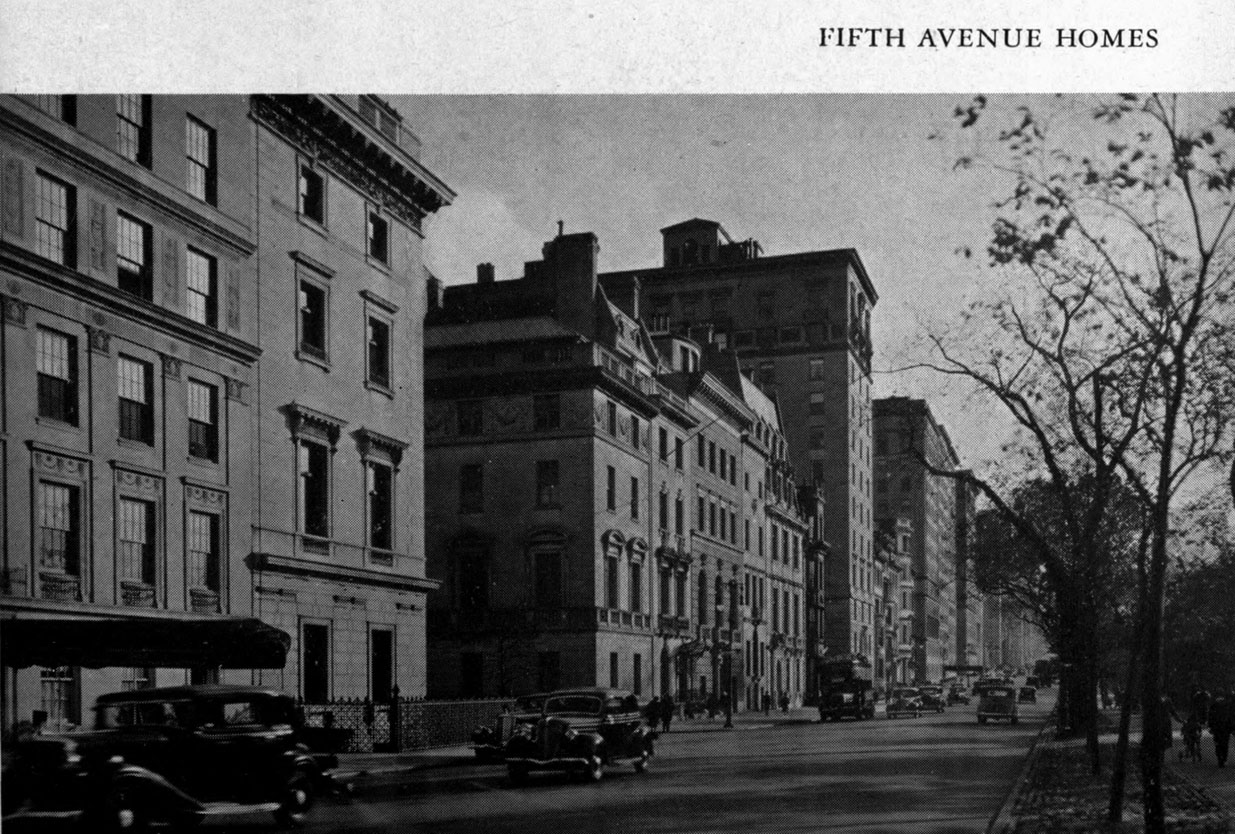
By 1872 Fifth Avenue was lined with residences as far as Fifty-ninth Street. Edith Wharton in "A Little Girl's New York," a posthumous magazine article, recalls that "the little brownstone houses, all with Dutch 'stoops' . . . and all not more than three stories high, marched Parkward in an orderly procession, like a young ladies' boarding school taking its daily exercise." She remembers when Fifty-seventh Street was a "desert" and new construction on Fifty-ninth Street was regarded as a "bold move which surprised and scandalized society." When Central Park was completed (1876) the movement northward continued and the dwellings erected were pretentious and rococo, with limestone supplanting the brownstone fronts. Not until the twentieth century, however, did the long stretch of the avenue facing the park achieve its fame as "Millionaires' Row."
When, in 1905, Andrew Carnegie built his mansion at Ninety-first Street his nearest neighbors were inhabitants of a shanty. Soon one commodity king after another in the company of the Astors, Vanderbilts, Whitneys, Belmonts, and Fishes erected sumptuous dwellings on the avenue. Among these industrialists were Henry Phipps (iron), Daniel G. Reid (tin plate), Charles T. Yerkes (rapid transit), James B. Duke (tobacco), O. H. Havemeyer (sugar), Edward S. Harkness (oil), Sir Roderick Cameron (ships), and F. W. Woolworth. Senator William A. Clark of Montana, a copper magnate, erected at Seventyseventh Street one of the costliest private homes ever built in New York, with material brought from every country in the world.
Charles A. Beard, in The Rise of American Civilization, described the dwellings of millionaires as "chateaux of French design, mansions of the Italian renaissance, English castles of authoritative mien a riot of periods and tastes with occasionally a noble monument to the derivative genius of some American architect trained in Europe and given freedom to create." This description of the architecture of the Gilded Age (the late nineteenth century) was equally true of the 1900*5. Today, as in the past, heavily curtained windows and drawn blinds contribute to the museumlike atmosphere of Millionaires' Row.
Fifth Avenue, as well as the other streets on the upper East Side, has been affected greatly by the postwar trend toward apartments. Its doom as Manhattan's last stronghold of single-family homes seems certain. Some of the wealthiest families have closed or sold their homes and moved into apartments; many have their mansions on Long Island or elsewhere and maintain more modest quarters in the city.
The growth of Madison Avenue and the cross streets followed that of Fifth Avenue. Park Avenue, as the railroad back yard to the sector, lagged far behind. Between 1890 and 1910 old twenty-foot flats were replaced by sevenand nine-story elevator apartments, but it was not until after the World War, when it was demonstrated that skyscraper apartments could be constructed on stilts free from the vibration of the New York Central Railroad yards hidden below, that Park Avenue became fashionable. Today a double row of tall apartments, broken by an occasional church or single-family dwelling, stretches from the Grand Central Terminal at Forty-sixth Street to the uncovered railroad tracks at Ninety-sixth Street, where the avenue abruptly changes into a slum tenement area Spanish Harlem.
One of the broadest of New York's thoroughfares, Park Avenue is divided by a fenced-in parking of well-tended grass, flower beds, and shrubbery. As the main artery of this locality, it is constantly filled with fast noncommercial traffic busses, drays, and trucks being banned. On the scrubbed sidewalks sedate housemen exercise dogs ; under the marquees uniformed doormen stand guard, ready to aid top-hatted men and begowned women in their journey from foyer to car, car to foyer.
No other street in the world approaches Park Avenue in its residential concentration of wealth. Apartment rentals average as much as $1,500 per room annually, yet it has been termed a "super-slum" by authorities on modern housing and city planning. Its architecture is noteworthy for its lack of imagination, one building resembling another like peas in a pod. Although the apartments have all modern conveniences and luxuries, adequate provision for light and air and view was generally neglected.
Madison Avenue is one of the world's most opulent marts. Its recent development as a smart shopping center is due largely to its situation between wealthy Fifth and Park Avenues. Below Fifty-ninth Street, among the hotels and office buildings, the shops more intimate than those on Fifth Avenue feature one or two specialties, domestic or imported : period furniture, luggage, millinery, pets, flowers, paintings, perfumes. Lexington Avenue, while still serving the tenement district to the east, is becoming another street of fine shops.
In Upper Fifth, Madison, and Park Avenues
- Andrew Carnegie Mansion5th Ave & E 91st St, New York
- Bache Collection814 5th Ave, New York
- Colony Club564 Park Ave, New York
- Columbia Broadcasting System485 Madison Ave, New York
- El Morocco154 E 54th St, New York
- Frame House3 E 83rd St, New York
- Frick Collection1 E 70th St, New York
- Grolier Club47 E 60th St, New York
- Heckscher Foundation for Children5th Ave & E 104th St, New York
- Home of Felix N. Warburg5th Ave & E 91st St, New York
- Home of Fiorello H. LaGuardia1274 5th Ave, New York
- Hotel AmbassadorPark Ave & E 51st St, New York
- Hotel MargueryPark Ave & E 47th St, New York
- Hunter CollegePark Ave & E 68th St, New York
- Mount Sinai HospitalMadison Ave & E 99th St, New York
- New York Academy of Medicine5th Ave & E 103rd St, New York
- New York Medical College5th Ave & E 105th St, New York
- New York Society Library53 E 79th St, New York
- Park Lane Hotel299 Park Ave, New York
- Residence of George BlumenthalPark Ave & E 70th St, New York
- Residence of Mrs. James Roosevelt47 E 65th St, New York
- Ritz Tower465 Park Ave, New York
- Rqcquet and Tennis Club370 Park Ave, New York
- Sherry's300 Park Ave, New York
- St. Bartholomew's Church325 Park Ave, New York
- Stork Club3 E 53rd St, New York
- Union ClubPark Ave & E 69th St, New York
- Villard HouseMadison Ave & E 50th St, New York
- Waldorf-Astoria301 Park Ave, New York
Overview from New York City Guide (1939), shown as printed.