Waldorf-Astoria
301 Park Ave, New York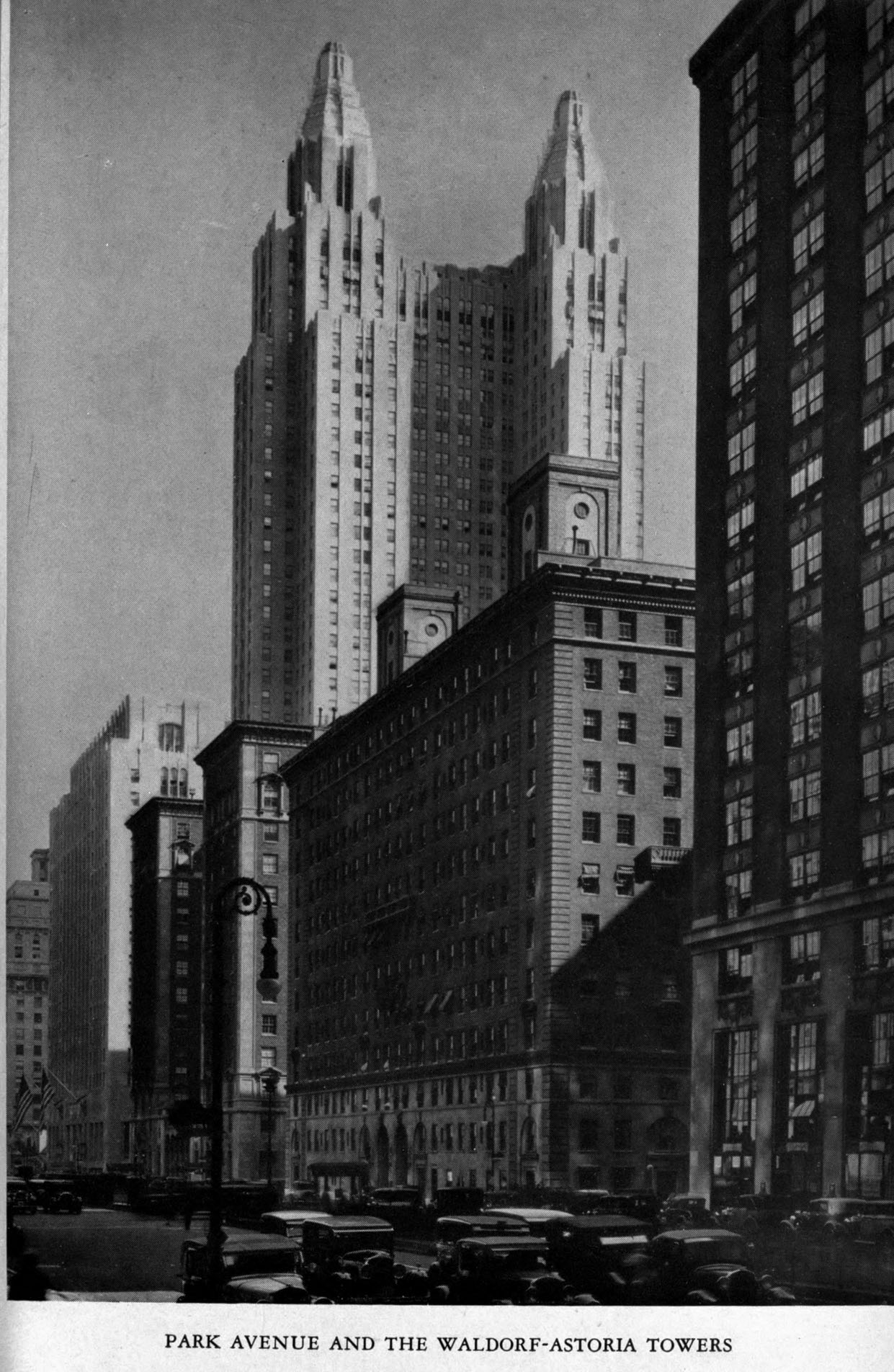
The WALDORF-ASTORIA, on the block between Forty-ninth and Fiftieth Streets, Park and Lexington Avenues, is successor to the old Waldorf-Astoria that stood on the site of the present Empire State Building (see page 319).
Opened in 1931, it continues the traditions of the old hotel: the celebrated Oscar is still host, and it still maintains the Peacock Alley, the Empire Room, and Astor Gallery. So many of the city's important social functions take place in the Waldorf-Astoria that it has been called New York's unofficial palace. Flags denoting the visit of foreign dignitaries are flown frequently.
The massive building, designed by Schultze and Weaver, is of limestone and light-colored brick, with a granite base. Above the first eighteen stories, which rise sheer, a well-proportioned series of setbacks is surmounted by twin chrome-capped towers that bring the building's height to 625 feet (forty-seven stories). The figure over the main entrance on Park Avenue, designed by Nina Saemundsson, represents the Spirit of Achievement.
In the interior, rare marbles, matched woods, selected stones, and nickel-bronzes are employed with exceptional skill. The furniture is eighteenth-century English and early American in design. Decorations were executed by noted artists: the murals in the Sert Room are by Jose Maria Sert; the rug (The Wheel of Life) and the paintings in the main foyer, by Louis Rigal; the murals in the Starlight Roof Garden, by Victor White. Tony Sarg decorated the Oasis, a popular rendezvous at the cocktail hour.
There are more than 2,200 rooms in this hotel in which more than forty million dollars was invested. About two thousand people are on its staff. The towers are reserved for residential suites, some of which have garden terraces. Eighty per cent of the building is over the tracks of the New York Central, and private railroad cars may be shunted to a special entrance.
Point of interest from New York City Guide (1939), shown as printed.