Times Square District
Area: 42d St. (5th to 6th Ave.), 39th St. (6th to 7th Ave.), and 41st St. (7th to 8th Ave.) on the south to 57th St. and Columbus Circle on the north; from 8th Ave. east to 5th Ave. Maps on pages 149 and 169.
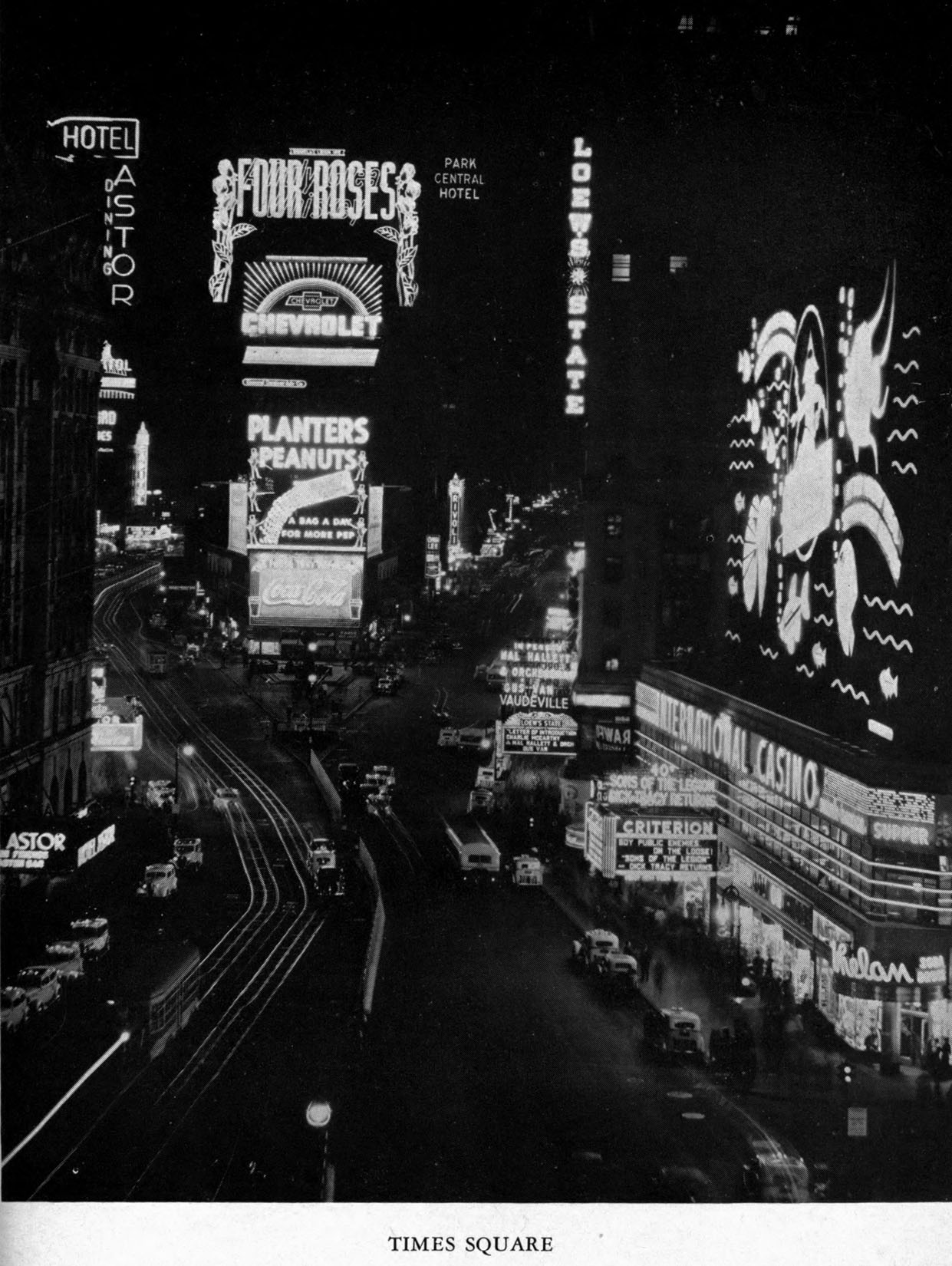
A belt of white electric bulbs girds the Times Building at Forty-second Street and Broadway, spelling out spot news in moving letters that can be read several blocks away. And to the north a wall of light and color, urging the onlooker to chew gum, drink beer, see the world's most beautiful girls, or attend the premiere of a Hollywood film, lights the clouds above Manhattan with a glow like that of a dry timber fire.
This is the Great White Way, theatrical center of America and wonder of the out-of-towner. Here midnight streets are more brilliant than noon, their crowds on ordinary evenings exceeding those of large town carnivals. Scarcely a day passes that does not inaugurate some notable event, and in these theaters, cafes, and hotels, personages mentioned daily in the newspapers are everywhere at hand. It is the district of glorified dancing girls and millionaire playboys and, on a different plane, of dime-a-dance hostesses and pleasure-seeking clerks. Here, too, in a permanent moralizing tableau, appear the extremes of success and failure characteristic of Broadway's spectacular professions: gangsters and racketeers, panhandlers and derelicts, youthful stage stars and aging burlesque comedians, world heavyweight champions and once-acclaimed beggars. An outer shell of bars and restaurants, electric signs, movie palaces, taxi dance halls, cabarets, chop suey places, and side shows of every description covers the central streets.
By day, Times Square is a jumble of skyscrapers, antiquated and remodeled commercial structures, and shabby taxpayers topped by the huge skeletons of electric signs. Without the beneficent flood of light descending from above, the area exhibits greater variety and at the same time a certain drabness. Adjoining elaborate hotel and theater entrances and wide-windowed clothing shops are scores of typical midway enterprises: fruit juice stands garlanded with artificial palm leaves, theater ticket offices, cheap lunch counters, cut-rate haberdasheries, burlesque houses, and novelty concessions. Streams of shoppers, movie-goers, and tourists move across the sidewalks, and members of the theatrical professions congregate on favorite street corners.
The name Times Square District designates the rectangle extending from Thirty-ninth Street to Fifty-seventh Street and from Fifth to Eighth Avenue. Below Forty-second Street the Metropolitan Opera House and a handful of theaters hold out against the intrusion of the mid-town business section. Times Square proper is the core of the neighborhood; it includes the roughly triangular area bounded by Forty-second Street, Broadway, Seventh Avenue, and Forty-seventh Street. The side streets east and west of Broadway between Forty-second and Fiftieth Streets are lined with hotels, theaters, restaurants, and boarding houses. In the upper Forties between Sixth and Seventh Avenues are many well-known eating places. Sixth Avenue, conditioned until 1939 by the el structure, was the dark border of the district. Eighth Avenue on the west takes its character from the sporting world attracted by Madison Square Garden. From Fiftieth to Fifty-seventh Streets between Fifth and Seventh Avenues are expensive night clubs, a number of substantial residential hotels, and a scattering of garages and parking lots. Northward from Fiftieth to Sixty-first Street west of Broadway, the area rapidly changes character. The theaters, restaurants, and crowds thin out, the hotels become smaller and shoddier, and the rooming houses multiply. The intersection of Fifty-seventh and Broadway is the focal point of a great cluster of automobile sales rooms. To the north is windy Columbus Circle.
Since early in the nineteenth century when New York could count but five playhouses, the theatrical district has kept close to Broadway, following it uptown with the changing city. By 1902, the theater had begun to concentrate itself about Times Square. The district was then occupied chiefly by old brownstones, carriage and harness shops, and livery stables. The northern end of this quiet quarter was called Longacre Square after the street in London.
The phrase, the Great White Way, is supposed to have been coined in 1901 by O. J. Gude, an advertising man, who is said also to have been the first to see the tremendous possibilities of electric display. A modest sign at Broadway and Twenty-third Street advertising an ocean resort was New York's first experience with this phenomenon. The present show of light has never been dimmed in the evening, except for a brief period during the World War.
Rapid transit reached Times Square in 1904 with the opening of the first IRT line to 145th Street, and since then the growth of the city's transportation has played a vital part in the development of the district. Every twenty-four hours, two hundred thousand passengers emerge from the IRT and BMT subways to the cement passageways of the underground stations extending from Fortieth to Forty-third Street. A shuttle connects the East Side IRT lines at Grand Central with Times Square, and the Eighth Avenue (Independent) subway has a station from Fortieth to Forty-fourth Street on Eighth Avenue. Forty-second Street surface cars carry riders from the New Jersey ferries; north- and southbound Manhattan busses cross the square; interstate busses arrive at many terminals in the Forties; Pennsylvania Station and Grand Central Terminal are near by--all the city's boroughs, every state, and many foreign countries contribute to the crowds that overflow the sidewalks and gape enchantedly at the tall buildings, the shop windows, and the gyrating sky signs.
Once a year sees the Times Square district as jammed as a rush-hour subway train. On New Year's eve crowds fill the bars, restaurants, and theaters of the square and block the streets and sidewalks. Prices in restaurants soar to premiums. A tremendous wave of joviality and good will, in which even the police participate, carries the crowds along. At midnight a lighted globe on the roof of the Times Building falls, and a shout goes up from the square. Boat whistles, tin horns, rattles, and klaxons swell the racket until it can be heard all over the island.
Election night is a milder and less jubilant occasion. On other nights the lights and noise of the Rialto begin to dim at four o'clock (at three on Saturday), the official closing hour for bars. By six, in the gray light of morning, Broadway is momentarily empty of life. Soon the flow of workers begins; and at high noon the sun beats down upon the heads of the first matinee-goers.
In Times Square District
- New Criterion Theater BuildingBroadway & W 44th St, New York
- Strand Theatre1579 Broadway, New York
- Actors Equity Association45 W 47th St, New York
- American Federation of Actors1560 Broadway, New York
- American Federation of Musicians6th Ave & W 50th St, New York
- Ascension Memorial Chapel8th Ave & W 43rd St, New York
- Astor Hotel1515 Broadway, New York
- Belasco Theatre111 W 44th St, New York
- Biltmore Theatre261 W 47th St, New York
- Brass Rail745 7th Ave, New York
- Broadway TabernacleBroadway & W 56th St, New York
- Bush Terminal Sales Building130 W 42nd St, New York
- Capitol1645 Broadway, New York
- Casa Manana7th Ave & W 50th St, New York
- Church of St. Mary the Virgin145 W 46th St, New York
- City Club and Bar Association57 W 44th St, New York
- Columbus CircleColumbus Cir, New York
- Continental1664 Broadway, New York
- Cotton Club7th Ave & W 48th St, New York
- Dinty Moore's216 W 46th St, New York
- Empire TheatreBroadway & W 39th St, New York
- General Motors Building1775 Broadway, New York
- General Society of Mechanics and Tradesmen20 W 44th St, New York
- Grand Street Boys Association6th Ave & W 55th St, New York
- Harvard Club27 W 44th St, New York
- Hippodrome51 W 43rd St, New York
- Hotel Algonquin59 W 44th St, New York
- Jack Dempsey's Broadway BarBroadway & W 49th St, New York
- Knickerbocker BuildingBroadway & W 42nd St, New York
- Lambs Club128 W 44th St, New York
- Lindy's Restaurant1626 Broadway, New York
- Loew's Mayfair707 7th Ave, New York
- Loew's State1540 Broadway, New York
- Lyceum Theatre149 W 45th St, New York
- Manhattan Storage Warehouse7th Ave & W 52nd St, New York
- Martin Beck Theatre302 W 45th St, New York
- Mecca Temple135 W 55th St, New York
- Merchant's GateColumbus Cir, New York
- New York CasinoBroadway & W 39th St, New York
- New York Herald Tribune8th Ave & W 41st St, New York
- New York Times Annex229 W 43rd St, New York
- New York Yacht Club37 W 44th St, New York
- Night Clubs of 52nd St72 W 52nd St, New York
- Palace1564 Broadway, New York
- Paramount Building1501 Broadway, New York
- RialtoBroadway & W 42nd St, New York
- Rivoli1620 Broadway, New York
- Rockefeller Apartments17 W 54th St, New York
- Rose Land239 W 52nd St, New York
- Roxy153 W 50th St, New York
- Sardi's Restaurant234 W 44th St, New York
- Shubert AlleyShubert Alley, New York
- Side Street TheatersBroadway & W 42nd St, New York
- St. Malachy's Church239 W 49th St, New York
- Statue of Rev. Father Francis DuffyBroadway & W 47th St, New York
- Theatre Guild245 W 52nd St, New York
- Times BuildingBroadway & W 42nd St, New York
- Town Hall123 W 43rd St, New York
- Union Methodist Episcopal Church229 W 48th St, New York
- Variety154 W 46th St, New York
- Winter Garden1634 Broadway, New York
- Ziegfeld Theatre141 W 54th St, New York
Overview from New York City Guide (1939), shown as printed.