New York Botanical Garden
2900 Southern Blvd, Bronx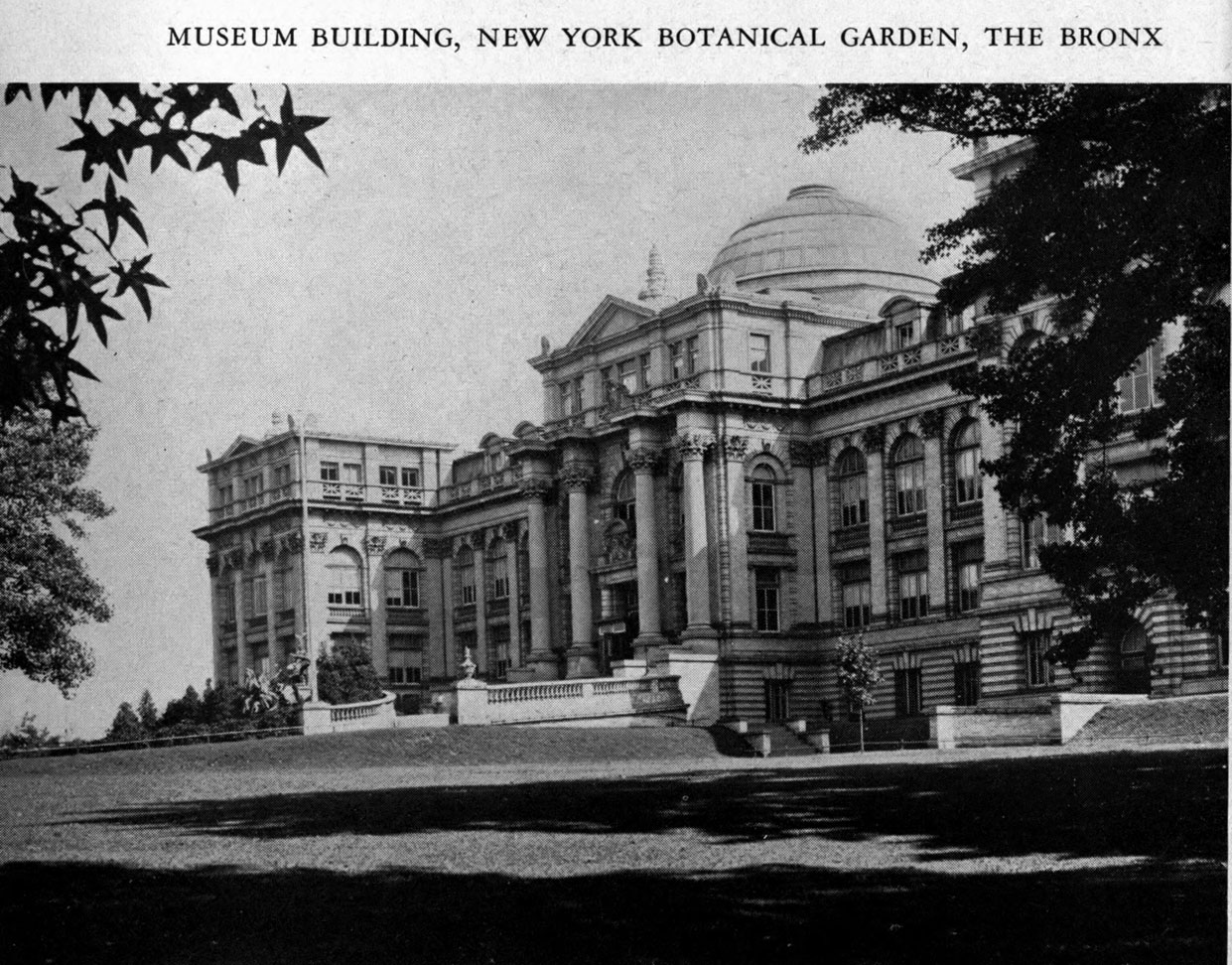
The botanical garden, incorporated by the State Legislature in 1891, after a two-year campaign for funds, is maintained by city appropriations, membership fees, and funds from the sale of publications. (Open daily; admission free.) In recent years considerable improvements have been effected by PWA and WPA grants.
The garden is separated from the zoological park by Pelham Parkway. From the Bronx Park station of the Third Avenue el, a short walk between clumps of varied pine leads to the Main Conservatory Range, a huge glass building consisting of fifteen subdivisions or "houses." Palms fill the domed house (ninety feet high) that serves as the main entrance.
The three houses at the southwest end are devoted to succulent plants of which the garden has more than two thousand species and varieties. One house contains cacti natives of the New World; another, century plants of the southwestern desert of the United States; a third, the succulent plants of the Old World, notably those that grow in the deserts of South Africa.
Other houses in the main conservatory are devoted to flowering plants of the tropics; economic plants of the tropics, such as bananas and spices, and of the temperate zone, such as coffee and camphor; trees, vines, and epiphytic plants; aroids, such as jack-in-the-pulpit, the brilliant red tail flowers, and gigantic Amorphophallus; and tropical aquatic plants. Two houses have been converted into indoor flower gardens with varying displays; in another a tropical forest has been reproduced, even to the overhead growth that characterizes plant life at the equator.
In the immediate neighborhood of the conservatory are numerous pools and beds where flowers bloom in season. In pools to the southwest are varieties of water lilies, including the sacred "Egyptian," actually Indian, lotus. Crocuses bloom in late March or early April on lawns east of the conservatory; the tall bearded iris comes in May, followed by peonies; day lilies appear about the first of June; cannas, cultivated to enormous sizes, flower in August. Many beds are opposite Fordham Hospital at the southwest corner of the garden; here hardy chrysanthemums survive even the first snows.
The perennial borders facing the southeastern and southwestern sections of the conservatory blossom luxuriantly throughout June, and the colors of delphinium, Canterbury bells, lupine, sweet william, and clematis resemble the colors of an old palette. Near the southeastern bed are dark cedars and flowering shrubs ; next to the borders are model gardens.
North of the main conservatory is the museum building, a four-story structure in Italian Renaissance style, which contains the administrative offices of the botanical garden and a herbarium that is one of the finest in America.
In the basement are fossil exhibits, a special laboratory for the study of vitamins and their effect on plant growth, and a lecture hall seating seven hundred. On the first floor are exhibits of preserved economic plants, about seven thousand specimens of drugs, oils, resins, beverages, dyes, foods, spices, and starches, and a herbarium of flora found within a hundred miles of New York.
The second floor contains a museum of systematic botany, with the exhibits arranged in the order of probable evolution from fungi and algae to the angiosperms.
On the top floor are the library (open to students) with 47,000 volumes, the herbarium with 1,900,000 dried specimens from all parts of the world, and laboratories where important research in plant genetics and pathology is conducted. Among recent achievements have been the production of new varieties of seedless grapes and fast-growing poplars to aid reforestation.
In the Thompson Memorial Rock Garden, east of the museum, exotics as well as favorite plants from native meadows, woods, and hills grow in appropriate surroundings.
To the southeast, across the Bronx River, are the nurseries and the great rose garden, which, by masterly cultivation, is made to bloom twice in June and in October. Also east of the river, near Allerton Avenue, is a second conservatory, temporarily closed to visitors.
Many native wild flowers bloom in the hemlock and deciduous forests that border the Bronx River. (The hemlocks lie between the rock garden and the west bank of the river, and the deciduous trees to the south.) Paths twist through the woodlands, and here, in spring, the maple bears its crimson flowers, and bloodroot and hepatica cover the loam; in summer, the trees provide a sanctuary for native birds; in autumn, the gum trees, the oaks and maples, sassafras and tulip color the banks of the river.
The botanical garden, in addition to its exhibits and research activities, conducts a training school for professional gardeners and extension courses in practical gardening, sponsors radio talks by staff members, publishes scientific and popular periodicals and articles, and co-operates with New York public schools in the teaching of natural science.
Point of interest from New York City Guide (1939), shown as printed.