New York Zoological Park
2300 Southern Blvd, Bronx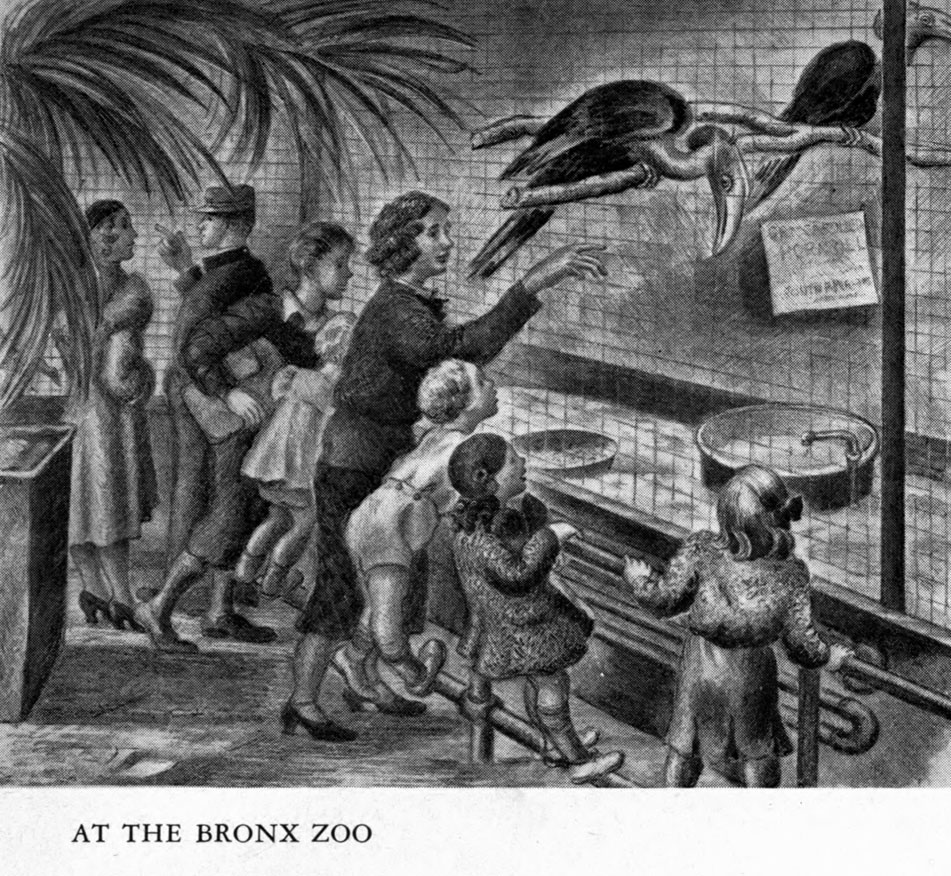
The zoo, founded in 1895, is controlled by the New York Zoological Society, but is maintained by the city. (Open daily 9 a.m. to a half -hour before sunset April 15 to October 15, 10 a.m. to 6:30 p.m. October 16 to April 14; admission, adults 25¢, children under 12, 15¢, Monday and Thursday, free other days and holidays.)
Although the southern half of Bronx Park was allotted to the society for buildings and enclosures, the zoo, housing about 2,600 specimens (representing almost a thousand species), at present occupies an area about a mile long and three-fifths of a mile wide in the southwestern section; the southeastern part is devoted chiefly to Bronx Lake and woodland walks.
Most visitors arrive by subway (IRT Bronx Park-180th Street line) and use the Boston Road entrance at 182d Street. A short flight of steps from the small pla2a near the gate leads to the hoofed-animal ranges. Along the path to the right is the Yak House ; American bison, or buffaloes, roam on a twenty-acre range banked by shade trees; wild sheep and goats wander over a ridge of pink granite in which are caves for shelter from both heat and cold.
To the east, on another hill, is the Rocking Stone, a thirty-ton boulder deposited in the glacial period. Pressure applied to its northernmost edge will cause it to teeter back and forth.
The Bear Dens, north of Rocking Stone hill, house members of American, European, and Asiatic species in snug and dry sleeping quarters and large open yards for play and exercise. To the southwest, an enclosed cedar tree shelters a number of racoons, while to the north, in a near-by valley shaded by splendid trees, shy beavers live in their marine retreat.
At the edge of a cluster of oaks, west of the bear dens, is the Reptile House containing, among its amphibians and reptiles, regal pythons, enormous crocodiles and giant tortoises, as well as uncommon bats, including the grisly bloodsucking varieties. In summer many of the non-poisonous snakes inhabit a moat-encircled lawn near the house. Occasionally the giant Komodo lizards, sole survivors of the Dinosaur age, are exhibited.
To the northwest stands a huge structure which houses elephants, hippopotamuses, and rhinoceroses in large compartments. Directly north lies the quadrangle of Baird Court around which are grouped a number of exhibition buildings. The sea lions, the vaudevillians of the animal world, honk and cavort in the pool at the center of the court, while the monkeys, apes, baboons, and lemurs in the Primate House near by maintain an incessant racket.
Near the Primate House is the Heads and Horns Museum where exhibits are grouped according to species and geographic distribution. The eleven-foot five-and-a-half-inch tusk of a Sudanese elephant indicates the tremendous size of many of the specimens. Of notable interest is the Combat Collection, containing the heads of animals who died during the mating season, when their antlers interlocked and they were unable to separate and search for food, or defend themselves against enemies.
In the northeastern corner of the court is the Administration Building. Opposite is the rambling Lion House, 244 feet long and 115 feet wide, including the outdoor cages, which hold a splendid collection of beasts of prey tigers; lions, leopards, pumas, jaguars, and cheetahs. The chief attraction is a recent acquisition, a rare giant panda, captured in Tibet.
The large Bird House, an L-shaped building, occupies the northwestern corner of the court. In 152 indoor and outdoor cages is a colorful, noisy galaxy of more than two thousand native and foreign birds captured in virtually every region of the globe, many with names as strange as their appearance and their cries. In the foot of the L is Parrots' Hall, whose inhabitants are provided with flying cages, pools of running water, umbrageous trees, and rocky ledges. Outside, along the western wall, fourteen large cages shelter members of the crow and blackbird families, natives of American woods and fields.
The great Flying Cage, near the lower end of a section called Bird Valley, a tall arched enclosure of steel pipe and chain net, containing trees, shrubbery, and a hundredfoot pool, is the summer habitat of a mixed flock of large water birds. In winter these birds dwell in the Aquatic Bird House not far to the west; here, too, large migratory water birds find shelter from the winter climate of New York, and eagles and owls roost in large cages outside. In an open glade toward the south stands the Eagle and Vulture Aviary, an enclosed wire structure which exhibits scavengers and birds of prey.
Adjacent to the Flying Cage are Cranes' Park, whose inmates fill the vicinity with their trumpet-like calls, and Goose Aviary, which is also the sanctuary of such rare specimens as the frigate bird, gannet, and saddlebilled stork. Cope Lake to the north is used by Canada geese during the mating season. Just north of Baird Court is the Concourse entrance to the zoo dominated by the Rainey Memorial Gate, a massive structure decorated with animal figures by Paul Manship. A driveway beneath elms, flanked by rhododendron and conifers, leads south from the Memorial Gate to the Italian Gardens and the William Rockefeller Fountain.
Near the Fordham entrance at the corner of Pelham Parkway and Southern Boulevard are several deer ranges, spread over a broad knoll with fine old trees. Farther south is the cheerful Zebra House ; wild horses and zebras cavort on a hillock south of the red deer pen. At the south door of the Zebra House is the little Heart-Shaped Pond, the trumpeter swan's retreat.
From the pond to the Crotona Parkway entrance are the corrals of the deer family, the wolf and fox dens, and the elk range with its natural lake. The elk may be viewed at their best in October, when the groves which shelter them acquire brown and russet tints. Ducks and geese ripple the waters of Wild Fowl Pond to the east; near by are the Seal Pools, the Alaskan house, a wild turkey enclosure, the Puma and Lynx House, the Pheasant and Pigeon Aviary, and Prairie Dog Village. The ungainly camel and the long-haired llama (often called the cameloid) greet visitors as they come through the Crotona entrance, while to the southeast the giraffes, kudus, gnus, and other members of the antelope family look down from the commanding heights of Antelope House. Westward are the thirty compartments of the Kangaroo and Wild Swine House, and southward roam a fine herd of fallow deer.
The aim of the founders of the New York Zoological Park was to establish a vivarium which would make "captive animals not only comfortable, but really happy." The longevity of many of the zoo's inmates some have been in the park for more than thirty years attests to the excellent treatment they receive. Ailing animals are cared for by an expert veterinarian in a special hospital equipped with the most modern therapeutic and surgical devices. Treatments range from the extraction of hippopotamus molars to the cure of bronchitis in monkeys.
The New York Zoological Society maintains a research laboratory in the park, and publishes excellent popular and technical bulletins, pamphlets, and periodicals.
Point of interest from New York City Guide (1939), shown as printed.