Cloisters
The Cloisters, 99 Margaret Corbin Dr, New York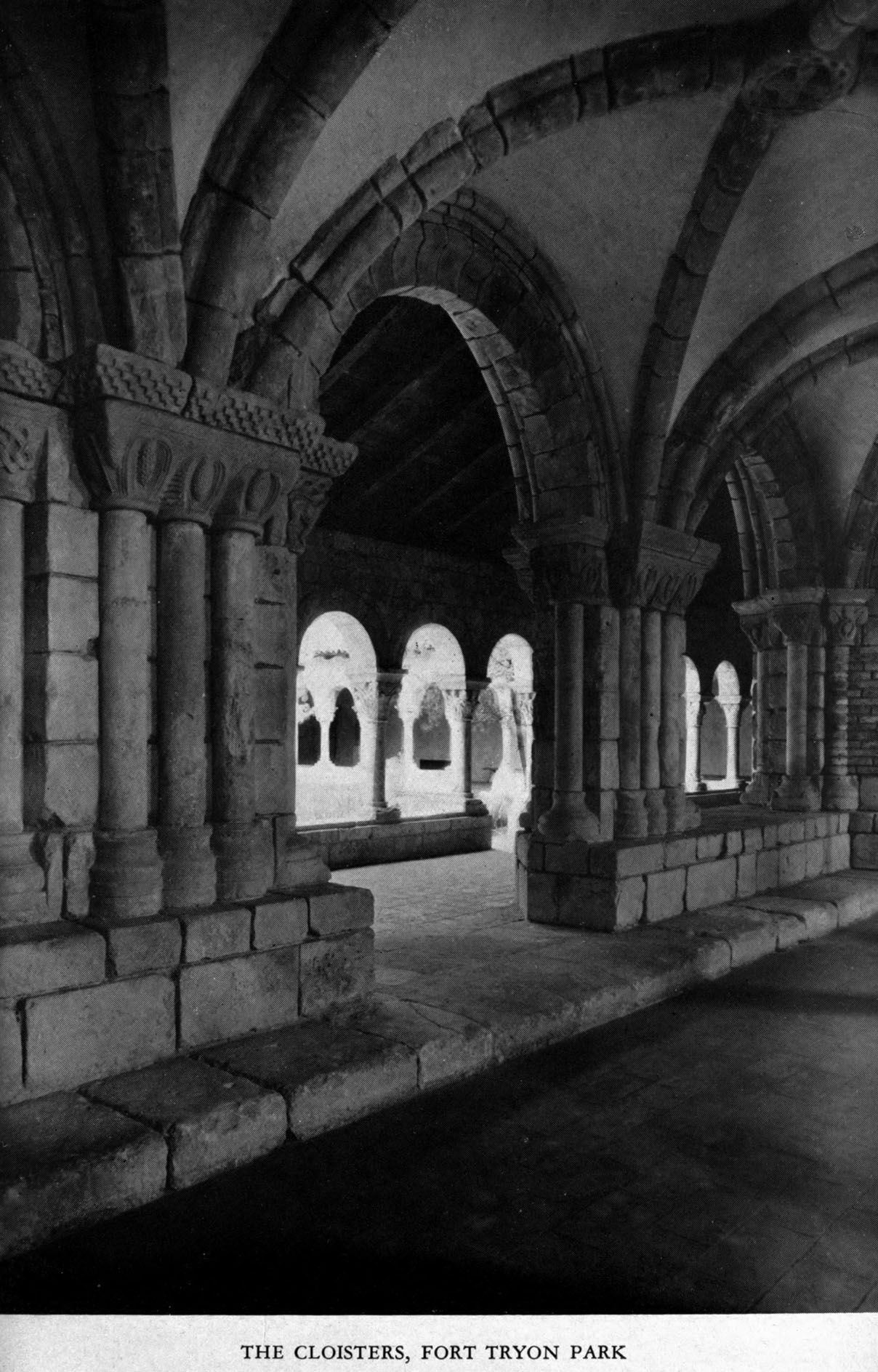
The colored granite, tile-roofed building that stands in impressive isolation on the northern crest of the park is the CLOISTERS, branch of the Metropolitan Museum of Art (see page 368), sheltering a collection of medieval art. (Open daily 10 a.m. to 5 p.m., Sunday 1 to 6 p.m., Christmas 1 to 5 p.m.; admission 25¢ Monday and Friday, other days free.)
The building includes four cloisters and an arcade of a fifth, a chapel incorporating the remains of a Romanesque twelfth-century church, an original chapter house, and nine other exhibition areas, all chronologically arranged and so constructed as to include original structural or decorative members. A simple square tower surmounts the entrance. The central and largest cloister is that of St. Michel de Cuxa.
Open to the sun, and surrounded by pink marble arches and columns, it dates from the twelfth century. Other cloisters are those of St. Guilhem-le-Desert (late twelfth to early thirteenth century), Bonnefont-en-Comminges (thirteenth to fourteenth century), and Trie (second half of the fifteenth century). The latter two overlook the park to the south and the Hudson River.
The halls and chapels contain such notable sculptures as the tomb effigy of Jean d'Alluye, who died about 1248, a Romanesque torso of Christ, a fourteenth-century sainted deacon, and many superb statues of the Virgin, particularly from the He de France and Lorraine.
A set of six handwoven, fifteenth-century tapestries depicting the Hunt of the Unicorn was given by Mr. Rockefeller in 1935; they are displayed in a special room. These textiles, on which is portrayed an allegory of the Incarnation, with Christ represented by the fabulous unicorn, symbol of purity, are remarkable for their beauty of color and design and the intensity and vitality of their pictorial realism. While these tapestries have many Flemish characteristics, it has not been possible to establish their origin.
The Cloisters collection was started by the late George Grey Barnard, the sculptor, who spent many years in France gathering examples of medieval art; a few of them were found in barns and pigsties near ruined churches and monasteries. In December, 1914, the artist placed the collection on display in a building specially built for it on Fort Washington Avenue. The Metropolitan Museum bought the collection in 1925 with funds provided by Mr. Rockefeller.
When the Fort Tryon property was given to the city by Mr. Rockefeller in 1930, four and a half acres were reserved as a site for a museum building to be devoted exclusively to the collection. Land along the Palisades on the opposite side of the Hudson was acquired by the patron to insure the view.
Plans were drawn by Charles Collens of the Boston firm of architects, Allen, Collens, and Willis, in collaboration with officials of the Metropolitan Museum. The building was opened in the spring of 1938.
Point of interest from New York City Guide (1939), shown as printed.