Fort Tryon Park
Fort Tryon Park, 1 Margaret Corbin Dr, New York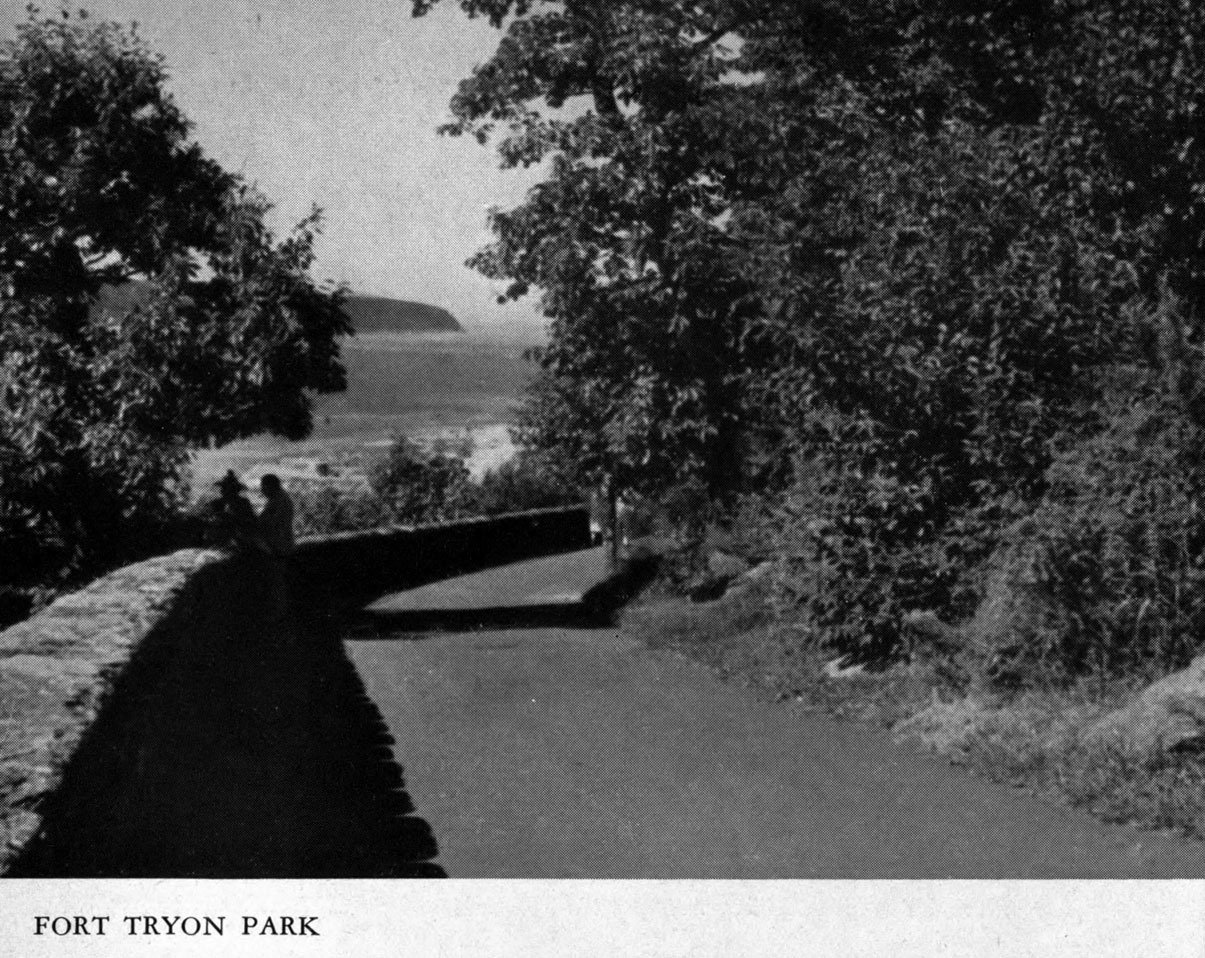
FORT TRYON PARK is one of the most beautiful public parks of America landscaped with trees, lawns, terraces, rock gardens, paved walks, and many benches, all cleverly ordered in harmonious composition. The precision of its design is explicitly urban.
The views from its heights are perhaps the finest Manhattan offers, for they sweep mile after mile of the Hudson and the Palisades, and, to the east, range across the lowlands of Inwood.
At the southern entrance to the park, near Fort Washington Avenue, a large sloping rock garden forms an approach to the stone ramparts marking the site of old Fort Tryon, built in the summer of 1776 and taken in the fall of the same year by the Hessians. The landscaping was done, appropriately, by Frederick Law Olmsted, son of the proposer of the park plan for Inwood.
The park's sixty-two acres include the grounds of the former C. K. G. Billings estate. John D. Rockefeller, Jr., bought the property in 1909 for $1,700,000, gave it to the city in 1930, and spent $3,600,000 improving it.
The gift was in accordance with an agreement between Mr. Rockefeller and the city whereby the eastern ends of Sixtyfourth and Sixty-eighth Streets were closed and conveyed to Rockefeller Institute (see page 245).
Automobiles enter Fort Tryon Park from Riverside Drive through a cut in the solid rock that leads circuitously to parking spaces and to an observation terrace overlooking the Hudson. An unconsciously metropolitan touch is added by the sign, "Park here only while enjoying view from car." Another motor road enters from the end of Fort Washington Avenue.
The Eighth Avenue (Independent) subway station at 190th Street is carved out of the side of the east cliff; from it passengers are delivered by elevator to the promenade at the southern entrance. East of the station a playground for adults will be constructed.
Point of interest from New York City Guide (1939), shown as printed.